
West Texas Intermediate (WTI) futures on NYMEX declined approximately 1.2%, trading near $75.50 during Monday’s Asian session, reversing early-session strength and confirming a shift into a short-term bearish regime.
The move reflects a rapid geopolitical risk premium contraction, rather than a deterioration in demand-side fundamentals. The broader context and market perspective are covered in detail by Fonndure’s brokers in this piece.
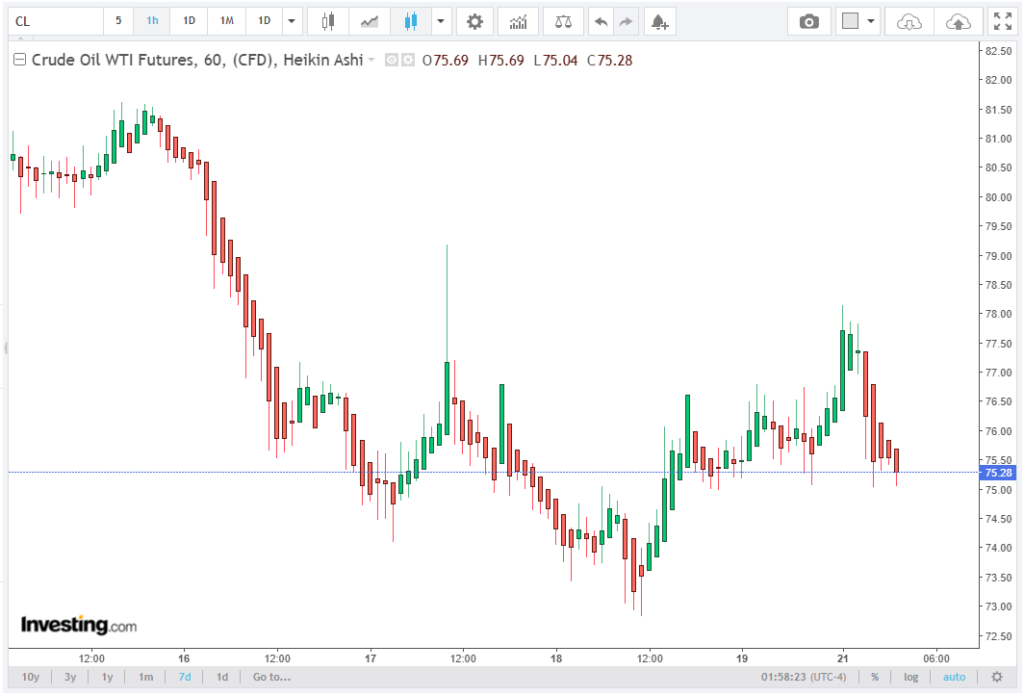
Intraday flow data indicates rejection of early highs around $76.80–$77.10, followed by sustained selling pressure into the $75.40–$75.60 liquidity zone, where bids temporarily stabilized. The failure to sustain levels above $76.50 reinforces a lower-high structure consistent with ongoing corrective price behavior.
The broader context remains dominated by expectations of reduced supply disruption risk following diplomatic signaling between the United States and Iran, with secondary stabilization input from mediators including Qatar and Pakistan.
Supply-Side Repricing: Iranian Export Re-Entry Scenarios
A key structural variable is the potential normalization of Iranian exports under reported sanction relief mechanisms. Market estimates indicate that Iran’s export capacity could increase by 0.8 to 1.5 million barrels per day (mb/d) under partial waiver conditions, particularly in crude oil and petrochemical-linked condensates.
This potential supply re-entry is critical in a market where OECD inventories are already within a neutral-to-slightly-oversupplied band, limiting the system’s ability to absorb incremental barrels without downward price adjustments.
The anticipation of export normalization has shifted forward curves, flattening near-term backwardation and increasing the probability of contango formation if supply increases accelerate faster than demand absorption.
Volatility Regime: Declining Geopolitical Premium
Implied volatility in front-month WTI contracts has begun to compress, reflecting reduced uncertainty around immediate supply disruption scenarios. The shift is consistent with a transition from a high-volatility geopolitical regime into a more fundamentally driven pricing structure.
The reduction in headline risk has lowered short-term skew in options markets, with downside puts seeing relatively higher demand concentration compared to upside calls, indicating persistent hedging against further price declines.
Technical Structure: Breakdown Below Dynamic Resistance
From a technical standpoint, WTI remains firmly below the 20-day Exponential Moving Average (EMA) at approximately $84.05, a level that continues to function as dynamic resistance. This positioning confirms that the market is operating within a medium-term corrective downtrend, with rallies increasingly being sold into.
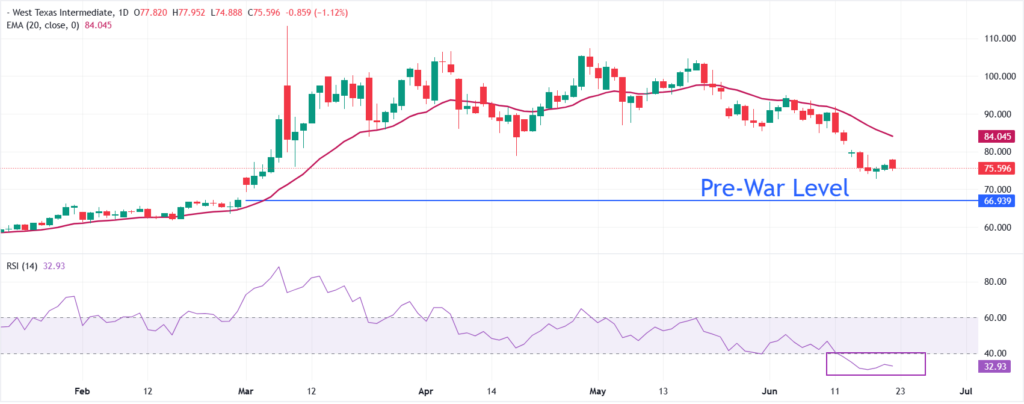
Momentum indicators reinforce this structure. The Relative Strength Index (RSI 14) is currently near 33, reflecting sustained bearish momentum pressure while approaching oversold territory. Historically, RSI levels in this range often coincide with temporary consolidation phases rather than full trend reversals.
Price structure analysis shows repeated rejection of the $80.00–$82.50 supply zone, suggesting strong institutional positioning on the sell side during recovery attempts.
Key Technical Levels and Liquidity Zones
Immediate downside liquidity is concentrated around $74.80–$75.00, with a break below this band likely accelerating algorithmic selling flows toward the prior swing low at $72.79.
A sustained breach of $72.79 would confirm continuation of the broader corrective wave and open a higher-probability path toward $67.20, a level aligned with pre-escalation geopolitical pricing equilibrium. This zone represents a full retracement of the risk premium expansion observed during the prior conflict-driven volatility phase.
On the upside, resistance remains structurally intact at the 20-day EMA (~$84.05). Only a decisive daily close above this threshold would signal a potential transition back into a neutral-to-bullish regime, with secondary upside extensions toward $88.00–$90.00, where macro supply elasticity becomes more relevant.
Flow Dynamics: Positioning and Market Behavior
CFTC-style positioning proxies suggest that speculative net-long exposure has been gradually reduced over recent sessions, consistent with profit-taking and risk de-leveraging in response to easing geopolitical tensions.
Systematic trend-following models, which typically respond to EMA and RSI signals, are likely maintaining short bias exposure, reinforcing downside momentum through mechanical rebalancing flows.
Physical market participants are also adjusting hedging ratios downward, reflecting lower expected short-term supply disruption probability and reduced urgency for forward coverage.
Outlook: Transition Toward Fundamentals-Driven Pricing
WTI is currently positioned at a critical inflection point where geopolitical drivers are being replaced by structural supply-demand fundamentals. The dominant pricing mechanism is shifting away from risk premium expansion toward inventory balance and export normalization expectations.
If diplomatic progress continues and maritime security conditions in the Strait of Hormuz remain stable, the probability distribution skews toward continued downside pressure, with $72.79 acting as the next major trigger level.
Conversely, any deterioration in negotiations or disruption to shipping assurances would rapidly reintroduce a volatility spike, likely restoring a significant portion of the previously compressed risk premium.
At present, the market reflects a bearish technical structure layered on top of rapidly deflating geopolitical risk, with medium-term bias anchored below the $84.05 EMA resistance ceiling and downside exposure extending toward $67.20 in a full normalization scenario.