
For much of the past two decades, U.S. companies have leaned heavily on share buybacks rather than dividends to return cash to shareholders.
Buybacks offer flexibility and tax efficiency, and they can lift earnings per share when share counts shrink. Brokers from Fonndure dive into this topic, noting that despite the popularity of buybacks, dividend-paying stocks remain a core pillar of many long-term portfolios.
According to a recent forecast from S&P Dow Jones Indices, U.S. dividend growth is expected to reach 6.5% in 2026, pushing the aggregate payout total to roughly $827 billion.
The report also projects that all 24 sectors it tracks will post positive dividend growth this year. That kind of broad-based momentum is why income-focused investors continue to build dedicated dividend exposure into their portfolios.
The Case for ETFs Over Individual Stock Picking
For investors who prefer a diversified approach rather than picking individual dividend stocks, exchange-traded funds (ETFs) offer a simpler entry point. Three funds in particular stand out for long-term, buy-and-hold investors seeking a mix of consistency, yield, and sector-specific exposure. Each takes a different approach to defining what counts as a quality dividend payer.
A Fund Built for Consistent Dividend Growth
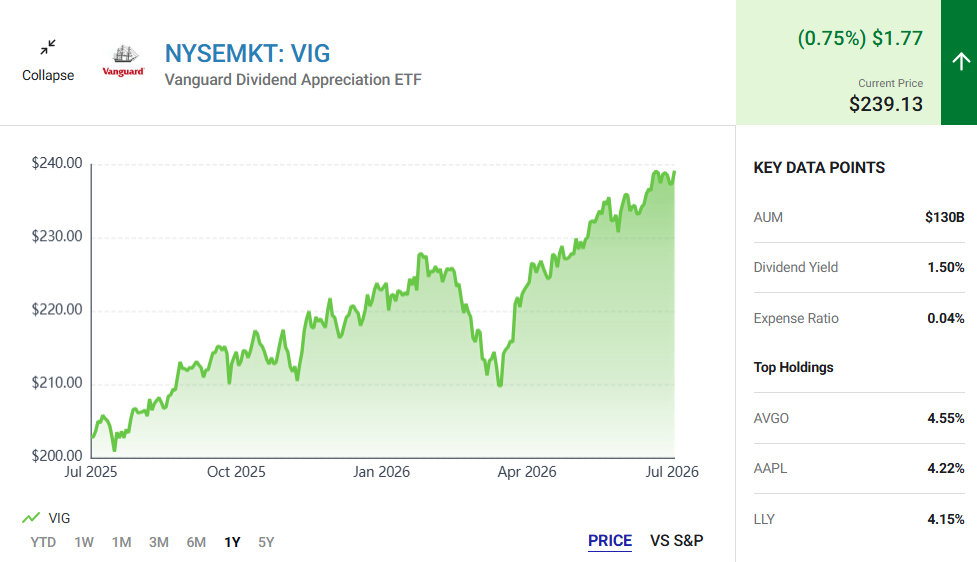
The largest fund in the group holds approximately $130 billion in assets and follows an index that requires companies to raise dividends for at least 10 consecutive years a strict quality screen that eliminates inconsistent dividend payers.
It maintains a portfolio of 331 stocks, with nearly 49% concentrated in technology and financial services sectors typically associated with dividend growth rather than high current yield.
Performance has been notably strong. Over the 10-year period ending June 30, only four dividend ETFs outperformed it, and it maintained a wide performance gap over lower-ranked peers.
Cost efficiency is another standout feature, with an expense ratio of just 0.04%, equating to $4 annually on a $10,000 investment significantly below the category average of 0.72%.
A High-Yield Option for Income-Focused Investors
Investors who prioritize current income over long-term growth often look toward higher-yielding alternatives.
One such fund carries a dividend yield of roughly 3.4%, well above its growth-focused counterpart, and holds 99 stocks screened for both payout consistency and reasonable payout ratios. That combination allows investors to capture yield without sacrificing too much on quality.
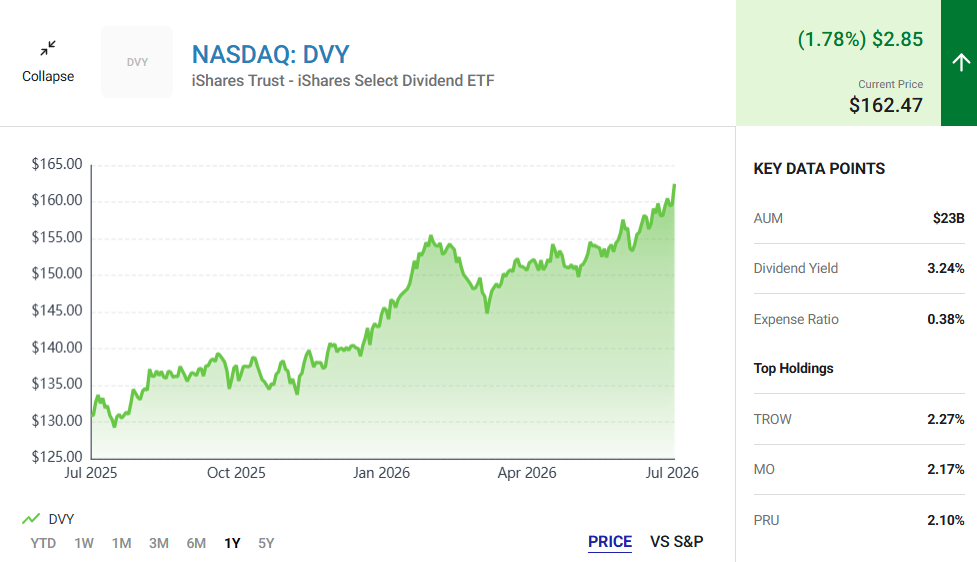
Sector weightings in this fund skew defensive. Financial stocks account for about 26% of the portfolio, while utilities make up another 24%.
That tilt toward value and defensive sectors means investors should expect limited exposure to fast-growing companies, but in exchange they get a fund built for stability. Its expense ratio of 0.38% still ranks in the lowest quintile among comparable funds.
Tech Dividends: A Newer but Growing Niche
A third approach targets technology-focused dividend investing, a segment not traditionally associated with income strategies. This fund among the first ETFs dedicated to tech dividend payers manages approximately $4.3 billion in assets and is approaching its 14-year track record, reflecting durability in a niche category.
It also includes select communication services companies, providing additional diversification beyond pure technology exposure.
Key Inclusion Criteria
To be part of the underlying index, companies must:
- Maintain a minimum dividend yield of 0.5%
- Pay consistent dividends over the prior year
- Avoid any dividend cuts during that period
This methodology emphasizes dividend consistency rather than long-term growth streaks, which leads to a notable outcome: some of the largest technology companies by market capitalization are excluded if they don’t meet these criteria.
Trade-Off to Consider
The fund carries an expense ratio of 0.50%, which is relatively high for dividend ETFs. Investors must weigh this higher cost against the benefit of gaining targeted exposure to dividend-paying companies within the tech sector, a less conventional but potentially complementary income strategy.
Choosing the Right Fit
Taken together, these three approaches illustrate that dividend investing today isn’t a one-size-fits-all strategy.
Investors can choose funds emphasizing long streaks of dividend growth, funds prioritizing higher current yield with defensive positioning, or funds targeting sector-specific dividend growers like technology. The right mix often depends on whether an investor values growth, income, or diversification most.
Regardless of approach, the broader trend is clear: dividend payouts across U.S. markets are expanding, not contracting, even as buybacks remain a popular capital-return tool.
For long-term investors building an equity income allocation, ETFs offer a straightforward way to gain broad exposure without the work of screening individual stocks. As always, expense ratios, sector concentration, and yield targets should all factor into which fund, or combination of funds, best fits an individual portfolio’s goals.