
Wall Street’s attention has been locked on tech, semiconductors, and artificial intelligence for most of this year, and understandably so given the returns those sectors have produced. But that focus has quietly overshadowed a different story.
The iShares Core Dividend Growth ETF (NYSEMKT: DGRO) is one of several dividend focused funds that have outperformed the broader market this year, and brokers from Rubinax dive into this topic, breaking down why this particular fund looks especially well positioned right now.
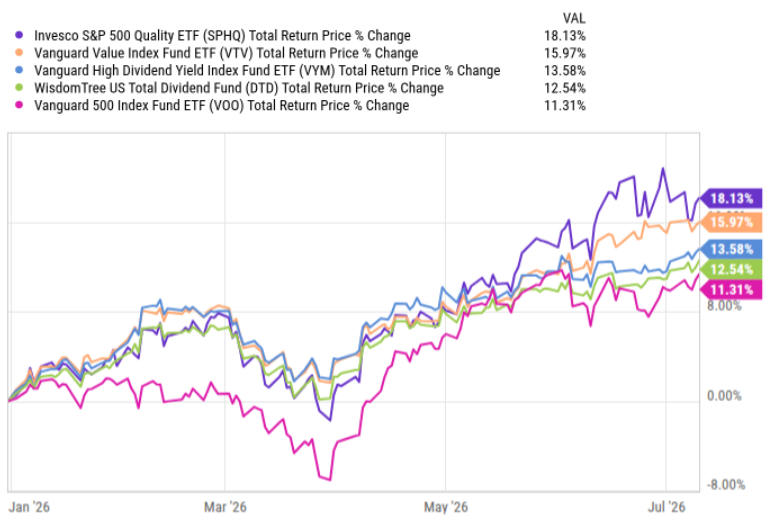
Value stocks, quality stocks, and dividend payers, especially higher yielding names, have all outpaced the Vanguard S&P 500 ETF so far in 2026. A large part of that outperformance showed up in the first quarter, when the so-called Magnificent Seven names began falling out of favor, but these more defensive groups have kept their edge even through recent bouts of volatility.
Why Dividend ETFs Are Getting A Second Look
For much of the past few years, the defensive nature of dividend paying stocks has not been in high demand while tech stocks did the heavy lifting for portfolio returns. That backdrop appears to be shifting. Inflationary pressures are building, growth is slowing in parts of the economy, and geopolitical risks threaten to weigh on economic activity further.
Together, those forces are strengthening the investment case for dividend focused strategies, and DGRO stands out as one option that combines several of the traits currently in favor.
What Makes DGRO Different
DGRO tracks the Morningstar US Dividend Growth Index, and the companies it holds have to clear several hurdles before making the cut. Each must pay a qualified dividend, show at least five consecutive years of uninterrupted dividend growth, and maintain an earnings payout ratio below 75%.
Companies in the highest-yielding decile are excluded entirely, a deliberate step meant to screen out potential yield traps where an unusually high payout signals distress rather than strength. Qualifying holdings are then weighted by the dollar amount of dividends paid, so companies distributing more in dividends carry a larger allocation within the fund.
None of these individual rules is especially strict on its own, but combined, they do a solid job of filtering out weaker dividend candidates while keeping the fund diversified. The portfolio looks meaningfully different from the S&P 500, which helps reduce volatility relative to a plain index fund.
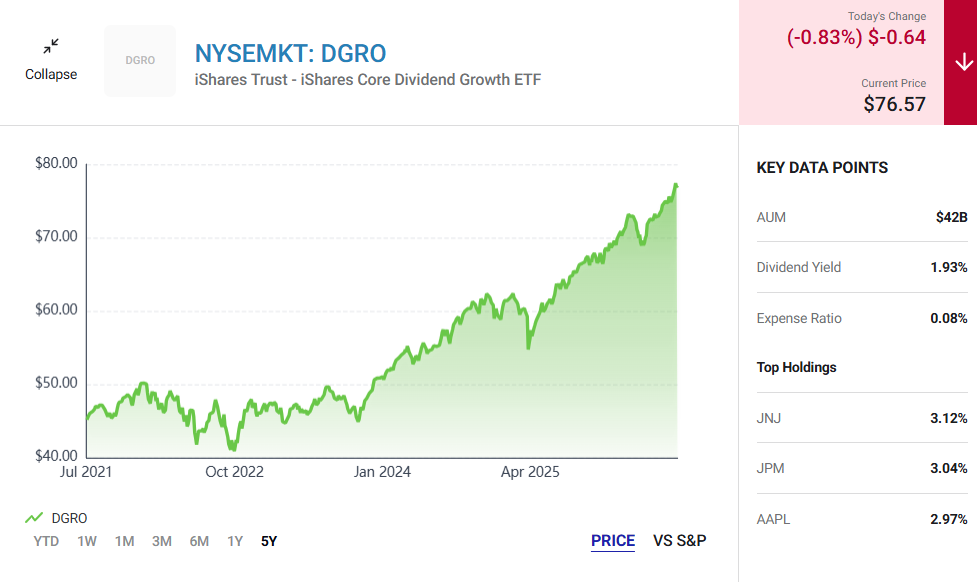
Five sectors each carry allocations of at least 10%: financials at 21%, healthcare at 18%, technology at 16%, industrials at 12%, and consumer staples at 12%. The fund currently holds about $42 billion in assets, charges a low 0.08% expense ratio, and yields 1.93%, with top holdings including familiar large-cap names.
Why This Setup Looks Attractive Right Now
Technology remains the best-performing sector in the S&P 500 so far this year, but signs of fatigue are showing. Most Magnificent Seven names are trading more than 10% below their all-time highs, and even the VanEck Semiconductor ETF sits roughly 11% below its own high.
Other stocks have picked up some slack, but betting exclusively on tech no longer looks like the obvious, low-risk trade it once did.
That shift is turning attention toward companies with durable business models and financial strength. These are businesses that reward shareholders consistently, rather than chase the next growth story.
If macro risks intensify, a fund like DGRO could be well positioned to outperform the broader market.
Financials tend to benefit when rates stay elevated longer. Healthcare and consumer staples offer goods and services that stay in demand regardless of the economy. Industrials have ridden the ongoing infrastructure buildout. And the fund’s technology allocation still provides exposure to the sector that has driven much of the market’s growth in recent year.
What This Means For Investors
The appeal of DGRO isn’t outrunning a hot tech rally in a strong bull market. It’s that the fund is built to hold up reasonably well across a range of conditions, combining quality screens, a demonstrated history of dividend growth, and a yield tilt in a single, low-cost package.
For investors wanting to add ballast to a portfolio overly concentrated in high-flying growth names, or simply seeking a straightforward way to generate meaningful passive income without picking individual stocks, DGRO offers a diversified, rules-based approach that has already proven it can compete with, and in 2026 has beaten, the S&P 500.
As with any fund, investors should weigh how DGRO fits their broader portfolio rather than treat it as a complete solution.
Its sector tilts toward financials and healthcare mean it won’t move in lockstep with the broader market, which is generally the point for those seeking a smoother ride. For investors balancing growth exposure with income and quality, DGRO remains one of the more compelling dividend ETFs available today.