
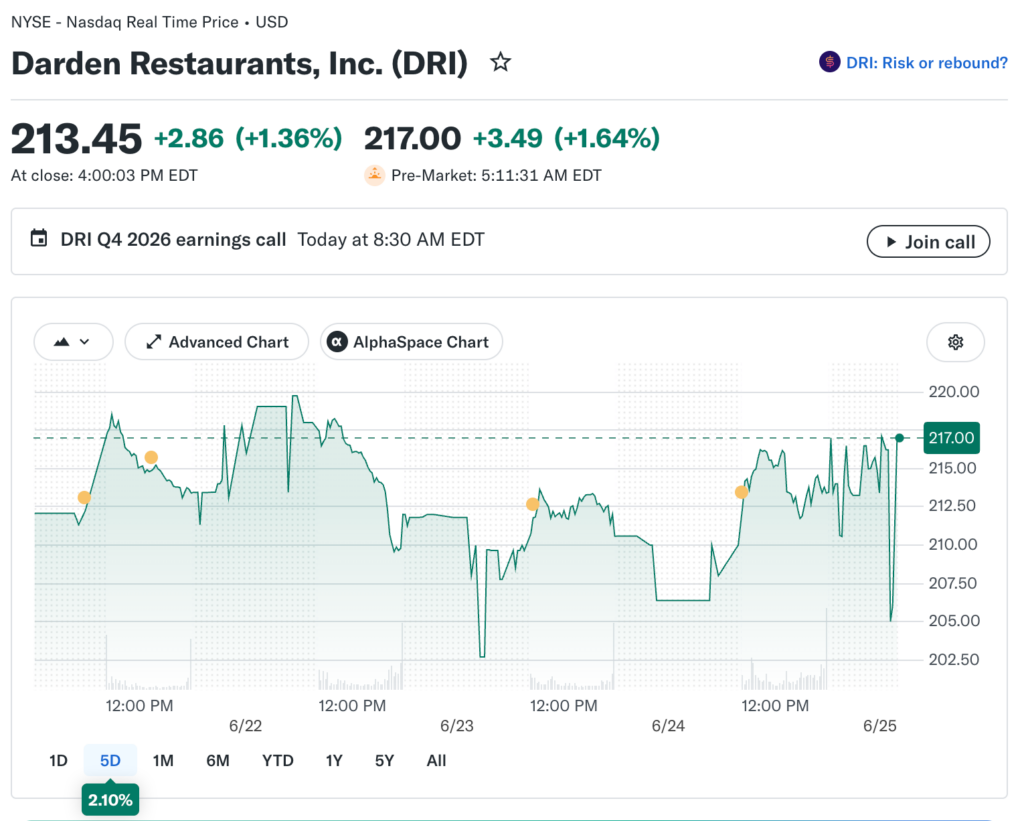
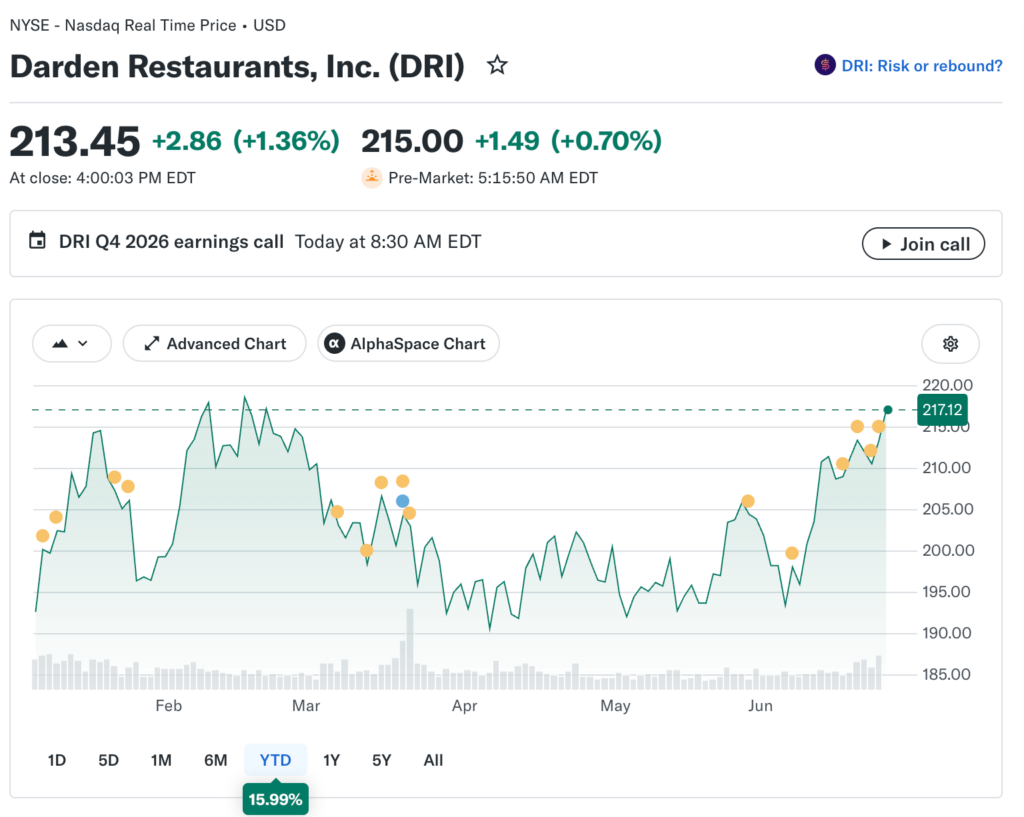
Darden Restaurants steps up to report fiscal Q4 2026 results on June 25 alongside a morning packed with May PCE inflation data and the Q1 GDP final estimate. Those macro releases will absorb most of the market’s attention, but Darden’s numbers carry information that aggregate inflation and growth data cannot capture.
A financial expert at explores why the Darden report matters beyond the restaurant sector and what the results tell investors about discretionary spending durability in a rate environment most models predicted would compress it significantly by mid-2026.
Full-Service Dining as a Consumer Spending Thermometer
The category Darden operates in, sit-down restaurant dining across brands including Olive Garden, LongHorn Steakhouse, Yard House, and Cheddar’s Scratch Kitchen, occupies a specific and revealing position in the consumer spending hierarchy.
Unlike grocery spending, which is largely unavoidable regardless of economic conditions, or fast food, which captures necessity-level food expenditure at lower price points, full-service dining is a genuine discretionary decision that consumers adjust fairly quickly when household budgets tighten. Restaurants are one of the first categories to see reduced traffic when financial stress builds and one of the last to recover when it eases.
That behavioral pattern makes Darden’s traffic and same-restaurant sales data a more direct read on consumer financial confidence than most survey measures provide. If customers are still choosing full-service dining despite the inflation environment persisting through mid-2026, it signals a more resilient discretionary consumer than macro indicators alone would suggest.
The Prior Quarter Set a High Bar
Darden’s most recent quarterly results showed adjusted diluted EPS of $2.95 from continuing operations and same-restaurant sales growth of approximately 4.5% against a backdrop of total inflation running at approximately 3.5% across the business. All four of its primary brands significantly exceeded their respective industry same-restaurant sales benchmarks for the period.
That kind of broad-based outperformance across different brand segments is considerably harder to sustain than a single brand beating its benchmark in a favorable quarter.
For June 25 results to clear the prior quarter’s bar, Darden needs to demonstrate that the cross-brand momentum was not a single-quarter event.
If same-restaurant sales growth holds near 4.5% and benchmarks are still being outpaced across all four brands, it confirms that the execution advantage CEO Rick Cardenas attributed to historically high team member retention is generating the consistent guest experience that drives repeat dining visits across quarters.
The Food Cost and Labor Equation in 2026
Managing a restaurant business in 2026 means navigating cost pressure from two directions simultaneously. Food cost inflation is influenced by energy prices declining toward $73 per barrel as the Iran ceasefire normalizes Strait of Hormuz shipping. Labor costs are influenced by wage expectations that remain elevated even as the broader economy slows, creating margin pressure that menu price increases can only partially offset.
Darden’s full-year guidance built in total inflation of approximately 3.5%, requiring precise management of both cost vectors to protect margins while sustaining same-restaurant sales growth. The ceasefire-driven oil decline toward $73 per barrel provides a more favorable food cost environment than the full-year guidance assumed.
If energy-linked food costs came in below the 3.5% inflation assumption in the fiscal fourth quarter, Darden’s actual margin will exceed its modeled margin even at identical same-restaurant sales growth rates, giving the company room to raise full-year guidance or expand its share repurchase program beyond the $516 million remaining under its $1 billion authorization.
What the Week’s Consumer Data Is Building Toward
Victoria’s Secret reported double-digit comparable sales growth across every major channel on June 24 while running significantly fewer promotional events than the prior year, confirming that discretionary fashion spending is holding at full price levels despite the elevated borrowing cost environment.
KB Home beat fiscal Q2 revenue estimates despite the thirty-year fixed mortgage rate running near 6.47%, confirming housing demand has not collapsed under elevated financing costs. Darden reporting on June 25 adds a third independent discretionary spending category to the week’s picture.
When three companies in fashion retail, housing, and restaurant dining each confirm organic revenue growth in the same five-day window, the aggregate read on consumer health is more reliable than any single result.
Darden’s numbers on June 25 will either reinforce the resilient consumer picture assembling this week or introduce the first crack in a more durable discretionary spending story than most rate-sensitive models predicted.
The Metric Worth Tracking Alongside Same-Restaurant Sales
Investors watching Darden on June 25 should track traffic volume separately from average ticket size. A company can grow same-restaurant sales purely through menu price increases while losing customer visits simultaneously, a weakening signal despite the headline growth number.
Traffic growth alongside average check growth is the combination that confirms genuine demand momentum rather than simply pricing power holding against cost inflation.
If Darden reports traffic growth running alongside same-restaurant sales growth, it becomes the strongest available confirmation that full-service dining consumers are spending by genuine choice, not because operators are capturing the same revenue from fewer visiting households.