
USD/JPY climbed above 163 on Thursday as the Japanese yen weakened to its lowest level since 1986. The pair reached roughly 163.24, supported by US dollar strength, rising oil prices, and concern about Japan’s policy outlook.
This analysis from Lucovox.com examines whether USD/JPY can extend toward 164.00 or whether intervention risks and Bank of Japan expectations could trigger a correction.
The Yen Remains Under Heavy Pressure
The latest decline reflects more than temporary dollar strength.
Japan imports much of its energy, so higher oil prices can increase import costs, worsen the trade balance, and add to domestic inflation. Recent data showed Japanese imports rising to a record high as energy costs increased.
Expensive oil, low Japanese interest rates, and strong US yields continue to favor USD/JPY buyers.
Markets remain uncertain whether the Bank of Japan can raise rates quickly enough to support the yen without placing too much pressure on growth and government debt.
The Daily Trend Remains Bullish
USD/JPY is trading above both its 20-day and 50-day Exponential Moving Averages.
Holding above the 20-day EMA would confirm that the short-term uptrend remains intact.
The 50-day EMA provides a wider measure of direction. As long as price remains above both averages, pullbacks are more likely to be treated as buying opportunities.
A sustained drop beneath the 20-day EMA would be the first warning that momentum is weakening.

Image 1: USD/JPY Daily Chart With the 20-Day and 50-Day EMAs, Support at 161.50 and Resistance Near 163.25
RSI Warns of Overextended Conditions
The 14-day Relative Strength Index has strengthened as the pair reached a new multi-decade high.
A reading above 70 would indicate that USD/JPY has entered overbought territory.
That would not automatically signal a decline, but it could increase the risk of profit-taking or a sudden reaction to intervention headlines.
If RSI begins falling while price remains near its high, traders may interpret that as an early sign of fading momentum.
Resistance Builds Around 163.25
The first major resistance area sits near 163.25, close to the latest peak.
A clear break above this level could expose 164.00.
If buyers push through 164.00, the next target may appear around 165.00.
A sustained move above 164.00 would confirm that buyers remain in control despite rising intervention risk.
However, gains may become less orderly as the pair moves deeper into territory that could attract action from Japanese authorities.
Support Begins Near 162.50
The first support level appears around 162.50.
Holding above this area would preserve the immediate bullish structure.
A break below 162.50 could expose 161.50, where buyers may attempt to defend the broader trend. Further weakness may bring 160.50 into focus.
A sustained move below 160.50 would weaken the current recovery pattern and suggest that intervention or changing rate expectations are having a stronger effect.
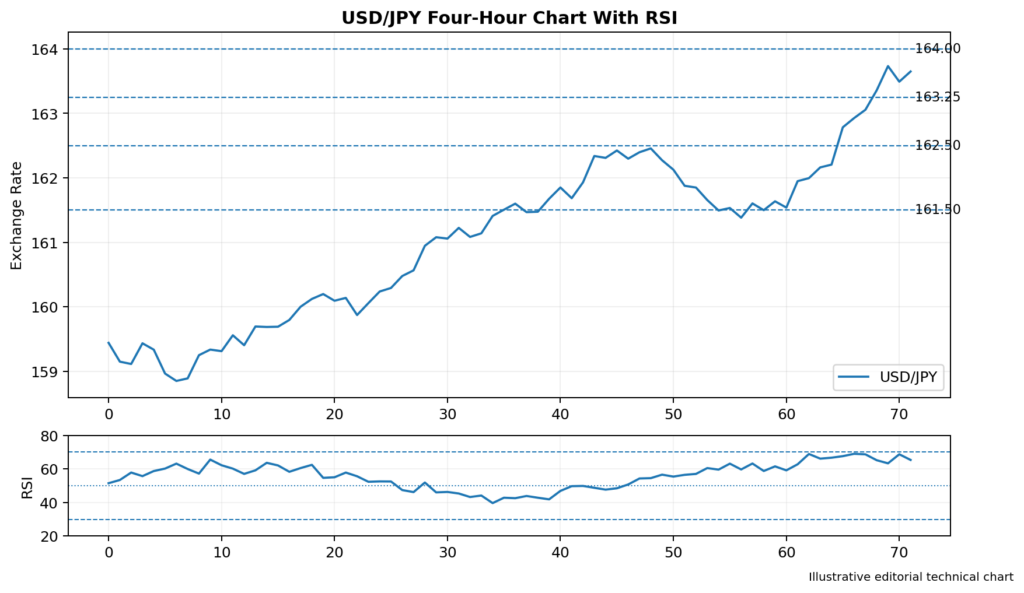
Image 2: USD/JPY Four-Hour Chart With RSI, Support at 162.50 and 161.50, and Resistance at 163.25 and 164.00
Intervention Risk Is Increasing
Japanese officials have warned that they are prepared to act if currency movements become excessive.
Intervention risk is now one of the main threats to further USD/JPY gains.
Previous interventions have caused sharp drops in the pair, even when the wider trend later recovered.
Traders may therefore become more cautious above 163, particularly during periods of thinner liquidity.
Bank of Japan Expectations Offer Limited Support
Most economists expect the Bank of Japan to raise rates again by the end of December, with some seeing a move as early as October.
A faster tightening path could support the yen by narrowing the gap between Japanese and US interest rates.
However, the central bank faces a difficult balance. Raising rates too slowly could worsen currency-driven inflation, while moving too quickly could damage growth.
Until markets expect more aggressive tightening, rate expectations may provide only limited support for the yen.
Higher Oil Prices Add Pressure
Brent crude recently surged toward $98 per barrel as conflict and shipping disruption raised supply concerns.
Higher energy prices affect Japan more severely than many major economies because of its dependence on imported fuel.
Oil strength creates double pressure on the yen by weakening growth expectations and lifting import-driven inflation.
Trading Implications
USD/JPY keeps a bullish short-term bias while trading above 162.50 and its main moving averages.
A confirmed break above 163.25 could expose 164.00 and 165.00.
A move below 162.50 would weaken immediate momentum, while a sustained break beneath 161.50 could signal a broader correction.
Traders should also remain alert to intervention headlines, which could produce sharp intraday moves.
Conclusion
USD/JPY has risen above 163 as the yen falls to its weakest level in four decades.
Resistance is positioned near 163.25, 164.00, and 165.00. Support can be found around 162.50, 161.50, and 160.50.
The technical trend continues to favor buyers, but intervention risk and possible Bank of Japan tightening leave the market vulnerable to sudden reversals.