
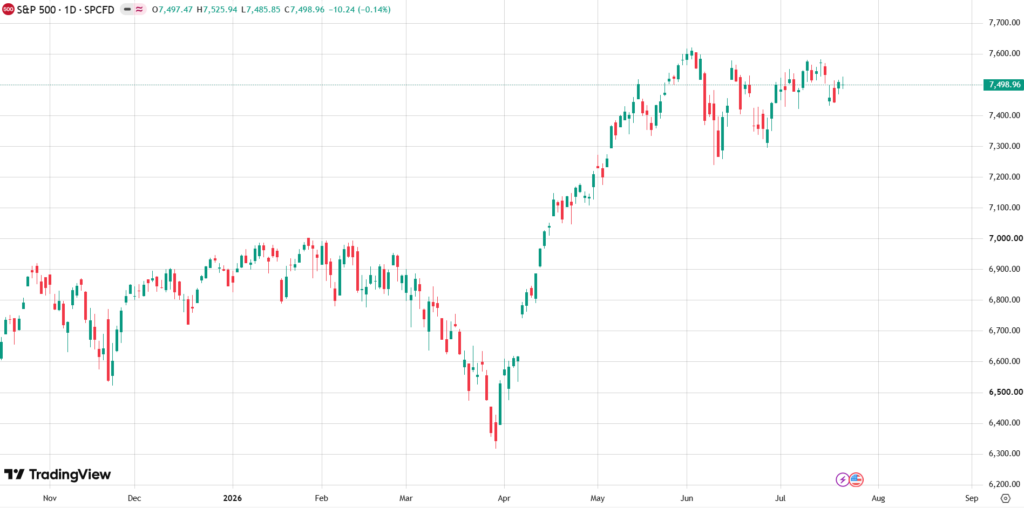
US equity markets delivered a mixed performance on Wednesday as rising oil prices, higher Treasury yields, and the start of earnings season created a cautious environment for investors. While the Dow Jones Industrial Average and the S&P 500 managed modest gains, the Nasdaq 100 underperformed as traders reduced exposure to large technology stocks ahead of earnings from several market leaders.
Lucovox reviews the latest developments across US financial markets, examining how energy prices, Federal Reserve expectations, and corporate earnings continue influencing investor sentiment and broader market direction.
Big Tech Earnings Become the Main Market Focus
Investor attention has shifted toward the first major earnings releases from the so-called “Magnificent Seven,” with Alphabet, Tesla, and IBM scheduled to report after the closing bell.
Although the broader market has remained relatively resilient, investors appear reluctant to increase risk exposure before seeing whether large technology companies can justify their elevated valuations. This caution weighed particularly on the Nasdaq 100, which slipped roughly 0.4% during the session after an early semiconductor rebound faded.
Meanwhile, the S&P 500 gained approximately 0.2%, while the Dow Jones Industrial Average added nearly 160 points, supported by stronger performances from industrial, materials, and defensive sectors.
Market breadth remained uneven as investors rotated away from high-growth technology names toward companies viewed as better positioned to benefit from the current macroeconomic environment.
Rising Oil Prices Continue Supporting Inflation Concerns
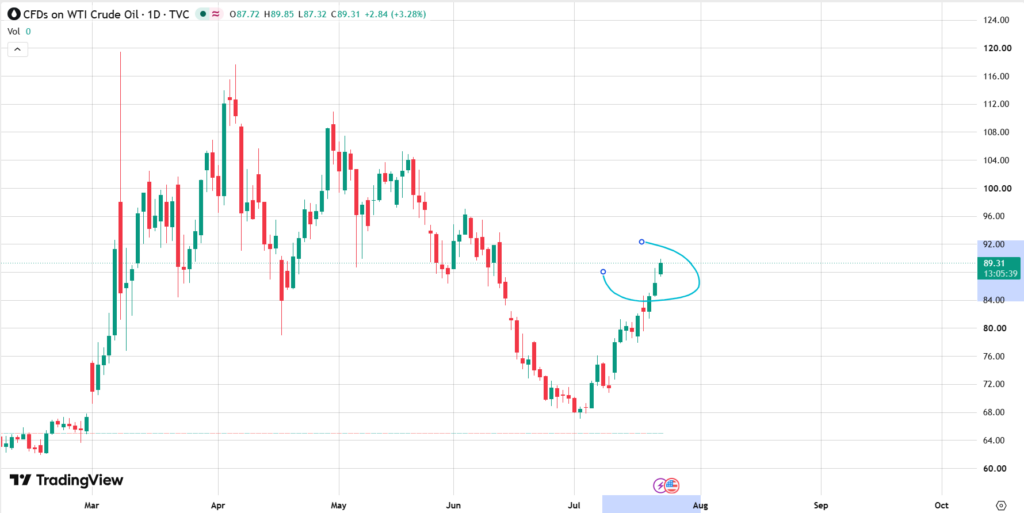
Energy markets remained one of the day’s primary drivers after crude oil climbed toward $88 per barrel.
The advance followed another night of military activity involving the United States and Iran, increasing concerns that disruptions around the Strait of Hormuz could affect global oil supplies. As energy prices moved higher, investors reassessed inflation expectations, pushing Treasury yields modestly upward.
The yield on the 10-year US Treasury climbed toward 4.65%, while the 30-year yield approached 5.14%. Higher yields generally reduce the attractiveness of growth-oriented assets because future corporate earnings are discounted at higher interest rates.
Gold also benefited from the uncertain environment, advancing nearly 1.9% as investors increased allocations toward traditional safe-haven assets amid geopolitical uncertainty.
Federal Reserve Expectations Remain Firm
Markets continue expecting the Federal Reserve to leave interest rates unchanged at its upcoming meeting. However, recent economic data has reinforced expectations that policymakers could maintain a restrictive stance for longer than previously anticipated.
According to CME FedWatch estimates, traders now assign roughly a 24% probability of a rate increase in July and approximately a 69% chance of at least one quarter-point hike by September.
Recent strength in retail sales, resilient labor market data, and persistent inflation concerns linked to rising energy prices have all contributed to expectations that interest rates may remain elevated for an extended period.
Investors will also pay close attention to upcoming economic releases, particularly inflation indicators and business activity surveys, for additional confirmation that the current outlook remains valid.
Any unexpected weakening in economic data could prompt markets to reassess the timing of future policy decisions, while stronger-than-expected figures would likely reinforce expectations that interest rates could remain higher for longer, influencing both equity valuations and broader investor sentiment.
Consequently, investors continue balancing optimism surrounding corporate earnings with caution regarding future monetary policy.
Sector Rotation Defines Trading Activity
Sector performance highlighted how investors are adapting to the current market environment.
Energy, utilities, and materials outperformed as higher commodity prices and inflation expectations supported cyclical and defensive industries. Several individual companies also posted strong gains following positive earnings announcements and improved forward guidance.
At the same time, portions of the technology sector struggled despite continued enthusiasm surrounding artificial intelligence. Some software companies experienced sharp declines after weaker-than-expected quarterly results and cautious management commentary raised concerns about slowing enterprise spending.
This divergence illustrates that investors are becoming increasingly selective, rewarding companies with strong earnings visibility while penalizing businesses facing uncertain demand or margin pressure.
Conclusion
US equities continue navigating a challenging environment shaped by rising oil prices, evolving Federal Reserve expectations, and the beginning of another important earnings season. While the Dow Jones and S&P 500 have remained relatively resilient, technology shares continue facing greater volatility as investors await results from several of the market’s largest companies.
With geopolitical developments, inflation data, and corporate earnings all converging over the coming days, market participants are likely to remain cautious as they assess whether the current rally can extend further or whether renewed volatility will emerge across global financial markets.