
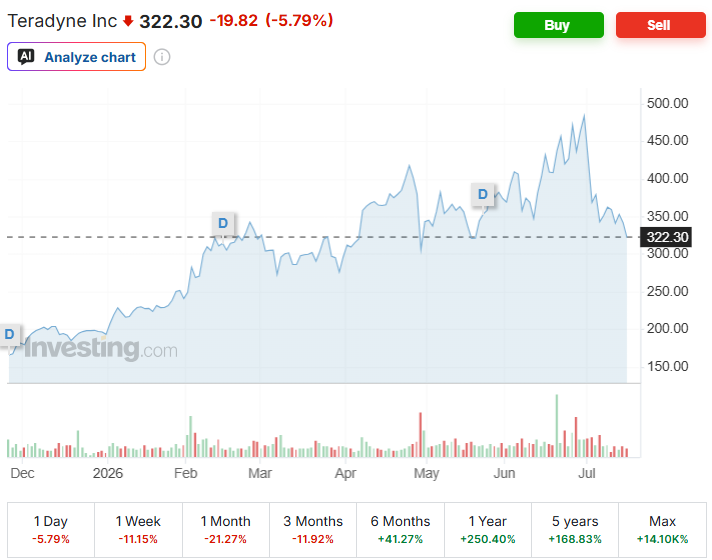
Teradyne, the semiconductor test equipment maker whose stock has surged 268% over the past 12 months, just saw two of its insiders sell shares on the same day. Director Marilyn Matz disposed of 1,200 shares worth roughly $428,000 on July 15, according to a recent SEC filing.
Brokers from Vaulltier break down what this transaction, and a nearly identical one from the company’s CEO the same day, actually signal for investors watching this red-hot AI-adjacent stock heading into earnings. The short answer is less dramatic than the headline number might suggest, but it’s still worth understanding the full picture.
The Transaction Itself
Matz’s sale reduced her direct holdings by about 7%. After the transaction, she still retains 16,240 shares directly, worth roughly $5.56 million at Teradyne’s most recent closing price. The shares were sold at a weighted average price of $356.31, a level that reflects just how far this stock has run over the past year.
Importantly, this wasn’t an impulsive decision. The sale was executed under a Rule 10b5-1 trading plan that Matz adopted back in February 2026. These pre-scheduled plans exist specifically to let insiders sell shares on a predetermined timeline, which separates the timing of the trade from any real-time view the insider might have on the company’s near-term prospects.
In other words, this sale was locked in months before it happened, well before anyone knew exactly where the stock would be trading in mid-July. That distinction matters quite a bit when evaluating insider activity, since a trade set up months in advance carries a very different signal than one executed on short notice around a specific news event.
She Wasn’t Alone
Here’s the detail that makes this filing more interesting than a routine insider sale: Teradyne’s CEO, Greg Smith, sold $1.4 million worth of stock the same day, at the identical price of $356.31, also under a separate preset plan.
Two insiders selling shares on the same day can understandably raise eyebrows. It’s a fair instinct to wonder whether something is signaling caution behind the scenes.
But when both sales run through pre-established trading plans set up months in advance, and both insiders still retain the overwhelming majority of their holdings afterward, the more reasonable interpretation is coordinated financial planning after an enormous run in the stock, not a shared loss of conviction in the business.
Why the Stock Ran So Far in the First Place
The bigger story here isn’t really the insider sales, it’s what’s driving Teradyne’s stock in the first place. The company’s chip-testing equipment has become deeply tied to the broader AI buildout, with AI-related demand now accounting for roughly 70% of revenue. That segment grew 87% last quarter alone, pushing revenue to a record $1.28 billion.
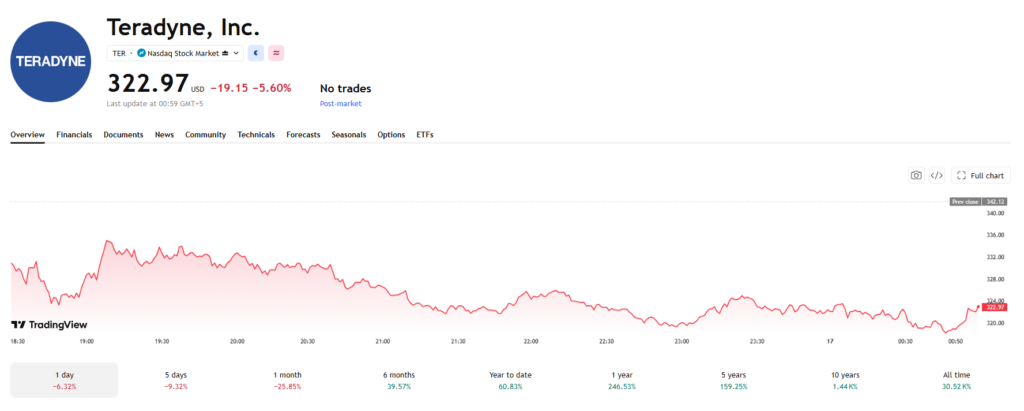
That kind of concentration cuts both ways, though. The same AI exposure that’s fueled the stock’s massive rally also makes it more sensitive to swings in sentiment around AI spending broadly. Consistent with that, Teradyne shares have actually pulled back sharply in recent weeks amid broader volatility across semiconductor-adjacent names, even before this filing.
What the Numbers Say About the Business
Beyond the stock price, Teradyne’s underlying financials remain solid. The company currently carries a market capitalization of roughly $53.6 billion, against trailing twelve-month revenue of $3.8 billion and net income of $854.1 million.
That’s a business generating real, substantial profit, not simply riding hype without fundamentals behind it. Profitability at this scale gives the company meaningful flexibility, whether that means continued investment in testing technology, potential capital returns to shareholders, or simply weathering a stretch of stock price volatility without operational pressure.
Teradyne’s core business, designing and selling automated testing equipment for semiconductor manufacturers, positions it as essential infrastructure within the chip supply chain rather than a speculative pure-play on AI enthusiasm. Its customers include major semiconductor manufacturers and integrated device makers who rely on Teradyne’s tools to validate chip performance before those chips ever reach the market.
What Investors Should Actually Watch
The insider sales themselves are unlikely to move the needle much on their own. Scheduled trading plans are common, and executives diversifying part of their holdings after a stock triples is neither unusual nor necessarily bearish.
What matters more is whether the demand driving Teradyne’s AI-related revenue proves durable over time, especially given how concentrated that growth has become in a single, still-evolving end market.
Teradyne is scheduled to report earnings again on July 29, which will offer a clearer read on whether the AI-driven growth story still has legs, or whether the recent pullback reflects genuine concerns about slowing demand.
For investors trying to separate routine insider activity from a meaningful signal, that earnings report will carry far more weight than a pair of pre-scheduled stock sales.