
AI has been the defining trade of the decade so far, and most of the market’s headline winners are up again this year. But not every AI-linked stock has kept pace. A handful of names have quietly strengthened their underlying businesses even as their share prices went nowhere or fell.
Brokers from Vaulltier highlight three such stocks whose fundamentals look increasingly disconnected from their stock charts. That gap has historically tended to close in the fundamentals’ favor over time. Each name below has posted real, measurable business improvement this year despite a rough stretch for its stock.
1. Synopsys: Growing Fast, Priced Like It Isn’t
Synopsys designs the software tools that let chipmakers build advanced AI chips. Its intellectual property creates a genuine competitive moat that keeps most rivals locked out.
The company also recently secured an expanded partnership alongside a $2 billion investment from Nvidia. That’s a meaningful vote of confidence from one of the most important players in AI hardware.
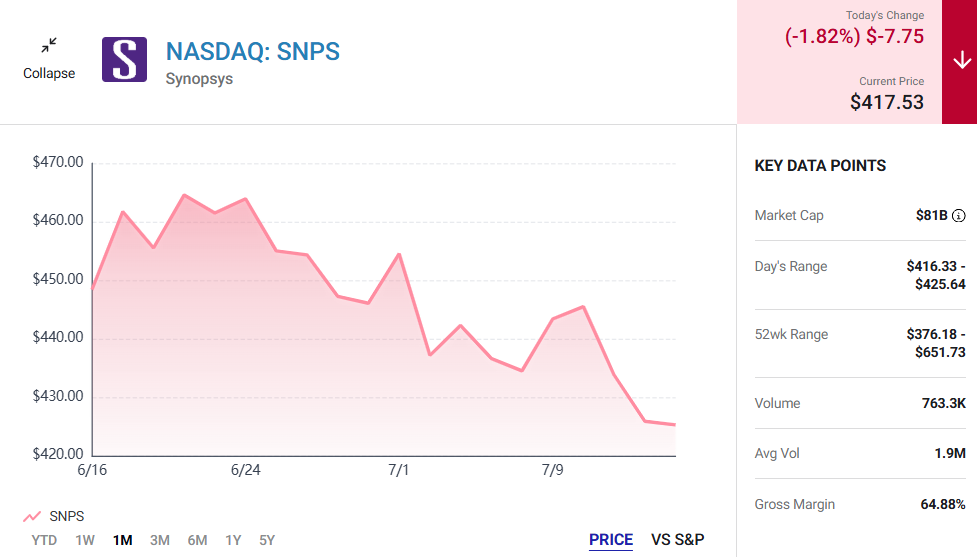
Despite that backdrop, Synopsys shares are down 12% year to date. That decline looks increasingly disconnected from the company’s actual performance.
Revenue grew 42% year over year in its most recent fiscal quarter, and management raised full-year revenue guidance rather than lowering it. Much of the near-term margin pressure traces back to its $35 billion Ansys acquisition, which brought real market share gains but also heavy amortization costs.
As those amortization costs taper off over time, margins have room to expand. That makes the current pullback look more like a temporary mismatch than a genuine warning sign.
2. Constellation Energy: Powering AI Without Building Data Centers
Constellation Energy occupies an unusual position in the AI trade. Rather than building AI infrastructure directly, it supplies the electricity that keeps it running, with 55 gigawatts of capacity spanning nuclear, natural gas, and other sources.
That capacity lets it sign long-term power contracts with major tech companies. It does this without shouldering the enormous capital costs of constructing data centers itself.
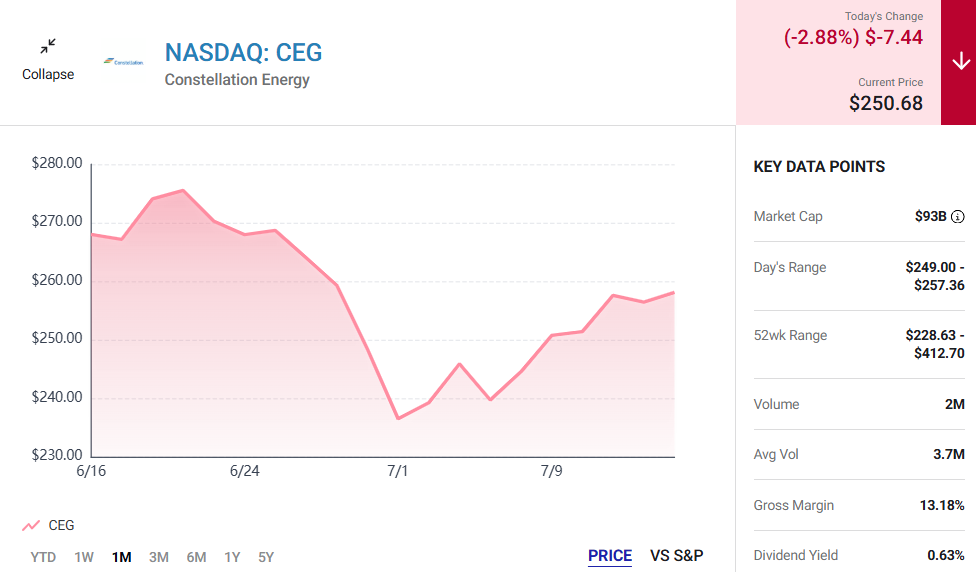
Even so, the stock is down roughly 30% year to date. Revenue grew 61% year over year in the first quarter, and management pointed to strong, visible cash flow ahead.
The stock currently trades at a 22.3 price-to-earnings ratio, a reasonable multiple given that growth. Much of the recent weakness traces back to the company’s $16.4 billion acquisition of Calpine, which some investors viewed skeptically.
That skepticism centered on added debt, share dilution, and a shift in focus toward natural gas rather than nuclear power. Longer term, Constellation is guiding for 20% annual earnings growth from 2026 through 2029, a trajectory that suggests the current correction may prove temporary.
3. Microsoft: The Hyperscaler That Got Left Behind
Not every major cloud provider has kept pace with the broader market this year, and Microsoft is a clear example. The stock is down more than 15% year to date, and several Wall Street analysts have trimmed their price targets.
But a closer look at the underlying business suggests the pessimism has run ahead of the facts. Microsoft’s AI business more than doubled its annual revenue run rate year over year in its most recent quarter.
Overall company revenue grew 18%, and net income climbed 20% over the same period. Cloud revenue grew even faster than the company as a whole, now accounting for more than half of total quarterly revenue.
Management has pointed to accelerating demand for Microsoft’s cloud offerings as the primary driver behind that growth. With shares trading at roughly 23 times earnings, a modest multiple relative to that growth rate, the valuation looks more like an opportunity than a red flag.
The Common Thread
What ties these three stocks together isn’t sector or business model, it’s the gap between price action and underlying performance. Each company has posted double-digit revenue growth and expanded its competitive position this year, yet each has still seen its stock fall or stagnate.
Markets don’t always reprice fundamentals immediately, and short-term sentiment can diverge from business reality for extended stretches. History suggests that companies continuing to gain market share and grow revenue tend to get rewarded eventually, even after periods where the stock price says otherwise.
For investors willing to look past this year’s price charts and focus on what these businesses are actually delivering, these three names offer a case study in exactly that kind of disconnect. It’s a reminder that near-term stock performance and long-term business quality don’t always move in the same direction at the same time.