
United States Treasury yields declined during Friday’s trading session as market participants balanced domestic economic data against the backdrop of intensifying geopolitical hostilities in the Middle East.
A market analyst at Sollventis indicates that government bonds experienced a broad rally, pushing yields downward across the entire curve.
Investors are currently interpreting recent economic reports as evidence that the domestic economy remains resilient despite persistent inflationary pressures fueled by ongoing international conflicts and the resulting volatility in global energy markets.
The current environment highlights a distinct shift toward defensive positioning as traders weigh the risks of regional instability against the potential for moderating domestic price levels.
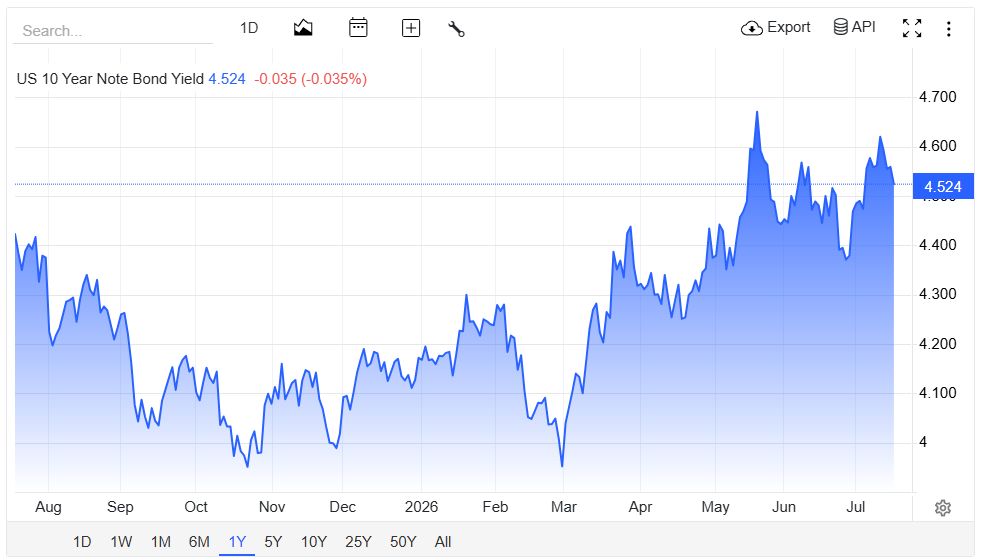
Benchmark Yields Retreat Amid Broad Bond Market Strength
The yield on the benchmark 10-year Treasury note, which serves as the foundational reference point for mortgage rates, consumer credit, and automobile financing, retreated by more than 4 basis points to settle at 4.525%.
In bond market terminology, one basis point is equal to 0.01%, and the inverse relationship between bond prices and yields ensures that the current rally in government securities reflects a shift in investor sentiment toward safer, fixed-income assets.
Shorter and longer-dated maturities also participated in the move. The 2-year Treasury note yield, which is frequently utilized by market analysts as a proxy for shifting expectations regarding Federal Reserve interest rate policy, declined by 3 basis points to reach 4.122%.
Simultaneously, the 30-year Treasury yield, a metric often responsive to long-term inflation outlooks and significant geopolitical developments, shed over 3 basis points to trade at 5.063%.
This coordinated move suggests that investors are seeking stability in the face of uncertainty, prioritizing the preservation of capital as the macroeconomic landscape evolves throughout the 2026 fiscal year.
Interpreting Domestic Economic Indicators
The downward pressure on borrowing costs this Friday arrives on the heels of a week defined by critical economic disclosures. Investors have been closely scrutinizing producer and consumer price indices for signs that inflationary pressures are beginning to moderate.
Supplementing this data, the most recent report on U.S. jobless claims for the week ending July 11 provided a positive surprise, with new filings recorded at a seasonally adjusted level of 208,000. This figure arrived lower than market forecasts, reinforcing the narrative of a robust labor market that continues to sustain economic activity despite elevated interest rates.
These domestic data points are essential for the Federal Reserve as it evaluates the necessity of further monetary policy adjustments. While the labor market remains tight, the cooling price data released earlier this week has provided some level of reassurance to traders who are attempting to model the trajectory of interest rates for the remainder of the 2026 fiscal year.
The ability of the economy to absorb the impacts of external shocks while maintaining moderate growth is a central focus for institutional investors currently rebalancing their portfolios.
Geopolitical Tensions And Volatility In Global Energy Markets
The bond market’s rally on Friday is particularly notable given the escalating geopolitical frictions that have introduced significant volatility into the energy sector. Overnight developments in the region, characterized by an intensification of hostilities, prompted a sharp reaction in commodity markets.
West Texas Intermediate futures for August delivery were last observed trading 1.9% higher at $80.44 per barrel, while Brent crude, the international benchmark, saw a climb of 1.6% to reach $85.59 per barrel.
This energy price surge stands in contrast to the bond market’s behavior, illustrating the complex environment that traders are currently navigating. Historically, rising oil prices often serve as a catalyst for inflation concerns, which would typically exert upward pressure on bond yields.
However, the flight to quality currently observed in the Treasury market suggests that the fear of geopolitical instability is currently outweighing the inflationary risks associated with higher energy costs.

Navigating Future Economic And Geopolitical Shifts
As the market approaches the weekend, the divergence between rising commodity prices and falling bond yields serves as a reminder of the heightened state of uncertainty. Institutional participants are operating with an emphasis on defensive positioning.
The primary challenge for investors in the coming sessions will be to distinguish between temporary market reactions to headline news and shifts that indicate a more fundamental change in the economic outlook.
The path forward for Treasury yields will likely remain tethered to the interplay between the Federal Reserve’s data-dependent approach to interest rates and the unpredictable nature of global geopolitical events.
By monitoring the ongoing relationship between labor market strength, energy price stability, and the cost of government borrowing, investors can better identify the signals that will define market trends in the second half of the year.
While the current rally indicates a preference for safety, the underlying potential for inflation means that market participants should remain prepared for sudden changes in sentiment as new information regarding both domestic policy and international security becomes available.