
Crude oil prices extended their rally during Friday’s trading session as market participants reacted to the rapid escalation of tensions involving major regional powers in the Middle East.
As threats to vital regional infrastructure intensify, traders are recalibrating their positions to account for the heightened risk of a long-term blockage of global oil traffic. This uncertainty has created a high-stakes environment where every new security update triggers immediate price fluctuations across the global energy complex.
Economic analysts at Sollventis highlight that this volatility is largely driven by fears that direct military confrontation could severely disrupt energy supplies moving through the Strait of Hormuz.
Benchmark Indices Reflect Growing Supply Vulnerabilities
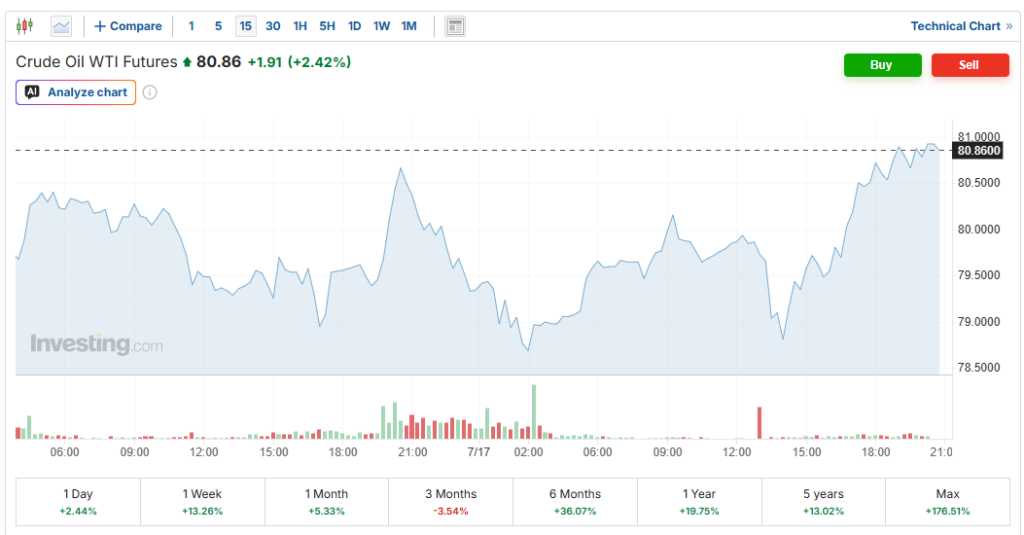
The international benchmark, Brent crude futures for September delivery, advanced by approximately 2% to reach $86.03 per barrel. Simultaneously, U.S. West Texas Intermediate (WTI) futures for August delivery demonstrated even greater upward momentum, gaining 2.6% to trade at $80.99 per barrel.
This performance marks a significant reversal from the relative stability observed earlier in the summer. Both oil contracts have surged more than 11% over the current week, placing them on a trajectory for their strongest weekly performance since the end of April.
The primary catalyst for this price action is the breakdown of the fragile truce established last month. Energy flows through the Strait of Hormuz are once again at the center of the geopolitical debate, as this narrow passage remains responsible for handling approximately 20% of the world’s daily oil traffic.
Any credible threat to this chokepoint forces energy traders to bake a significant risk premium into current futures contracts, as the global economy remains heavily dependent on the steady transit of crude through this region.
Military Escalation And The Threat To Regional Infrastructure
Recent reports from the region indicate a significant uptick in military engagement. Official sources have confirmed that consecutive nights of aerial strikes have targeted dozens of military objectives, including logistics infrastructure and maritime capabilities.
With more than 50,000 service members reported to be operating across the theater, the regional command has stated that these forces remain in a high state of operational readiness.
This mobilization has coincided with explicit warnings issued by senior military officials regarding the potential destruction of infrastructure if current diplomatic ultimatums are not met.
The rhetoric has shifted from localized posturing to threats of broad-scale industrial damage. Spokespeople for regional military commands have publicly vowed that any strikes on key power or transport infrastructure would result in a comprehensive response, targeting all remaining operational assets within the broader territory.
Furthermore, there are emerging reports suggesting that allied forces in adjacent areas may be mobilized to restrict transit through key maritime routes, such as the Red Sea, should the situation escalate further. These developments create an environment where the security of the entire energy supply chain is being openly questioned by market participants.
Economic Incentives Versus Geopolitical Reality
Despite the severity of the current standoff, energy analysts are attempting to determine if a diplomatic window remains open. Senior experts at Rystad Energy have noted that while confidence in a resolution has significantly diminished, a limited agreement between the involved parties remains a possibility.
There are substantial economic incentives for both sides to seek a return to the negotiating table rather than a permanent breakdown.
The current governing administration has demonstrated a consistent interest in maintaining lower energy prices as it navigates domestic economic cycles, while the regional power possesses a clear motivation to secure access to frozen financial assets and export waivers.
The current economic package under discussion represents a substantial potential gain for the regional power, one that the leadership may be reluctant to abandon permanently. However, the recurring nature of these military exchanges is testing the limits of this logic.
The market is effectively caught between two forces: the immediate, physical threat of supply disruption and the underlying economic reality that both sides have much to lose from a total cessation of diplomatic engagement.

Evaluating The Long-Term Market Risk Profile
Investors looking at the current energy landscape must differentiate between short-term noise and structural supply risks. If the current standoff continues to fracture the stability of the Strait of Hormuz, the energy sector will likely experience continued price pressure regardless of the underlying demand-side fundamentals.
Institutional investors are watching the daily updates from military command centers with as much intensity as they track standard inventory reports.
The ability of global energy markets to absorb these shocks depends heavily on the speed with which regional leaders can return to dialogue. If current threats are translated into actionable strikes against major infrastructure, the volatility seen this week will likely be viewed as the beginning of a larger upward trend in commodity pricing.