
Technology shares across the Asian markets experienced a significant downturn on Friday as investors reacted to a cascading liquidation of semiconductor stocks that originated in the United States.
This broad-based retreat, which mirrored steep losses observed on Wall Street during the previous session, marks a challenging inflection point for investors who have previously benefited from the prolonged surge in AI-related momentum trades.
As market sentiment turns increasingly cautious, the focus is shifting toward whether current capital investment levels can remain justified under prevailing economic conditions. Fundamental market data provided by Sollventis indicates that the recent volatility reflects a broader reassessment of growth valuations across the sector.
Market Contraction Across The Japanese Technology Sector
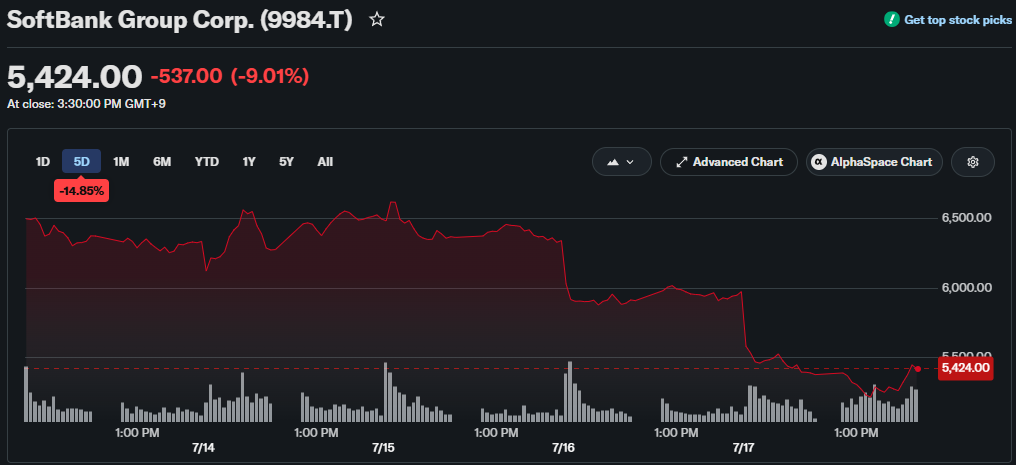
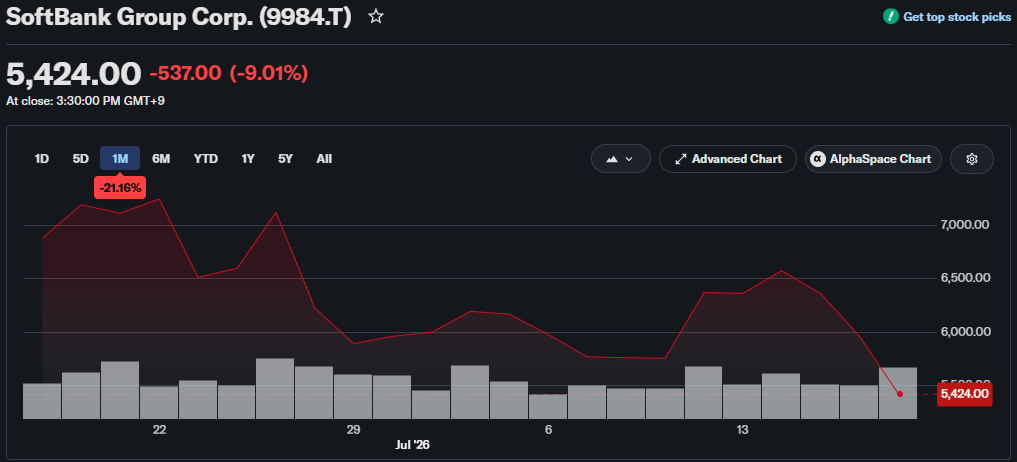
In Tokyo, the selling pressure was particularly severe. SoftBank Group shares concluded the session with a decline of 9%, while key hardware suppliers faced even greater volatility. Tokyo Electron, a major manufacturer of semiconductor production equipment, saw its valuation drop by 8.17%.
Similarly, Advantest experienced a contraction of 7.2%, reflecting the negative sentiment currently dominating the global chip sector. Adding to the complexity of the Japanese market performance, Kioxia witnessed a sharp plunge of more than 16%.
This steep decline followed a legal development in the United States, where a federal jury ordered the firm to remit $229 million in damages regarding a patent infringement case.
This combination of adverse judicial rulings and broader industry-wide liquidation has created a difficult environment for Japanese tech stocks, which were previously among the primary beneficiaries of the global push toward increased computational capacity.
Regional Divergence And Semiconductor Industry Pressures
Across the broader Asian market, the performance was marked by widespread weakness. Markets in South Korea were shuttered for a public holiday, preventing immediate reaction to the latest trends, although the region had already seen significant selling in prior sessions.
Meanwhile, Taiwan Semiconductor Manufacturing Company (TSMC) fell by 7.29% on Friday. This reaction occurred despite the company reporting a robust increase in profits that surpassed initial market projections. The market’s decision to penalize a positive earnings report highlights a shift in investor focus.
While TSMC elected to raise its full-year capital expenditure guidance to a range between $60 billion and $64 billion, up from the previous estimate of $52 billion to $56 billion, investors chose to prioritize the rising concern that the industry’s investment cycle might be reaching a point of diminishing returns.
Weakness In Chinese Tech And The Global Semiconductor ETF
Chinese technology stocks also struggled to maintain footing. In Hong Kong, Tencent slipped by 4.8% in late-session trading, while Meituan saw a retreat of 4.6%. The broader tech landscape in China, including companies such as Kuaishou, which lost 7%, Baidu, which fell 3.7%, and Alibaba, which eased 3.9%, reflected the global cooling of demand for high-growth tech assets.
These declines are a direct continuation of the weakness observed in the United States, where the Nasdaq Composite retracted 1.47%. The VanEck Semiconductor ETF experienced a notable contraction of almost 4%, while specific industry leaders including Arm Holdings, Micron Technology, Advanced Micro Devices, and Broadcom all suffered losses exceeding 5%.
The synchronized nature of this global sell-off underscores the high level of interconnectedness between U.S. markets and their international counterparts, particularly regarding the valuation of companies linked to the artificial intelligence boom.
Assessing The Sustainability Of Artificial Intelligence Momentum
Strategic analysts are currently debating whether this trend represents a permanent deterioration in fundamentals or a temporary correction. Andrew Jackson, a strategist at Ortus Advisors, noted that the current sell-off appears to be an unwinding of crowded momentum trades rather than a structural failure of the underlying technology sector.
According to this perspective, investors are pivoting away from positions that had become overextended after months of rapid, outsized gains. This skepticism is growing as capital markets begin to question the long-term profitability of the massive infrastructure spending currently underway.
The transition from an era of unchecked optimism to one characterized by rigorous scrutiny of capital deployment is inherently volatile.
As the industry moves into the latter half of the 2026 fiscal year, the ability of these technology giants to translate high expenditure into demonstrable, long-term efficiency gains will become the definitive factor in restoring market confidence and stabilizing global technology valuations.
Strategic Pivots Toward Robotics And Edge Hardware
Despite the broader retreat in semiconductor valuations, market participants are identifying emerging segments that demonstrate resilience against current volatility. Robotics stocks are increasingly viewed as a key AI-adjacent theme, with search interest for related components rising exponentially in recent months.
This shift is supported by high-profile pivots, such as Tesla refocusing factory capacity toward the production of its Optimus humanoid robot, signaling a transition toward physical, real-world AI applications.