
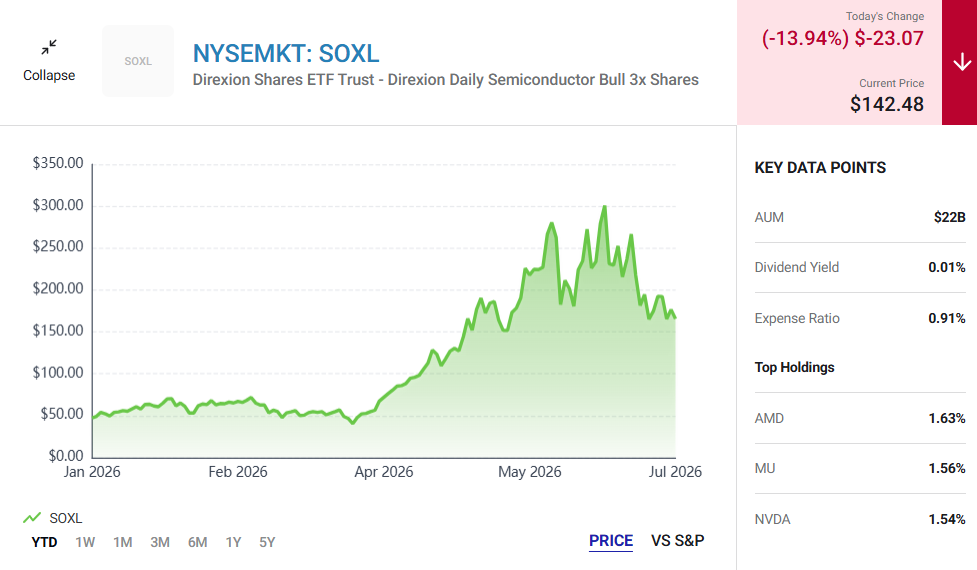
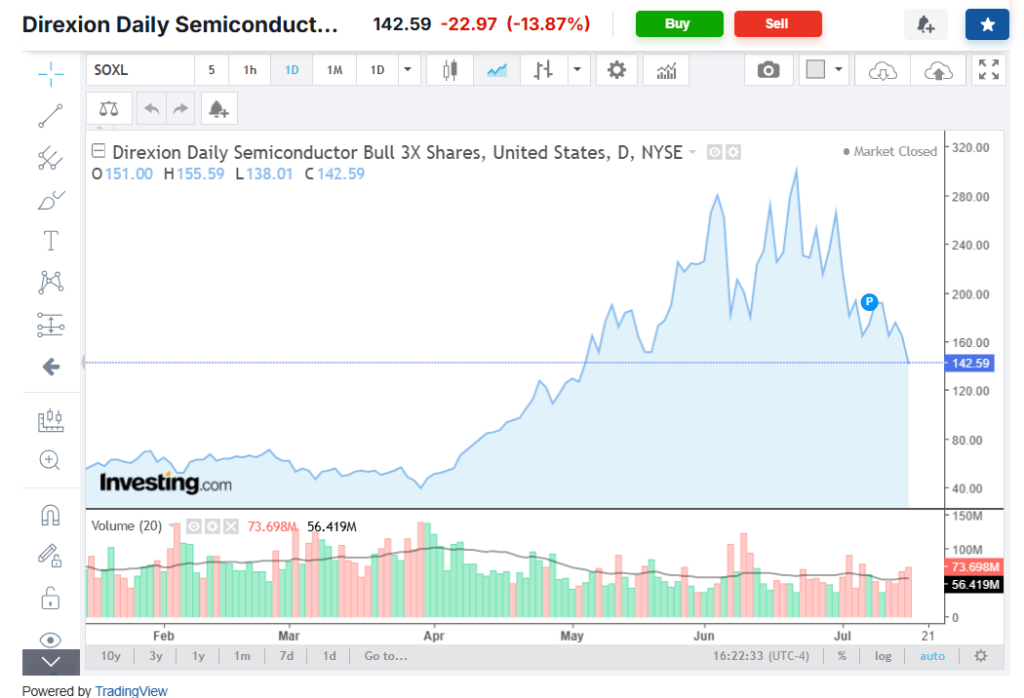
The Direxion Daily Semiconductor Bull 3X Shares ETF (SOXL) plunged roughly 14.5% in a single session, even as the broader Nasdaq fell a comparatively modest 1.3%. That gap looks strange at first glance, especially since the news triggering it was, on the surface, a genuinely strong earnings report.
Brokers from Vaulltier break down what actually happened, and why a triple-leveraged ETF like SOXL can post such an outsized move on a day when the underlying stocks it tracks only fell by a few percentage points each. The short version involves both a subtle warning buried inside a blowout quarter and the mechanical way leveraged ETFs amplify ordinary market moves.
TSMC’s Quarter Looked Great, Until It Didn’t
Taiwan Semiconductor Manufacturing, the world’s leading chip foundry, reported second-quarter results that beat expectations on nearly every headline metric. Revenue jumped 33% to $39.4 billion, and profit grew even faster, climbing 77% year over year to $21.9 billion.
Beneath those strong numbers, though, was a detail that unsettled the market. Free cash flow came in at just $8.9 billion, significantly weaker than reported earnings, as the company continued pouring capital into expanding chip production capacity.
The real trigger came from guidance, not results. TSMC had previously told investors it expected to spend about $54 billion this year on capital investment. That figure has now been revised up to $60 billion or more.
Why Rising Capex Spooked Semiconductor Investors
That upward revision matters because it touches a broader anxiety already circulating around the AI trade. Some investors worry that the enormous cost of building chip factories and manufacturing AI hardware may never be fully recouped through selling AI services.
If that concern proves accurate, the broader AI buildout could eventually slow or stall under its own weight. TSMC signaling even heavier spending than previously guided reads, to some investors, as evidence supporting that worry rather than dismissing it.
That reaction rippled across the sector well beyond TSMC itself. Shares of Nvidia, Micron, and Intel, all components held within the SOXL ETF, each fell by single-digit percentages on the same day.
Why SOXL Fell So Much Harder
Here’s where the ETF’s structure becomes the real story. SOXL is a triple-leveraged fund, meaning it’s designed to deliver three times the daily return, in either direction, of its underlying semiconductor holdings.
When those component stocks fall by a few percentage points, SOXL doesn’t just mirror that decline, it multiplies it roughly threefold. That mechanical amplification is exactly why single-digit losses across Nvidia, Micron, and Intel translated into a double-digit collapse for the ETF itself.
This isn’t a flaw or a malfunction, it’s simply how leveraged ETFs are built to work. The same multiplier that can generate outsized gains on a strong day works just as aggressively in the opposite direction, and that symmetry is baked into the fund’s design from day one.
It’s also worth noting that triple-leveraged funds like SOXL reset their exposure daily, which means the multiplier applies to each day’s move rather than compounding smoothly over longer stretches. That structure can create meaningful divergence from the underlying sector’s return over weeks or months, especially during periods of high volatility like this one.
The Trade-Off Investors Signed Up For
Leveraged ETFs like SOXL exist specifically for investors seeking amplified exposure to a sector’s daily moves. That amplification cuts both ways, and days like this one are the explicit trade-off for the outsized gains these funds can deliver when sentiment runs the other direction.
Anyone holding a triple-leveraged semiconductor fund should understand this dynamic going in, since a single earnings report from one major industry player can trigger outsized swings even when that company’s own results were largely strong. The capex guidance revision, not the earnings beat itself, was the specific detail that moved markets today.
The Bigger Picture
TSMC’s quarter, taken as a whole, still looks like a fundamentally strong one. Revenue and profit growth both outpaced analyst estimates by wide margins, and the company remains the dominant player in advanced chip manufacturing globally.
The market’s reaction reflects a specific worry about capital intensity and long-term AI economics, not a rejection of TSMC’s near-term execution. For investors in leveraged products like SOXL, days like this are a useful reminder that even one data point buried inside an otherwise excellent earnings report can trigger a sharp, mechanically amplified move.
That distinction matters for anyone deciding how to react. A genuine deterioration in TSMC’s business would be a different story entirely than a higher spending forecast tied to strong demand, and conflating the two risks overreacting to what is, at its core, a company investing aggressively because customers are asking for more chips, not fewer.