
One of the most widely held growth ETFs on the market has already more than doubled over the past five years, and a fresh analysis argues it could triple again within the next decade. Brokers from Vaulltier dive into this topic to walk through the math behind that bullish call, the historical track record backing it up, and what would actually need to happen for it to play out.
A Fund Built on the Biggest Growth Names
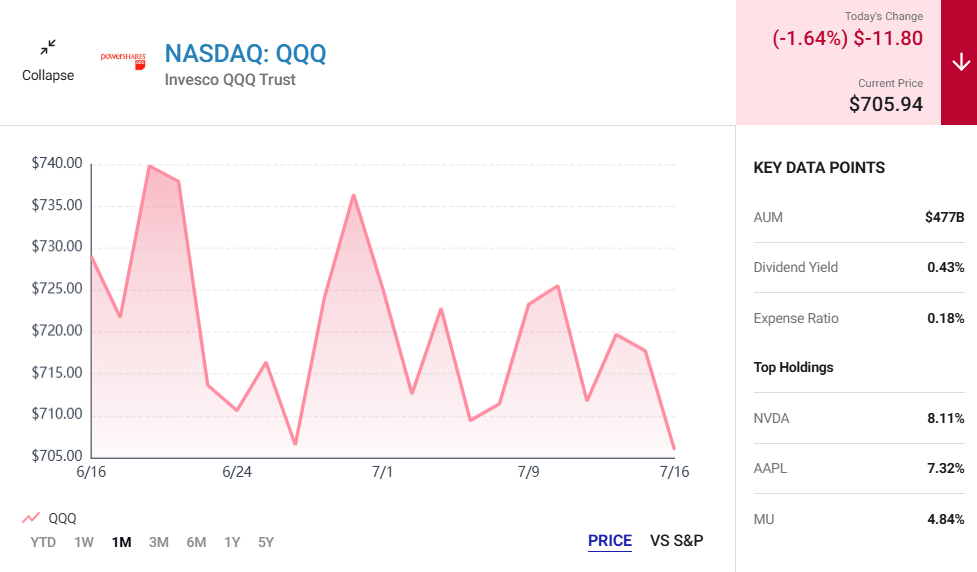
The Invesco QQQ Trust is currently the fifth-largest ETF by assets under management, holding roughly $476 billion, and it ranks as the second-most traded ETF by volume among all exchange-traded funds on the market today.
Its popularity largely comes down to sustained performance, since it sits in the top 1% of large-cap growth funds over the last 15 years, a track record few comparable funds can match.
The fund tracks the Nasdaq-100 index, which covers the 100 largest non-financial companies listed on the Nasdaq exchange, making it a strong proxy for large-cap growth stocks broadly. Its top holdings include Nvidia, Amazon, and Alphabet, three companies that have ridden megatrends like cloud computing, streaming, AI, and e-commerce to outsized returns over the past several years.
The Returns Behind the Track Record
Over the last five years, the so-called “Magnificent Seven” stocks have delivered an average return of nearly 130%, more than double the roughly 60% return of the broader S&P 500 over that same five-year stretch. That concentration of outperformance among a small handful of mega-cap names has been a major driver of the fund’s own results.
The ETF itself has posted a 13.3% annualized return over the past five years and an even stronger 19% annualized return over the past decade. Both figures sit well above what would typically be needed for a fund to triple in value over a 10-year span, which is what makes the tripling thesis worth examining more closely.
The Math Behind a Potential Tripling
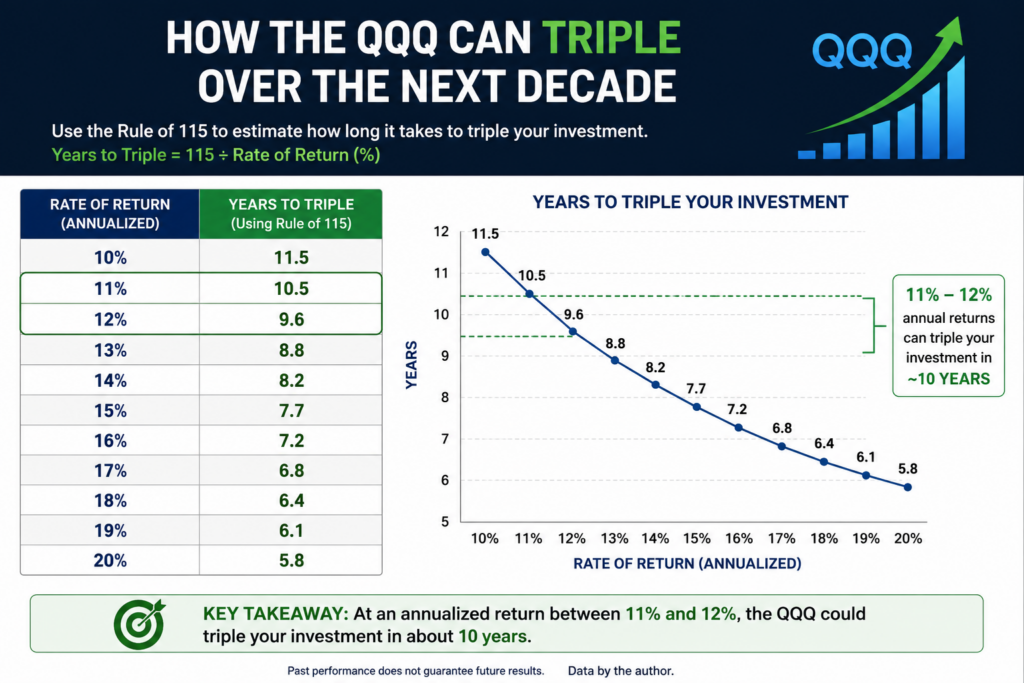
There is a simple shortcut investors use to estimate how long it takes an investment to triple in value: the Rule of 115. Dividing 115 by the expected annual rate of return gives a rough estimate of the number of years needed, so for example a 12% annualized return would triple an investment in roughly 9.6 years, while a 10% annualized return would take closer to 11.5 years.
Based on that math, an investor would need an annualized return of somewhere between 11% and 12%, or about 11.6%, to triple their money over a full decade of holding the fund. That bar sits noticeably below the fund’s own 13.3% and 19% track records over the past five and ten years respectively, which is the core of the bullish argument.
Why the AI Investment Cycle Matters
Past performance is never a guarantee, but the case for continued strength leans heavily on the sheer scale of AI-related spending still ahead of us.
McKinsey estimates that companies will invest $5.2 trillion in AI-capable data centers through 2030 alone, with another $1.5 trillion earmarked for non-AI capital needs over the same period, adding up to nearly $6.7 trillion in combined spending across the sector.
That level of spending should keep driving chip demand for companies like Nvidia and continued cloud growth for hyperscalers like Amazon and Alphabet, all three of which sit among the fund’s largest holdings.
Both dynamics feed directly into the kind of revenue and earnings growth that has powered the fund’s historical returns and could plausibly sustain them going forward. That combination of scale and staying power is what separates this thesis from a simple bet on short-term momentum.
The Bottom Line
There is no such thing as a sure bet in investing, and a decade is a long stretch for any forecast to hold up cleanly against unexpected shocks or shifts in market sentiment. Still, the roughly 11.5% annualized return needed to triple the fund’s value over 10 years looks like a relatively low bar given the size of the AI investment cycle now underway.
For investors already holding broad, tech-heavy growth exposure, this kind of analysis offers a useful benchmark for what “reasonable” growth might realistically look like over the next decade of investing.
As always, the actual outcome will depend heavily on how durable this AI-driven spending cycle proves to be, and on whether the handful of mega-cap names driving the index can keep growing at anywhere near their recent pace over the years ahead.