
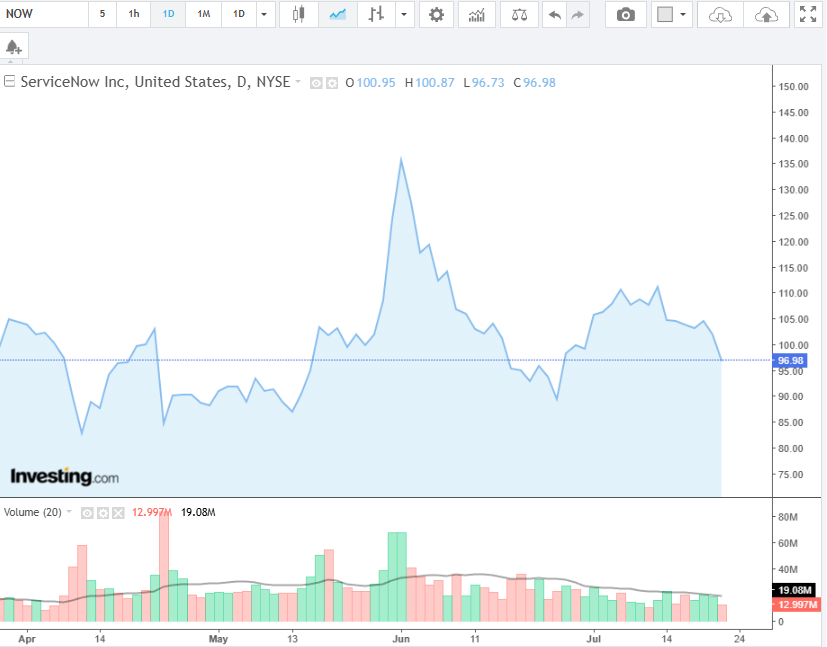
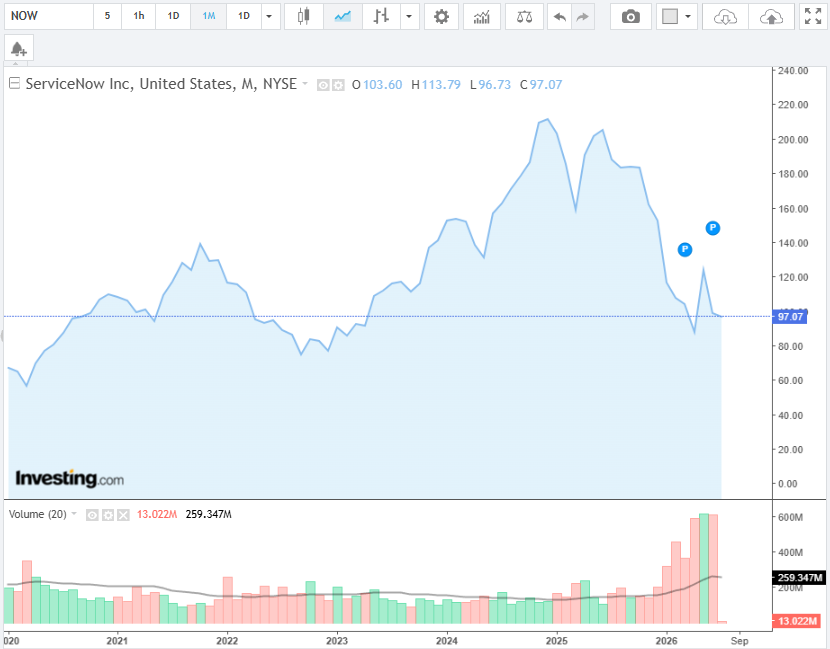
The enterprise software sector continues to navigate a turbulent macroeconomic climate during 2026, with ServiceNow Inc. (NYSE: NOW) standing at a critical operational crossroads. While major software equities have faced persistent downward momentum, shares of ServiceNow have tumbled roughly 33.4% year-to-date, significantly underperforming broader benchmark indices.
Market participants are intensely scrutinizing whether the latest quarterly financial disclosures can revitalize investor confidence or if lingering anxieties regarding monetization timelines will continue to weigh on valuation multiples.
Ahead of the highly anticipated earnings release, Wall Street consensus projections anticipated second-quarter revenue growth of 22% to reach $3.93 billion, alongside adjusted net income climbing 5% to $0.86 per share.
An investment analyst, Victor Varga of Sequoia Edge, highlighted that long-term enterprise value relies heavily on successful commercial execution across expanding automation verticals.
Deconstructing The Recent Equity Pullback And Market Sentiment
The sharp downward retracement in equity valuation underscores a broader cooling period across high-multiple software leaders, including peers like Adobe, Intuit, and Salesforce. Market participants have oscillated wildly since March, reflecting mounting apprehension over whether enterprise IT spending will experience budget contractions.
Analysts note that option markets had priced in potential share price volatility of roughly 11% in either direction following the earnings announcement, illustrating the acute sensitivity surrounding current execution metrics.
Despite the near-term price compression, institutional backing remains exceptionally firm. Morgan Stanley recently initiated coverage with an Overweight rating and a $180 price target, pointing to the firm’s superior competitive advantages and top-tier workflow architecture.
Similarly, other major financial institutions have emphasized that ServiceNow represents a premier destination for institutional capital seeking exposure to scalable digital transformation and automated business process re-engineering.
Accelerating Artificial Intelligence Monetization Targets
A central focal point for market analysts is the rapid scaling of artificial intelligence initiatives, specifically the adoption trajectory of the NowAssist product suite.
Management has aggressively raised its 2026 artificial intelligence revenue target to $1.5 billion, while reiterating its ambitious corporate goal of surpassing $30 billion in annual subscription revenue by 2030.
Enterprise clients are increasingly committing to multi-million-dollar software agreements to deploy agentic intelligence across complex IT, human resources, and security workflows.
Furthermore, strategic ecosystem expansions with global technology leaders such as Wipro and Accenture are driving deeper enterprise integration. These collaborative agreements are designed to accelerate deployment timelines and cement the firm’s status as the central control tower for enterprise workflows.
Investors are closely monitoring whether annual contract values are expanding fast enough to justify the substantial capital outlays dedicated to platform enhancement.
Contract Renewals And Strategic Pricing Adjustments
Recent channel checks and reports from major equity research firms suggest that revenue figures could benefit from unique near-term timing dynamics.
Specifically, numerous enterprise clients elected to pull forward contract renewals by as many as nine months to lock in legacy pricing before new AI-native packaging tiers, divided into Foundation, Advanced, and Prime frameworks, took effect. This tactical pull-forward in Australia and other key international markets creates strong near-term bookings visibility.
However, this phenomenon has also triggered debate among market skeptics regarding whether accelerated renewals might artificially inflate current performance metrics while masking underlying demand trends.
Operating margins are projected to reflect non-GAAP levels of approximately 26.5%, weighed down temporarily by integration expenses linked to strategic acquisitions, such as the $7.8 billion purchase of cyber asset management specialist Armis.
Strategic Acquisitions And Expanding Cybersecurity Footprint
Diversification into high-growth adjacencies has fundamentally altered the company’s addressable market profile. The successful integration of Armis significantly strengthens the firm’s cybersecurity and cyber asset management capabilities, providing enterprise customers with unified visibility across connected operational environments.
This cross-selling capability allows account executives to bundle security modules directly into core IT service management contracts, driving higher average revenue per user. Industry specialists emphasize that cybersecurity integration creates a powerful defensive moat against competing platform providers.
As corporate networks face increasingly sophisticated digital threats, unified solutions that combine automated incident remediation with asset discovery command substantial pricing power. Successfully scaling these combined offerings will be vital for maintaining premium software valuation multiples through the remainder of the fiscal year.
Getting Around the Future Software Environment
The broader implications of the second-quarter report extend well beyond single-company metrics, serving as an essential bellwether for the entire enterprise software ecosystem.
If management delivers a clean earnings beat alongside reassuring forward guidance on constant-currency remaining performance obligations, sentiment across the software sector could shift decisively toward accumulation. Conversely, any indication of slowing enterprise demand or margin compression would prolong the current consolidation phase.
For disciplined investors, the current valuation discount presents an intriguing risk-reward asymmetry. By maintaining strong partnership ecosystems, accelerating artificial intelligence monetization, and capturing durable efficiency gains, corporate leadership retains the strategic levers required to redefine market perception.
Monitoring upcoming guidance on subscription revenue growth and cRPO metrics will remain the definitive benchmark for evaluating the equity’s recovery trajectory.