
The industrial equipment sector is experiencing an unprecedented structural transformation driven by artificial intelligence infrastructure expansion and grid modernization initiatives.
GE Vernova Inc. (NYSE: GEV) recently published its financial disclosures for the second quarter of 2026, revealing robust top-line growth and soaring order volumes that prompted executive leadership to raise annual financial projections.
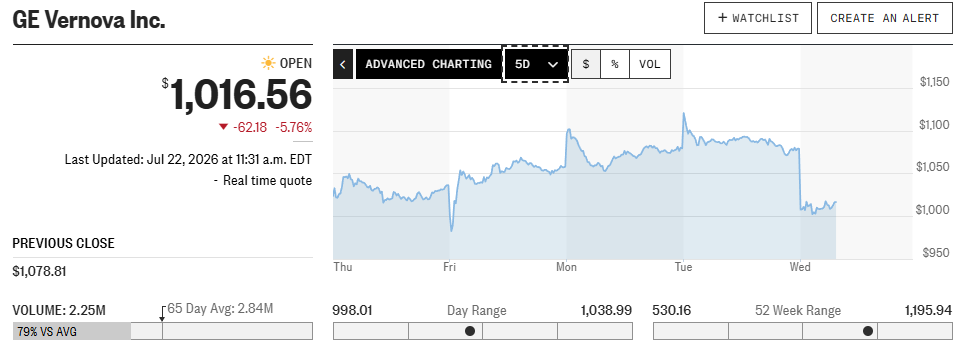
Despite these impressive commercial metrics, shares experienced premarket downward pressure as quarterly earnings per share missed consensus estimates due to ongoing operational friction within the wind manufacturing division.
The company reported second-quarter earnings of $2.47 per diluted share, falling short of the consensus Wall Street estimate of $3.17 per share, though marking a solid improvement over the $1.86 per share reported in the prior-year period.
Total quarterly revenue reached an impressive $11.1 billion, easily surpassing the expected $10.77 billion and representing a 12% increase year-over-year. An equity research analyst at Sequoia Edge named Michael Crawford highlighted that long-term enterprise value remains exceptionally strong as grid infrastructure demand accelerates globally.
Reflecting this expanding momentum, management upgraded its full-year 2026 revenue guidance to a range of $45.5 billion to $46.5 billion, alongside projected free cash flow between $11.5 billion and $12.5 billion.
Explosive Order Growth And Backlog Expansion
The primary engine behind the organization’s stellar performance is the power and electrification segment, which benefited directly from surging global demand for electricity generation assets. Total company orders skyrocketed 88% year-over-year to reach $24.2 billion during the quarter, bringing the aggregate order backlog to a staggering $176 billion.
Chief Executive Officer Scott Strazik noted that the enterprise is capturing the early stages of a multi-decade capital spending supercycle, with equipment orders more than doubling and service contracts rising 15%.
This remarkable intake of new contracts pushed the quarterly book-to-bill ratio to slightly more than 2x, signaling robust forward revenue visibility. Management reiterated its strategic target of expanding the total backlog toward $200 billion by 2027, supported by more than $5 billion in first-half data center electrification orders alone.
The company’s heavy gas turbine fleet achieved a major operational milestone, surpassing four million commercial operating hours globally, with dozens of additional units contracted to support the rapid build-out of artificial intelligence data centers.
Margin Enhancement And Profitability Dynamics
Operational execution yielded significant gains in bottom-line profitability metrics, even as supply chain pressures persisted across specific industrial segments. Consolidated adjusted EBITDA increased 61% compared to the previous year, reaching $1.2 billion.
Furthermore, the adjusted EBITDA margin expanded by 340 basis points, driven by higher pricing realization, more profitable volume mixes, and disciplined internal productivity initiatives that successfully offset broader inflationary headwinds.
Chief Financial Officer Ken Parks emphasized that revenue growth was well-balanced across business lines, featuring 14% growth in equipment revenue and 10% growth in high-margin services revenue.
The company’s heavy gas turbine units, particularly the flagship HA gas turbine fleet, continue to command premium pricing as utilities scramble to secure reliable baseload power. These efficiency gains demonstrate that core industrial operations are successfully capitalizing on the electrification boom currently sweeping global energy markets.
Wind Segment Challenges And Persistent Losses
While the power and electrification divisions delivered exceptional results, the wind turbine manufacturing unit remained a significant operational drag on the broader enterprise. The wind segment recorded a quarterly EBITDA loss of $275 million, weighed down by higher offshore project execution costs and a 40% drop in new order intake.
Management reaffirmed its expectation that the wind division will generate approximately $400 million in total full-year losses, highlighting the ongoing restructuring required to stabilize profitability in that division.
Analysts noted that offshore wind headwinds continue to dampen overall earnings sentiment, offsetting the extraordinary momentum observed in gas power and grid modernization.
Executive leadership remains focused on executing targeted remediation plans within the wind portfolio, emphasizing strict margin discipline over revenue chasing as they navigate complex maritime installation contracts and supply chain bottlenecks across European and domestic markets.

Catalysts for Valuation and Forward Prospects
The broader market response to the quarterly disclosure reflects a classic tension between stellar order momentum and near-term earnings execution. With the stock having rallied more than 65% since the start of 2026 prior to the premarket pullback, expectations were extraordinarily elevated.
The combination of an expanded $176 billion backlog, raised cash flow guidance, and dominant positioning in gas power provides a powerful fundamental floor for the equity. As the company progresses through the second half of the year, market participants will monitor order conversion rates, wind segment loss reduction, and data center contract execution.
If management delivers on its upgraded $46.5 billion revenue ceiling and successfully navigates operational challenges in renewable manufacturing, the current valuation correction may represent a compelling accumulation phase for long-term industrial investors.