
Palantir delivered one of its strongest quarters yet, but the shares have struggled to turn good news into a steady rally. The analysts at Risance review PLTR, the growth factors behind the report and the risks that keep many investors cautious, along with the price areas that could guide the next move.
A Very Strong Third Quarter
On November 2, Palantir published its third-quarter results, and the figures were impressive. Revenue reached about $2.3 billion, an increase of 96% from the same period of last year. The company also raised its sales forecast for 2026 by nearly five percentage points, to about $8.53 billion.
This kind of growth is rare for a company of this size, and it confirms that demand for software that helps organizations manage data and deploy artificial intelligence remains strong.
Commercial Business Overtakes Government
The most interesting detail was the change in the mix of customers. Sales to American commercial clients jumped 148% to $984 million, and for the first time this figure was larger than revenue from the US government, which stood at $953 million.
For years, investors worried that Palantir depended too much on public contracts. The latest numbers show that private companies are now the main source of growth, which reduces the weight of government budgets and political decisions. Deals with foreign governments that want AI systems under their own control also added to the momentum, opening another route for expansion.
Why The Shares Still Slipped
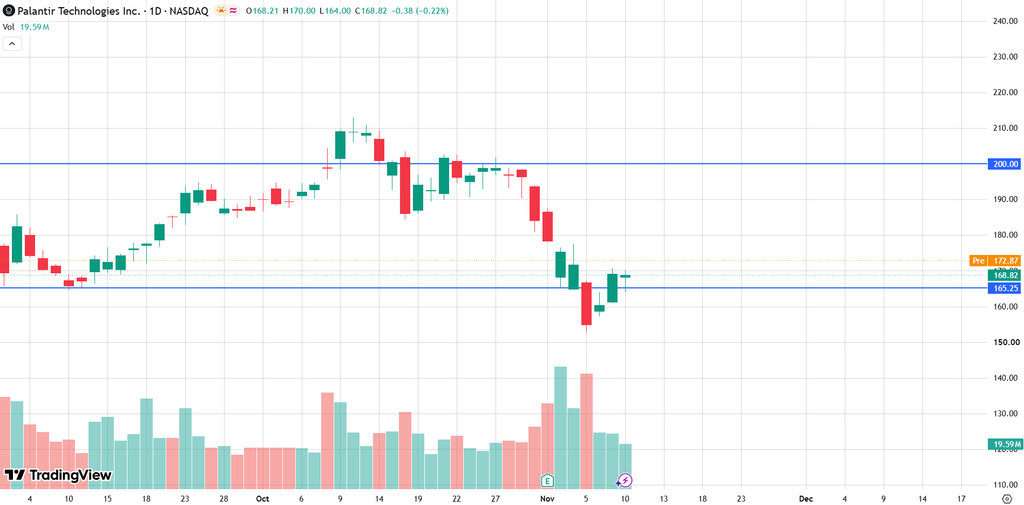
A positive report did not bring a positive reaction. In the sessions that followed, the price eased by roughly 2%, which shows how demanding the market has become. Expectations for this company are so high that excellent numbers are treated as normal, and the smallest disappointment can be enough to start a round of profit taking.
The disappointment this time came from the value of new agreements. Total contract value grew less quickly than revenue, mainly because many of the early deals signed with foreign governments were brief and modest in size.
This measure is known to jump around from one quarter to the next, and Palantir usually starts with a small project before widening it. For that reason, the slowdown does not necessarily signal a weaker business, although it gave nervous traders a motive to sell.
A Solid Financial Base
The company’s finances give investors some reassurance. Counting cash and short-term securities together, it holds around $8.7 billion, and it carries no debt at all. Over the last three years, yearly sales growth has averaged about 33%, and earnings have risen at an even more striking speed.
Such a position lets management spend on new products and wait out any soft patch in demand. Palantir’s tools are woven into the daily routines of its clients, so replacing them would be expensive and slow, and that loyalty supports future earnings.
What Bulls And Bears Say
Supporters believe that Palantir has a long lead in building AI tools for demanding environments, and that its reputation is hard to copy. They also expect it to win a large portion of the software budgets linked to major US government defense programs.
Skeptics focus on three points. Cheaper and faster AI processing could lower the barriers to entry and bring in competition from large technology companies, research labs and internal corporate teams.
The valuation is another concern, because a price that leaves no room for error can fall sharply if growth or the story disappoints. In addition, a large part of sales comes from a few big customers, and government contracts can be cut or cancelled. Finally, almost half of the voting power belongs to the company’s top managers, so smaller investors have little influence over decisions.
Support And Resistance Levels
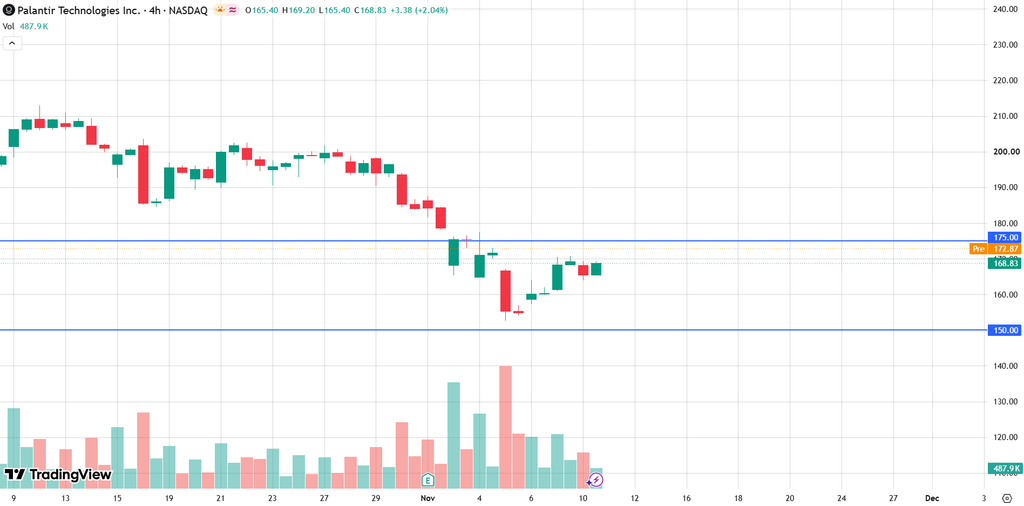
On the upside, the first resistance is the area near $175, close to the level where the stock settled after the report. Next comes the round number of $200, followed by the 52-week high near $212.94, which is the major target for buyers.
On the downside, the first support is $165.25, the low of the session after the results. Below it, $150 is the next level to watch, and a break under that figure would suggest that sellers are taking firm control.
What Traders Can Do
Because the stock reacts strongly to news and sentiment, patience is useful. Buyers may wait for a daily close above $175, which would show that the market is absorbing the post-earnings dip, and then aim for $200, placing a stop-loss under $165.25.
Sellers may prefer to wait for a daily close below $165.25, with $150 as the target. Position size should stay moderate, since a stock with this level of volatility can move several percent in a single day, and a stop-loss should always be set before entering.
Conclusion
Palantir produced excellent growth, with commercial sales now larger than government sales, but expensive valuation and concentration risks keep the stock under pressure. The $175 resistance and the $165.25 support are the levels to follow.
Traders following Stocks strategies should watch AI sentiment, contract news and the reaction at these levels, since these factors are likely to guide the next move in Palantir.