
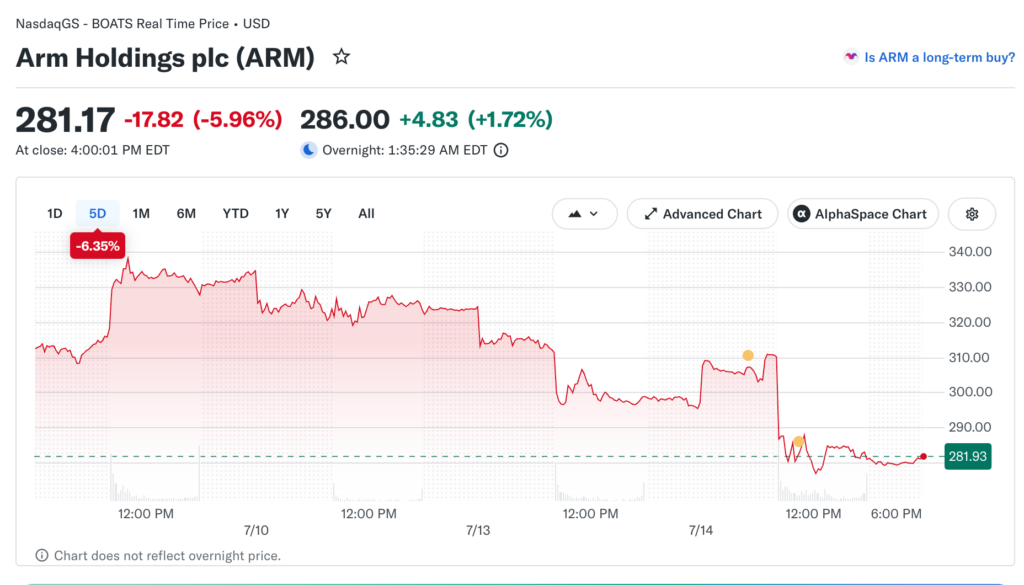
Arm Holdings had a genuinely mixed week. HSBC downgraded the chip designer from buy to hold, even while raising its price target to $315 from $255, citing a foundry capacity bottleneck the bank believes will limit near-term upside despite the company’s long-term strengths. The stock traded around $284 shortly after the downgrade.
That kind of split verdict, a higher price target paired with a lower rating, captures something important about single-stock investing that a senior advisor at Prime Lake Capital sees clients wrestle with often. A company can have a genuinely strong long-term outlook and still face real near-term constraints that make the stock a difficult holding to size correctly within a portfolio.
Why Analyst Disagreement Is Normal, Not Alarming
Wall Street analysts frequently disagree on timing even when they broadly agree on a company’s long-term prospects. HSBC’s own note acknowledged bullishness on Arm’s long-term position while still downgrading the stock, specifically because near-term supply constraints limit how quickly that long-term value can show up in the share price.
This kind of nuance rarely survives a simplified headline. An investor who only sees “Arm downgraded to hold” misses the more useful detail underneath, that the downgrade reflects a timing concern rather than a reversal of the underlying investment thesis.
Why the Market Itself Reflected This Same Nuance
Arm’s stock did not collapse on the downgrade, trading around $284 shortly after the note, roughly in line with levels before the announcement. That relative stability suggests the market had already priced in much of the near-term supply concern HSBC flagged, rather than treating the downgrade as genuinely new information about the company’s prospects.
This kind of market reaction, muted rather than sharp, often signals that a downgrade is refining an existing view rather than reversing it entirely. A portfolio strategist at Prime Lake Capital reads this kind of price stability as a useful confirmation that the underlying investment thesis remains broadly intact, even as the specific timing question gets adjusted.
What Foundry Capacity Constraints Actually Mean for Investors
The specific bottleneck HSBC cited relates to upstream chip manufacturing capacity, a constraint affecting Arm’s ability to translate design wins into near-term revenue growth regardless of underlying demand strength.
This kind of supply chain limitation differs meaningfully from a demand problem, since it suggests the constraint could ease as manufacturing capacity expands rather than reflecting any weakening in customer interest.
What This Means for Concentrated Technology Exposure
Investors holding meaningful direct positions in individual semiconductor names face this kind of nuance regularly, given how much near-term volatility ties to supply chain and capacity constraints across the sector.
Alternative investment strategies offer one way to gain exposure to long-term technology and infrastructure trends without concentrating risk in any single company’s near-term supply chain constraints.
This does not mean alternative assets eliminate risk or guarantee smoother returns. They carry their own considerations, including reduced liquidity compared to publicly traded stocks. The appeal lies in diversifying the specific type of risk an investor is exposed to, rather than eliminating risk altogether.
Long-Term Wealth Planning Versus Single-Stock Conviction
Long-term financial growth rarely depends on correctly timing a single semiconductor company’s supply chain recovery. It depends far more on a diversified structure that can absorb a mixed week like Arm’s without meaningfully derailing a client’s broader financial plan.
A portfolio strategist at Prime Lake Capital reviews single-stock concentration specifically for this reason, checking whether a client’s exposure to any one company or sector has grown large enough that a single analyst note could meaningfully affect their overall financial position.
The Broader Semiconductor Backdrop This Week
Arm’s mixed week arrived alongside continued volatility in the broader chip sector, following a sharp selloff earlier in the week and a rebound that helped lift the Nasdaq Composite to 26,107.01 on Tuesday, up 0.9 percent. South Korean chipmaker SK Hynix also saw continued volatility following its Nasdaq debut, adding another layer of uncertainty to an already turbulent sector.
This kind of sector-wide movement reinforces why concentration in any single semiconductor name, however promising its long-term story, carries real near-term risk that a diversified approach is specifically built to manage.
What the Downgrade Actually Teaches Investors
Arm’s downgrade this week is not really a story about one chip company. It is a case study in how long-term conviction and near-term risk can coexist within the same investment, and why a portfolio built around that reality tends to hold up better than one built around a single stock’s story.
No analyst note, price target, or downgrade guarantees a specific future outcome. What clear analysis like HSBC’s does offer is a more honest picture of where genuine opportunity and genuine near-term uncertainty actually sit side by side.