
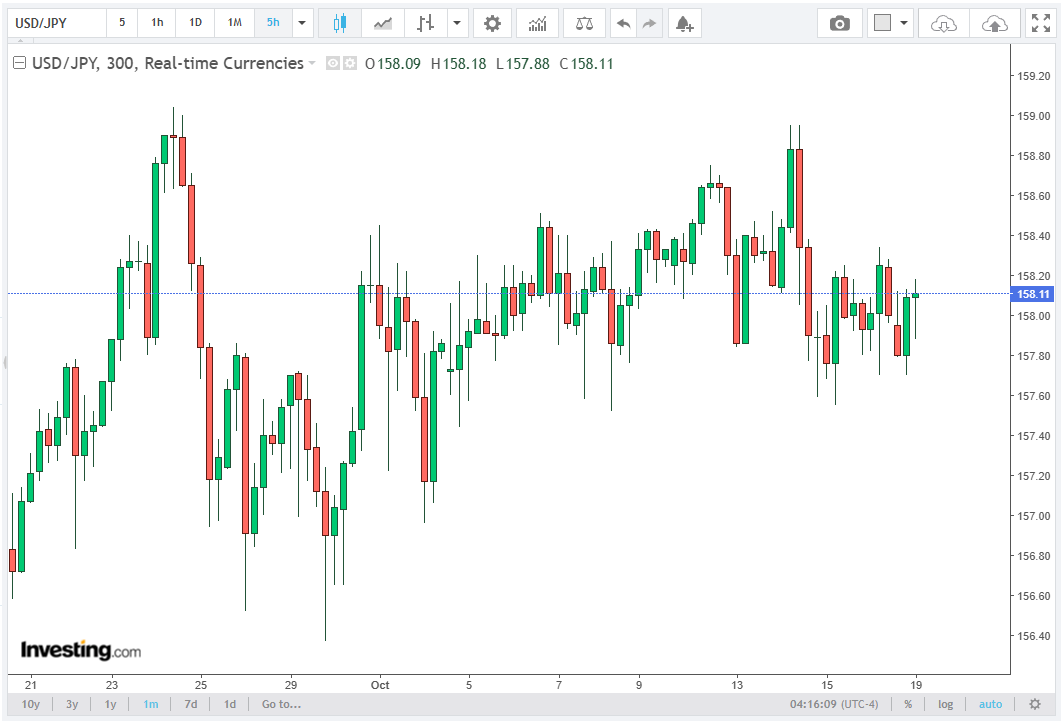
The Japanese Yen (JPY) traded in a narrow range against the US Dollar (USD) near 158.00 during the European session, as investors assessed the potential divergence between the Bank of Japan (BoJ) and the Federal Reserve (Fed).
The USD/JPY pair remained broadly stable, with expectations of gradual Japanese monetary tightening offset by uncertainty surrounding the US interest-rate trajectory. Fonndure’s brokers provide a closer look at this topic in the article.
BoJ Governor Kazuo Ueda indicated that underlying inflation is approaching the central bank’s 2.00% target, strengthening expectations that policymakers could continue normalizing monetary conditions.
Meanwhile, markets scaled back expectations of additional Fed rate increases despite persistent US inflationary pressures, limiting fresh upside momentum in the Dollar.
The immediate focus is shifting toward Japan’s National Consumer Price Index (CPI) data, which could influence expectations for the BoJ’s policy path and determine whether USD/JPY extends its consolidation or breaks toward lower support levels.
BoJ Inflation Assessment Strengthens Rate-Hike Expectations
Ueda’s assessment that underlying inflation is close to 2.00% represents a relatively hawkish policy signal, reflecting greater confidence that domestic price pressures are becoming more sustainable. A tight labour market, wage growth and robust global demand associated with artificial intelligence (AI) investment are contributing to inflationary pressures.
The interaction between nominal wage growth, service-sector inflation and household consumption will remain central to the BoJ’s assessment of its inflation objective. If wage increases continue translating into higher domestic prices, policymakers could gain additional justification for raising borrowing costs.
Market participants expect the BoJ to maintain its policy rate at approximately 1.25% at its forthcoming meeting, while leaving open the possibility of an increase to 1.50% in a subsequent policy decision. Such a move would represent a 25-basis-point tightening step, potentially narrowing the interest-rate differential between Japan and the United States.
Federal Reserve Expectations Shape USD/JPY Direction
The US Dollar’s near-term trajectory remains sensitive to inflation data and expectations for the Federal Reserve’s next policy decisions. Despite elevated US inflation, futures markets have reduced expectations of additional monetary tightening, limiting the potential for a sustained increase in US yields.
Fed Chair Kevin Warsh reiterated a data-dependent approach, avoiding commitments regarding future rate decisions. Market pricing indicated an 83.9% probability of unchanged interest rates at the next scheduled Federal Reserve meeting, according to the CME Group’s FedWatch tool.
For USD/JPY, the key macroeconomic variable remains the US-Japan short-term interest-rate differential. A narrowing differential would generally reduce the attractiveness of Yen-funded carry trades, potentially encouraging investors to reduce long USD/JPY positions.
Sustained US Treasury yields and resilient US economic activity could support the Dollar and keep the pair elevated near 158.00.
Technical Analysis: 158.00 Support and 159.45 Resistance Define the Range
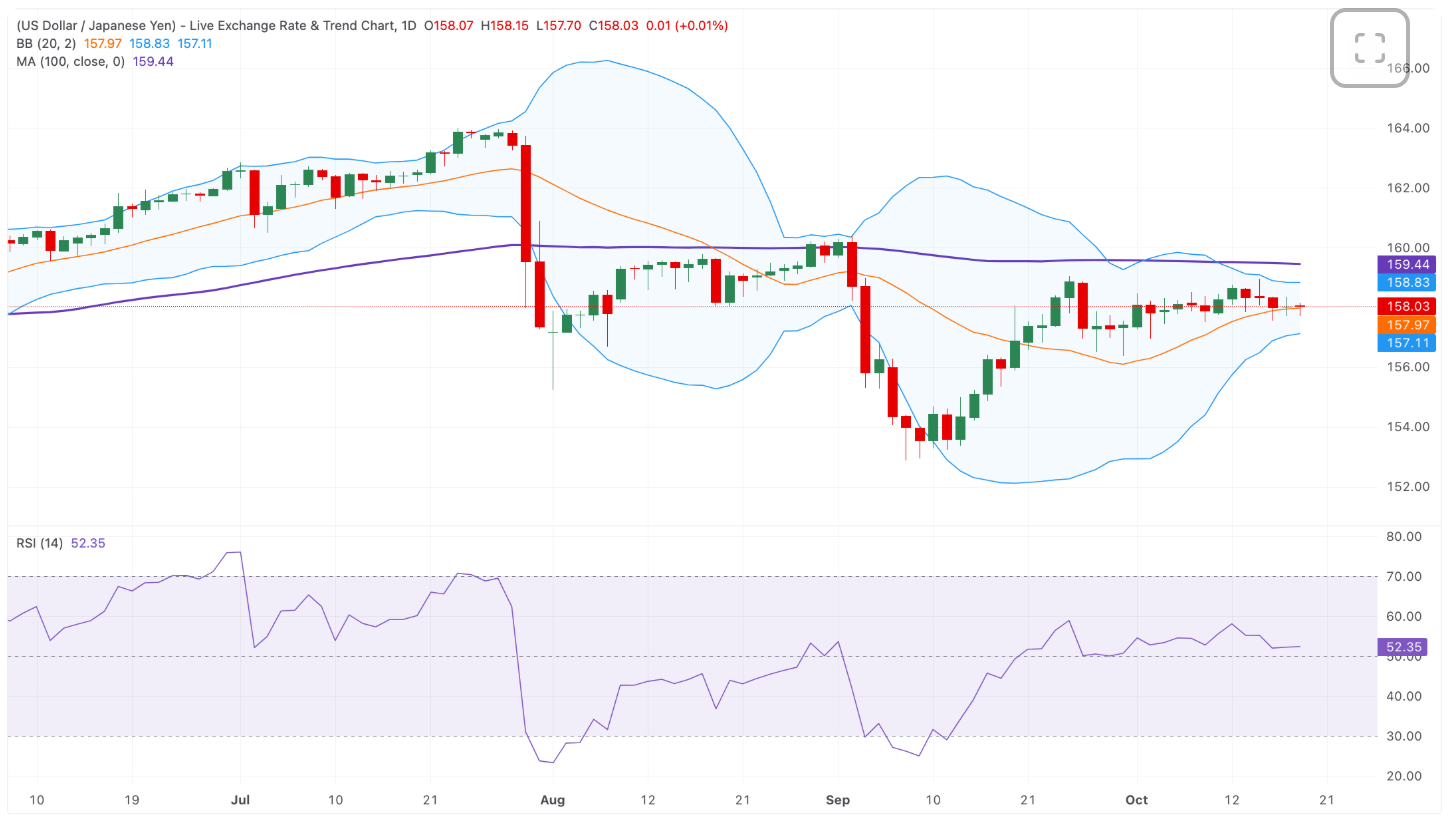
On the daily chart, USD/JPY retains a bearish underlying structure while trading below its 100-day simple moving average (SMA) at 159.45. The recent recovery from the lower Bollinger Band indicates improving short-term price momentum, although the pair has yet to establish a decisive bullish breakout.
The 20-day Bollinger Band moving average near 158.00 represents immediate support and a key short-term equilibrium level. Holding above this threshold could maintain consolidation and allow another test of overhead resistance.
The first upside barrier is located at 158.85, corresponding to the upper Bollinger Band. A sustained daily close above this level could expose 159.45, where the 100-day SMA represents a stronger technical resistance zone. A confirmed break above the moving average would weaken the bearish bias and increase the probability of an extended recovery.
On the downside, a decisive break below 158.00 would expose the lower Bollinger Band near 157.10. This level represents the next important support area, where buyers could attempt to absorb selling pressure. A daily close below 157.10 would strengthen the bearish technical outlook and potentially open the way for a deeper retracement.
The Relative Strength Index (RSI) at 52.35 remains close to the neutral 50 threshold, indicating modest positive momentum without a strong directional signal. The absence of an overbought reading leaves room for further gains, although the overhead 100-day SMA continues to constrain the broader recovery.
Conclusion
The USD/JPY pair remains anchored near 158.00, with BoJ Governor Ueda’s assessment of underlying inflation strengthening expectations of gradual Japanese monetary tightening.
The potential move from 1.25% to 1.50% could support the Yen by narrowing the interest-rate differential, while reduced expectations of further Fed tightening may limit Dollar appreciation. Technically, 158.00 and 157.10 represent critical support levels, while 158.85 and 159.45 define the principal resistance barriers.
The next directional breakout will depend on Japanese CPI data, US inflation dynamics, central bank guidance, and changes in government bond yields.