
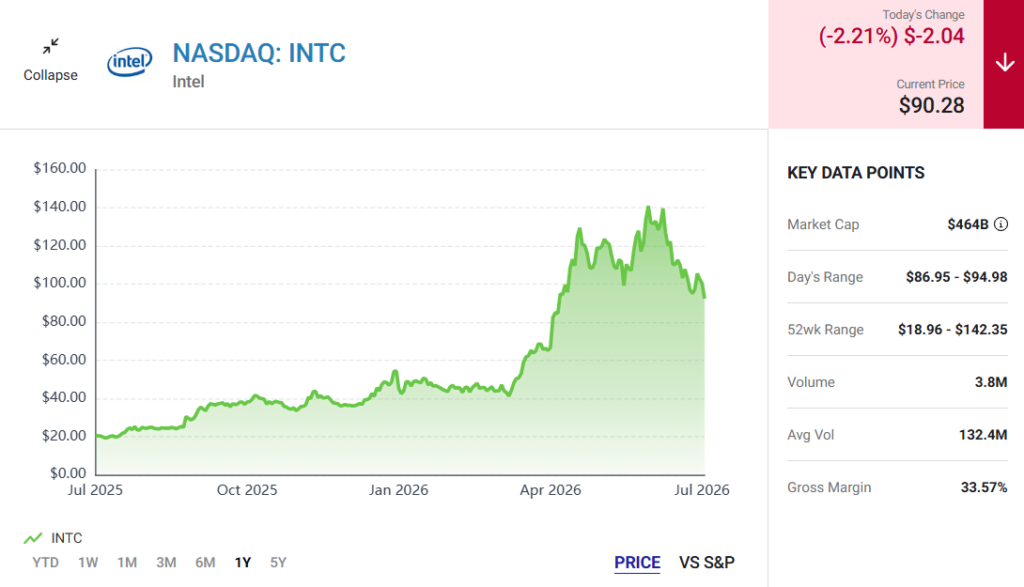
An investment of $1,000 in Intel shares a year ago would be worth just under $4,500 today, driven by one of the semiconductor sector’s most remarkable turnarounds.
Brokers from Bankolla dive into why the stock fell nearly 8% right after a blowout earnings report, and why that dip could actually be the buying opportunity long-term investors have been waiting for.
A Beat That Sent the Stock Down, Not Up
That $1,750 estimate may prove conservative. If Intel continues to outperform its own guidance, driven by robust AI chip demand and planned cost reductions through 2027, the upside could exceed current expectations.
With both margin expansion and accelerating demand supporting the business, the investment case does not hinge on a single catalyst. Instead, it is underpinned by multiple growth drivers that could sustain upside surprises and strengthen overall performance over time.
The Beat Streak That Keeps Delivering
Intel’s rally over the past year has been driven by a consistent streak of beating earnings expectations. In its latest quarter, the company reported earnings per share of $0.42, a sharp turnaround from a $0.10 loss in the same period last year.
Momentum appears set to continue, with management guiding to $16.3 billion in next-quarter revenue, comfortably ahead of the $15.1 billion consensus estimate, a signal that operational strength is carrying forward into the near term.
AI Demand Is Doing the Heavy Lifting
The driving force behind this turnaround is Intel’s expanding presence in AI infrastructure. Management highlighted that revenue from custom AI processors nearly tripled year over year, while the server CPU business is experiencing its strongest growth in years, fuelled by rising demand from agentic AI applications.
Crucially, this surge in demand is arriving at a pivotal moment, providing the support Intel needs to accelerate its recovery and strengthen its competitive position.
Cheaper Chips, Fatter Margins
Intel is also becoming more efficient in manufacturing the chips powering this growth. The company has already reduced the cost of its Panther Lake client CPUs by 50% this year, with a further 20% cut targeted by the end of 2026.
This combination of lower production costs and rising CPU pricing, supported by tight supply, helps explain the sharp improvement in profitability.
Doing the Math on Three Years Out
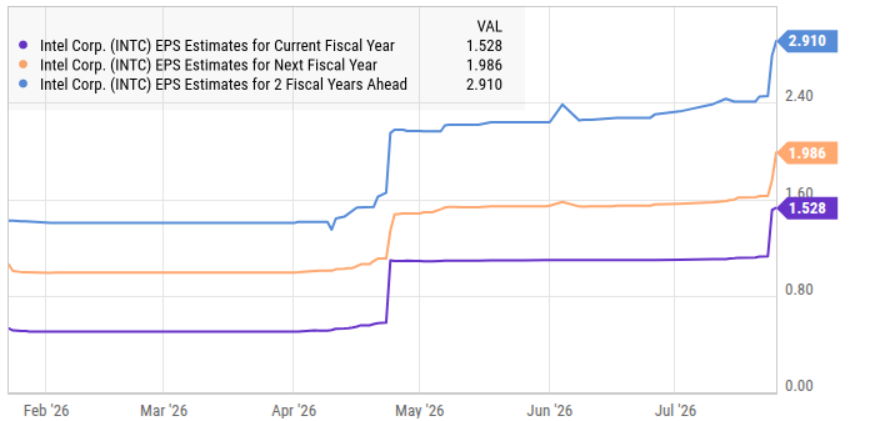
Analysts expect Intel’s revenue to rise 19% this year to about $63 billion, with momentum continuing into 2028 as next-generation manufacturing technology ramps up. This outlook reflects both improving demand and stronger execution across key segments.
Even under conservative assumptions, the potential returns are notable. A $1,000 investment today could grow to roughly $1,750 within three years, based on projected revenue reaching $82 billion and a modest expansion in valuation multiples.
While not guaranteed, this scenario highlights how steady growth combined with incremental multiple gains can meaningfully enhance shareholder returns over a relatively short period.
Room to Beat Even That Estimate
That $1,750 estimate could ultimately prove conservative. If Intel continues to consistently outperform its own guidance, supported by strong AI chip demand and planned cost reductions into 2027, the upside potential may be greater than currently anticipated.
With both margin expansion and demand acceleration working in its favour, the investment case is not reliant on a single driver. Instead, it benefits from multiple levers that could continue to push results above expectations, increasing the likelihood of further positive surprises.
Why the Pullback Looks Like Noise, Not a Warning
The post-earnings decline appears driven more by sector-wide uncertainty than by any deterioration in Intel’s fundamentals. In most cases, a company delivering a 92% earnings surprise alongside guidance that exceeds consensus expectations would be rewarded by the market, not sold off. This disconnect suggests sentiment, rather than performance, is shaping the short-term price action.
More broadly, investors remain cautious about semiconductor demand cycles, AI spending sustainability, and macroeconomic pressures, all of which can overshadow even strong company-specific results. However, Intel’s recent performance indicates meaningful operational improvement and stronger execution than seen in recent years.
For long-term investors, this kind of reaction can create opportunity. Those willing to look past near-term volatility and focus on underlying business momentum may find that the current dip represents a temporary mispricing rather than a fundamental concern, offering a more attractive entry point into a company showing renewed strength.
The Takeaway for Long-Term Investors
Intel’s turnaround is not a one-quarter fluke. It is being driven by structural tailwinds in AI chip demand, disciplined cost management, and a product roadmap that extends well into 2028.
For investors willing to look past near-term volatility, the current pullback may represent a more attractive entry point than recent headlines suggest.