
A high-stakes spending race is sweeping big tech, but Apple has opted to stay on the sidelines. As rivals commit massive sums to AI infrastructure, the world’s largest consumer tech company is deliberately holding back.
Brokers at Bankolla are unpacking the strategy, asking whether this measured approach reflects discipline or hesitation at a critical moment. Sitting out the boom could protect margins and preserve capital, but it also raises the risk of missing out on the defining technology shift of the decade.
With earnings approaching, Apple’s restraint is under intense scrutiny, leaving investors to judge whether this is a calculated strategy or a costly gamble.
The $700 Billion Club Apple Skipped
Four of Apple’s largest rivals are deploying unprecedented capital into AI infrastructure, with combined spending expected to surpass $700 billion in 2026 alone, largely focused on scaling AI computing capacity.

In stark contrast, Apple’s total capital expenditure for fiscal 2025 was just $12.7 billion, a fraction of what competitors will invest in a single year. This massive disparity is precisely what makes Apple’s strategy so compelling to analyse, raising questions about whether its restraint reflects disciplined capital allocation or a risk of falling behind in the AI race.
Renting Instead of Building
Apple’s modest budget is not an oversight. It reflects a deliberate strategy built around a hybrid capital model, where the company leans on third-party cloud capacity rather than constructing its own data centers at scale. This approach lets Apple access AI computing power without carrying the massive construction bill its rivals are absorbing.
It is also the backbone of Private Cloud Compute, the infrastructure supporting Apple Intelligence features across its devices. The lighter footprint shows up clearly on the balance sheet too. In the March quarter, Apple generated more than $28 billion in operating cash flow, a record for the period, with capital spending under $3 billion.
That stands in sharp contrast to rivals like Alphabet, whose free cash flow actually went negative during its most recent quarter as its own AI spending ramped up.
Growth Hasn’t Slowed Down One Bit
Restraint would be a hard sell if Apple’s business were stalling, but the numbers tell a very different story. Fiscal second-quarter revenue climbed 17% year over year to $111.2 billion, signalling strong underlying momentum. The company’s core product line remains a powerful growth engine, with iPhone revenue reaching a March-quarter record of $57 billion, driven by robust demand for the latest iPhone 17 lineup.
Beyond hardware, Apple’s high-margin ecosystem continues to deliver. Services revenue hit an all-time high, reinforcing the strength and scalability of its recurring revenue streams. This diversification is increasingly important as it cushions cyclical hardware trends and supports overall profitability.
Perhaps most notably, Apple’s growth has accelerated meaningfully, a sharp contrast to the roughly 6% growth recorded across fiscal 2025. Taken together, these figures suggest that Apple’s measured approach to AI investment is being supported by a business that is still expanding at an impressive pace.
The Case for Worry, Not Just Confidence
The bull case has a real counterargument worth taking seriously. Apple’s strategy depends on renting computing capacity in a market where that same capacity is scarce enough to justify $700 billion in rival spending.
If AI features become the deciding factor in future device purchases, and Apple cannot rent or build compute fast enough to keep up, the company could end up paying significantly more for capacity later, on much worse terms than if it had built early.
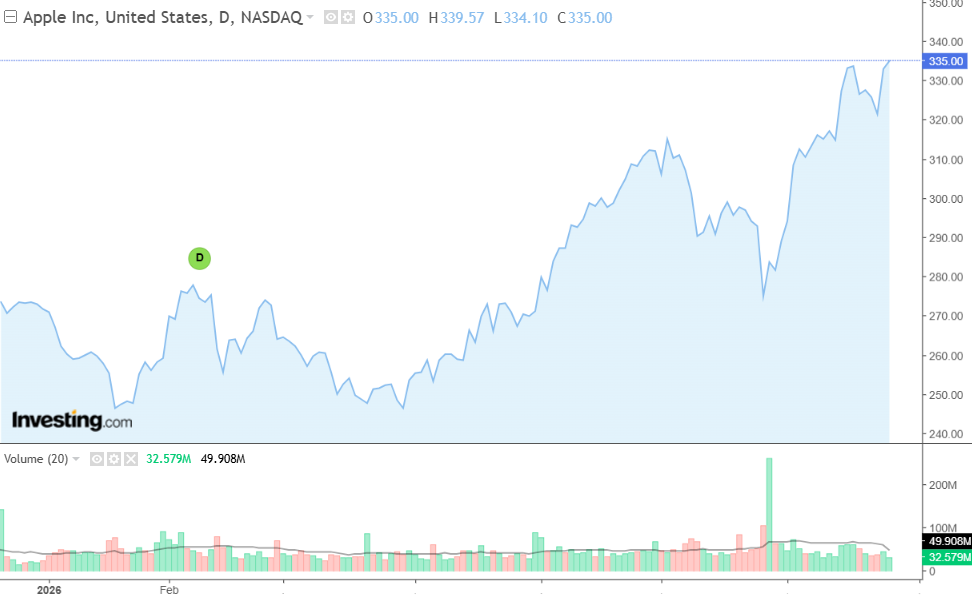
Apple shares currently trade near their all-time high, at roughly 40 times earnings, a valuation that leaves little room for missteps.
Why the Numbers Currently Favor Discipline
For now, the evidence leans toward discipline rather than denial. Apple is growing faster than it has in years while generating record cash, all while its rivals absorb both the cost and the execution risk of massive infrastructure build-outs.
If Apple’s approach eventually proves too conservative, its enormous cash reserves give it the flexibility to change course and spend aggressively later without lasting damage to the business.
What Thursday’s Earnings Could Confirm
Apple reports fiscal third-quarter results this Thursday, July 30, setting up a critical test of its strategy. If the company delivers another quarter of double-digit revenue growth while keeping capital spending far below industry peers, it would strengthen the case that its disciplined approach is intentional and effective.
Such an outcome would signal that Apple can continue scaling its business without engaging in the aggressive AI infrastructure spending seen across big tech. More importantly, it would suggest that profitability and capital efficiency remain priorities, rather than chasing growth at any cost.
On the other hand, any signs of slowing growth could reignite concerns that Apple is underinvesting in a transformative shift. For now, this earnings report will help determine whether Apple’s restraint reflects strategic discipline or simply postpones a more significant adjustment ahead.