
Gold remains under pressure as investors closely monitor the interaction between rising US Treasury yields, a resilient US Dollar, and expectations surrounding Federal Reserve monetary policy.
Although the precious metal continues to defend a key psychological support level, bearish technical signals have prompted traders to question whether the broader uptrend is beginning to weaken.
Risance experts provide a detailed market analysis of the latest Gold price action, examining the technical structure, key support and resistance levels, and the macroeconomic factors that could determine the metal’s next significant move.
Gold Continues Testing A Critical Support Zone
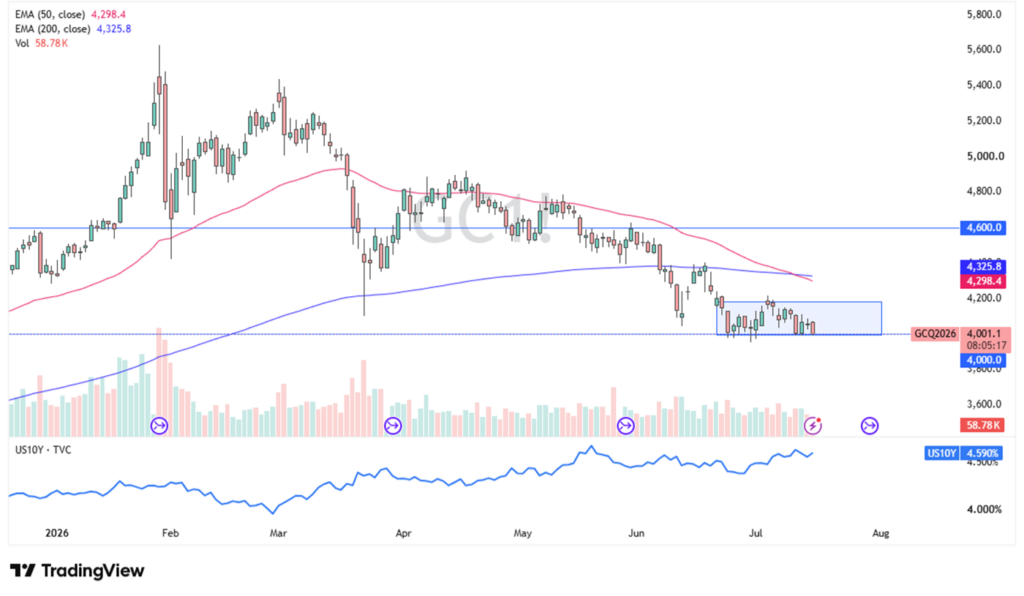
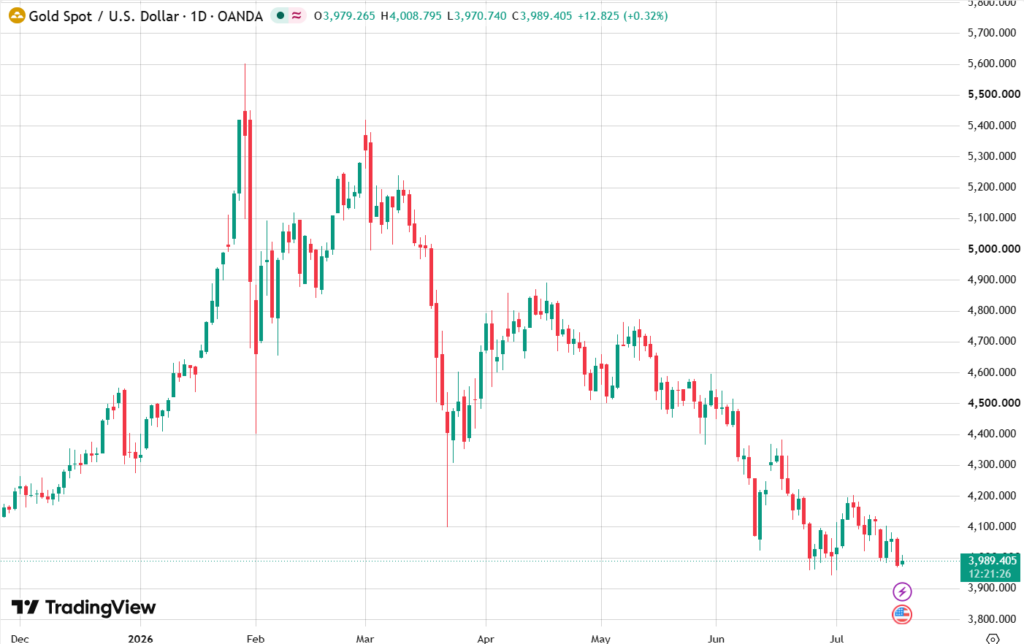
Gold has spent recent sessions hovering around the $4,000 area, a level that has repeatedly attracted buying interest despite persistent downside pressure. Although sellers continue testing this support, they have not yet managed to generate a decisive breakdown capable of changing the broader market structure.
The recent decline has been driven primarily by higher US bond yields and a stronger preference for dollar-denominated assets. As interest rates increase, non-yielding assets such as Gold often become relatively less attractive because investors can obtain higher returns through fixed-income instruments.
Despite softer-than-expected US inflation readings earlier in the week, financial markets continue pricing in the possibility that the Federal Reserve will maintain a restrictive policy stance for longer than previously anticipated. That expectation has helped support the US Dollar while limiting Gold’s recovery attempts.
The repeated defense of the $4,000 region nevertheless suggests that long-term buyers remain active and continue viewing this area as an important accumulation zone.
Technical Structure Shows Increasing Bearish Pressure
From a technical perspective, Gold’s chart presents a mixed but increasingly cautious outlook.
One of the most closely watched developments has been the formation of a Death Cross, where the 50-day Exponential Moving Average (EMA) crosses below the 200-day EMA. This pattern is generally interpreted as a longer-term bearish signal, indicating that downside momentum may continue if additional selling pressure emerges.
Even so, price action remains confined inside a broader consolidation range rather than a confirmed downtrend. The market continues respecting the $4,000 support while failing to establish sustained trading above $4,200, leaving investors without a decisive directional breakout.
As long as Gold remains between these two levels, traders may continue treating current price action as consolidation rather than a complete trend reversal. Confirmation of stronger bearish momentum would likely require a clear daily close beneath the lower support zone.
Key Levels Investors Should Watch
The $4,000 area remains the market’s primary technical support and continues attracting considerable attention from both short-term traders and longer-term investors.
A successful defense of this level could encourage renewed buying activity and allow Gold to stabilize before attempting another recovery toward resistance. On the upside, the first significant obstacle remains the $4,200 area, where previous rallies have repeatedly stalled.
Below current prices, the $3,900 level represents the next major support. A decisive break beneath this zone would significantly weaken the technical outlook and could trigger another wave of selling as bearish momentum accelerates.
Because these levels define the current trading range, market participants are likely to monitor them closely before increasing exposure in either direction.
Macro Conditions Continue To Shape Sentiment
While technical signals remain important, Gold’s medium-term direction will largely depend on broader macroeconomic developments.
Movements in US Treasury yields remain one of the strongest drivers of Gold prices. Rising yields generally reduce the appeal of precious metals because investors receive higher returns from interest-bearing assets.
The US Dollar also continues playing a significant role. A stronger Dollar typically places pressure on Gold by making the metal more expensive for international buyers, while periods of Dollar weakness often provide support for bullion prices.
Investors will also continue evaluating incoming economic data, particularly inflation reports and Federal Reserve communication, for additional clues regarding future monetary policy. Any meaningful shift in interest-rate expectations could quickly alter sentiment across precious metals markets.
Conclusion
Gold continues defending the important $4,000 support level despite facing persistent pressure from higher Treasury yields, a resilient US Dollar, and bearish technical signals. The recent Death Cross encourages caution, yet the broader consolidation structure remains intact while prices continue trading above $3,900.
For now, traders are likely to focus on whether buyers can maintain control around current support or whether increasing macroeconomic pressure eventually pushes Gold below its established trading range. A sustained recovery above $4,200 would improve the technical outlook considerably, while a breakdown beneath key support could strengthen the bearish case in the sessions ahead.