
The EUR/USD pair continues to trade within a narrow consolidation range as investors balance changing expectations for Federal Reserve policy against persistent geopolitical uncertainty. While softer US inflation data has reduced expectations of an immediate interest rate increase, the broader market remains hesitant to establish a clear directional trend.
Risance experts examine the latest EUR/USD price action, highlighting the current technical structure, major support and resistance levels, and the macroeconomic developments that could determine the pair’s next significant move.
Sideways Trading Continues To Define Market Structure
The euro has shown modest resilience during recent trading sessions, but price action remains largely confined within a well-established consolidation pattern. Although buyers have managed to generate several short-term rebounds, none has been strong enough to confirm a sustained bullish reversal.
Market participants continue weighing conflicting macroeconomic signals. On one hand, softer-than-expected US Consumer Price Index (CPI) and Producer Price Index (PPI) reports have reduced expectations that the Federal Reserve will tighten monetary policy aggressively in the near term. On the other hand, elevated geopolitical risks continue supporting the US Dollar by maintaining demand for safe-haven assets.
This combination has left EUR/USD trapped inside a relatively narrow trading range where neither buyers nor sellers have established lasting control. Until stronger catalysts emerge, short-term volatility may continue without producing a meaningful breakout.
Long-Term Consolidation Remains Intact
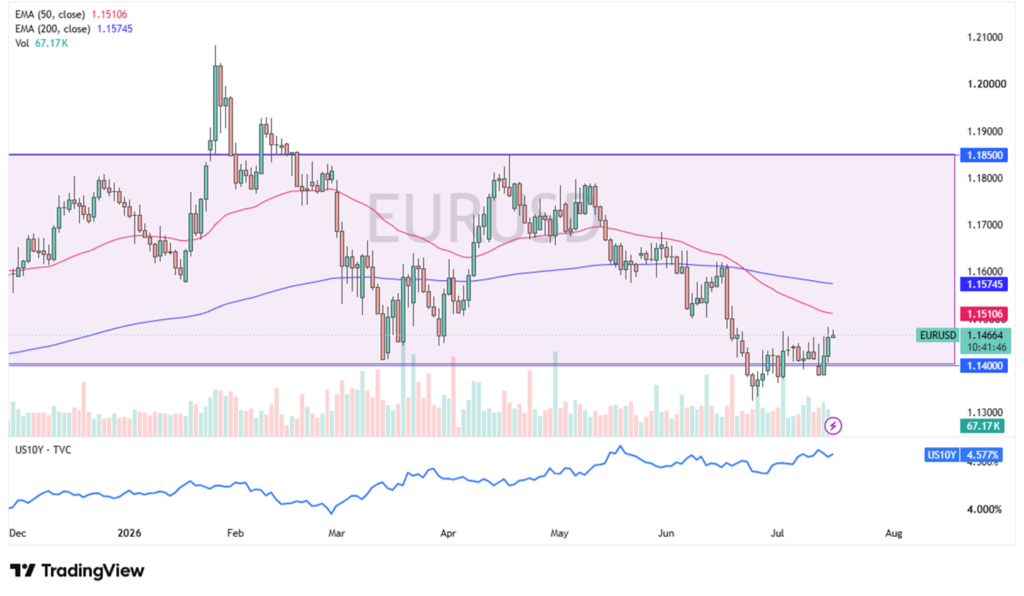
From a broader technical perspective, EUR/USD continues trading inside a range that has contained price action for well over a year.
The lower boundary near 1.1400 has repeatedly attracted buying interest, while the upper portion of the range around 1.1850 has consistently limited rallies. Previous attempts to break beyond either extreme have failed, reinforcing the importance of these long-term technical levels.
The recent recovery from support has improved short-term sentiment, yet the pair still faces important resistance before buyers can claim control. The 50-day Exponential Moving Average (EMA) remains an important barrier, while the 200-day EMA continues defining the broader trend.
Until EUR/USD produces a decisive breakout beyond the established range, the overall technical outlook continues to favor consolidation rather than a new directional trend.
Key Levels Traders Should Monitor
The most important support continues to sit around 1.1400, where buyers have repeatedly stepped into the market during previous declines. A convincing move below this level would expose additional downside toward 1.1350, an area that many traders view as the next significant bearish objective.
On the upside, the first technical challenge remains the 50-day EMA, which buyers must overcome to strengthen bullish momentum. Beyond that, the broader resistance zone extends toward 1.1850, the upper boundary of the long-term trading range.
Because the pair continues fluctuating between clearly defined support and resistance, many traders may prefer waiting for confirmation before increasing directional exposure.
Macro Factors Continue To Drive Sentiment
Beyond technical analysis, EUR/USD remains highly sensitive to developments in interest-rate expectations and broader geopolitical conditions.
US Treasury yields continue influencing demand for the Dollar, with higher yields generally strengthening the US currency against its major counterparts. Investors will therefore continue monitoring economic releases and Federal Reserve communication for additional clues regarding future monetary policy.
At the same time, geopolitical uncertainty continues supporting defensive positioning across global markets. Concerns surrounding energy markets, inflation risks, and potential supply-chain disruptions remain important variables influencing both the Dollar and the euro.
Should inflation continue moderating while geopolitical risks gradually ease, market expectations surrounding Federal Reserve policy could shift further, potentially creating additional opportunities for EUR/USD to challenge higher resistance levels.
Conclusion
EUR/USD continues moving within a well-established consolidation range as investors evaluate mixed economic signals and persistent geopolitical uncertainty. While softer inflation data has improved sentiment toward the euro, buyers have yet to generate the conviction necessary to break above key technical resistance.
For now, the broader trading range between 1.1400 and 1.1850 remains intact. A sustained move above the 50-day EMA could strengthen the bullish outlook, while a decisive break below 1.1350 would likely reinforce bearish momentum. Until one of these scenarios develops, consolidation is expected to remain the dominant theme for EUR/USD.