
Crude oil prices continue to trade within a relatively narrow range as investors assess the balance between improving technical conditions and lingering market uncertainty.
Although recent sessions have lacked strong directional momentum, the broader structure suggests that buyers are gradually building a stronger foundation while attempting to overcome an important resistance zone.
Risance experts provide a comprehensive analysis of the latest crude oil price action, highlighting the technical signals, major price levels, and broader market factors that could determine whether the next move develops into a sustained bullish breakout or another period of consolidation.
Sideways Trading Reflects A Market Searching For Direction
Crude oil has spent recent sessions fluctuating within a tight trading range, reflecting a temporary equilibrium between buyers and sellers. While neither side has managed to establish full control, the inability of bears to force a deeper correction suggests that underlying demand remains relatively resilient.
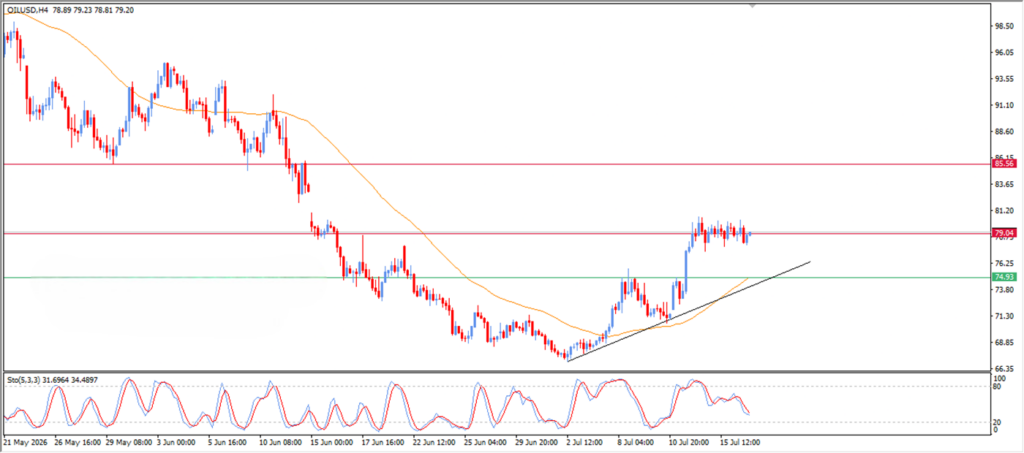
The repeated rejection near the $79.00 resistance level continues to define the current market structure. Each attempt to move higher has encountered selling pressure, preventing a decisive breakout. At the same time, pullbacks have remained relatively limited, indicating that buyers continue to defend higher price levels instead of abandoning positions.
Periods of consolidation often emerge after strong directional moves, allowing markets to absorb previous gains before determining the next trend. Rather than signaling weakness, sideways trading frequently represents a phase during which liquidity builds before volatility eventually returns.
Technical Structure Continues To Support Buyers
From a technical perspective, the overall short-term outlook remains moderately constructive despite the absence of a confirmed breakout.
Price continues trading above the 50-period Exponential Moving Average (EMA50), which currently acts as dynamic support throughout the ongoing corrective advance. As long as crude oil remains above this moving average, buyers maintain a technical advantage and continue to preserve the broader recovery structure.
The latest price action also reflects a sequence of higher lows, suggesting that bullish momentum has not disappeared even though upside progress has slowed near resistance. This gradual improvement in market structure often precedes stronger directional moves once resistance levels are finally absorbed.
The inability to break above $79.00 should still encourage caution. Resistance levels become increasingly significant after multiple failed attempts, and confirmation normally requires a convincing daily close above the barrier rather than only temporary intraday moves.
Key Levels Investors Should Watch
The $79.00 area remains the most important technical resistance for crude oil in the near term. A successful breakout above this level would strengthen bullish momentum and potentially encourage additional buying interest as traders gain confidence that the consolidation phase has ended.
On the downside, the EMA50 continues serving as the primary dynamic support. The chart also highlights an important horizontal support region around $74.90, where previous buying interest has repeatedly emerged.
Should prices fall below these support areas, short-term sentiment could weaken and increase the probability of a broader corrective decline. Conversely, continued trading above dynamic support would reinforce the bullish technical structure while allowing buyers to prepare for another attempt at overcoming resistance.
Because the current range remains relatively tight, traders are likely to monitor these levels closely for confirmation before committing to larger directional positions.
Macro Factors Could Trigger The Next Move
Although technical analysis currently favors a cautiously positive outlook, crude oil prices remain highly sensitive to external developments.
Global demand expectations continue to play an important role in shaping sentiment, particularly as investors evaluate economic growth prospects across major economies. Stronger industrial activity generally supports higher energy consumption, while weaker economic data can quickly reduce expectations for future oil demand.
Monetary policy also remains relevant. Expectations surrounding Federal Reserve interest rates influence the US Dollar, which often maintains an inverse relationship with commodity prices. A softer Dollar can improve purchasing power for international buyers, while a stronger Dollar may create additional headwinds.
Meanwhile, geopolitical developments continue to generate uncertainty across energy markets. Supply disruptions, production decisions from major exporters, and broader geopolitical tensions can all influence crude oil pricing even when technical conditions remain stable.
These macroeconomic variables may ultimately provide the catalyst needed to push prices beyond the current consolidation range.
Conclusion
Crude oil continues trading within a well-defined consolidation pattern as buyers attempt to build enough momentum to overcome the critical $79.00 resistance zone. The broader technical picture remains constructive thanks to continued support from the EMA50, while the sequence of higher lows suggests that bullish pressure has not disappeared.
Even so, confirmation of a stronger upward trend will require a decisive breakout above resistance. Until that occurs, traders are likely to remain focused on both technical levels and macroeconomic developments as they evaluate whether crude oil is preparing for its next sustained advance or an extended period of sideways trading.