
Gold (XAU/USD) continues to trade with a distinctly offered tone, hovering below the $4,100 mark during the European session and remaining close to a two-week low. The metal has now recorded two consecutive days of losses, extending to five negative sessions in the last six, underscoring a sustained shift in sentiment. This subject is examined in detail by Vaulltier’s brokers in the article that follows.
The dominant driver remains the strengthening US Dollar (USD), which has surged to a 13-month high amid escalating expectations of further Federal Reserve (Fed) tightening. In this environment, non-yielding assets like gold struggle to attract demand, particularly as rate hike bets increase the opportunity cost of holding bullion.
USD Strength and Fed Policy Expectations Drive Flows
The primary catalyst behind gold’s weakness is the aggressive repricing of Fed policy expectations. Investors have significantly increased bets that the central bank will maintain a restrictive stance, with growing odds of at least a 25-basis-point hike in 2026.
Recent Fed communications have reinforced this outlook. Notably, nine of the 19 FOMC members signaled that additional tightening may still be required to ensure inflation control remains durable. This hawkish tilt has provided strong support for the US Dollar Index (DXY), which has climbed to levels not seen since May 2025.
A stronger USD typically exerts downward pressure on gold, making it more expensive for non-dollar buyers and reducing its attractiveness as a global hedge. Consequently, XAU/USD remains pinned near its year-to-date lows, reflecting a market increasingly dominated by macro-driven dollar flows.
Easing Inflation Concerns Fail to Support Gold
Despite some relief from cooling inflation expectations, gold has failed to stage any meaningful recovery. A significant contributor to this easing narrative is the sharp decline in crude oil prices, which recently hit their lowest level since early March.
The reopening of maritime routes through the Strait of Hormuz has improved supply expectations, while reports of limited vessel passage coordination and a 60-day US sanctions waiver on Iranian energy exports have further reduced supply-side risks.
Lower oil prices typically translate into reduced upstream inflationary pressure, which in theory could support gold by weakening hawkish policy expectations. However, in the current environment, this effect has been overshadowed by aggressive USD demand and Fed tightening bets, leaving bullion without meaningful macro support.
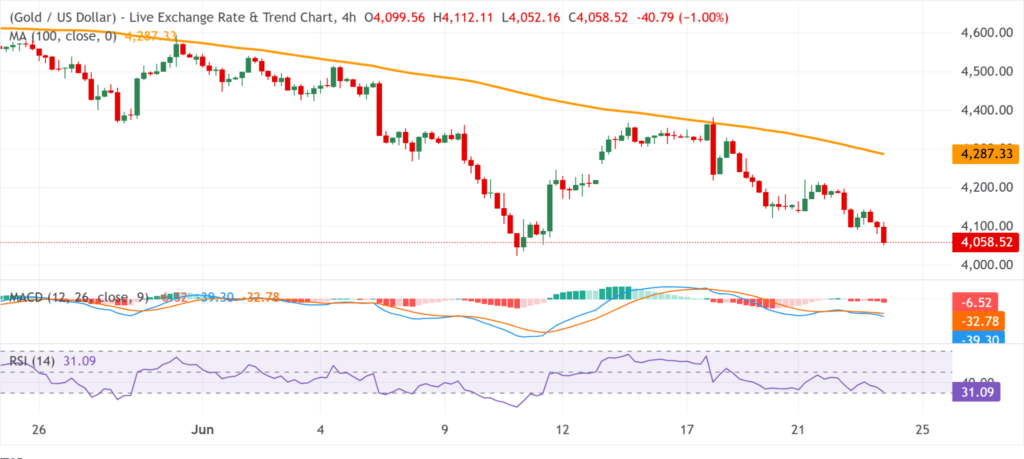
Technical Outlook: Bearish Structure Dominates
From a technical perspective, Gold (XAU/USD) continues to exhibit a clearly bearish configuration. The price has repeatedly failed to sustain moves above the 100-period Simple Moving Average (SMA) on the 4-hour chart, signaling persistent overhead resistance and weak bullish conviction.
A decisive break and acceptance below the $4,100 psychological level is now seen as a potential trigger for renewed downside momentum. Such a move would likely reinforce the ongoing bearish trend and open the door to further losses.
Momentum indicators also reflect weakening conditions. The Relative Strength Index (RSI) is hovering near oversold territory around 31, indicating persistent selling pressure, while the Moving Average Convergence Divergence (MACD) remains in negative territory, with a downward-sloping signal line reinforcing bearish momentum.
Although oversold conditions could trigger short-term technical rebounds or short covering, these are likely to be temporary corrective moves rather than trend reversals.
Key Levels: Support and Resistance Structure
On the downside, immediate attention is focused on the year-to-date low zone around $4,024–$4,023, which represents the next critical support area. A sustained break below this level could accelerate losses and confirm a deeper bearish continuation phase.
On the upside, the first meaningful resistance is located at the 100-period SMA near $4,287.33. A recovery above this level would be required to neutralize the current bearish bias and potentially signal the start of a broader consolidation phase.

However, until price action decisively reclaims the $4,280–$4,290 region, rallies are likely to be viewed as selling opportunities rather than trend reversals, especially given the prevailing weakness in momentum indicators.
Outlook: US PCE Data in Focus
Looking ahead, market participants are closely awaiting the upcoming US Personal Consumption Expenditures (PCE) Price Index, a key inflation gauge for the Federal Reserve, scheduled for release on Thursday.
This data will be critical in shaping expectations around the future path of interest rates. A stronger-than-expected reading could further reinforce USD strength and Fed hawkishness, placing additional pressure on gold.
Conversely, softer inflation data may offer temporary relief, though any rebound in bullion is likely to remain technically constrained unless accompanied by a broader shift in monetary policy expectations.
For now, the dominant narrative remains clear: a strong USD, persistent Fed tightening expectations, and a fragile technical structure continue to keep gold under pressure, with the path of least resistance still tilted to the downside.