
The EUR/JPY cross is under renewed selling pressure, slipping toward 184.45 during Friday’s early European session as the pair struggles to maintain upward traction. The broader tone remains tilted to the downside as the Japanese Yen (JPY) strengthens modestly against the Euro (EUR), driven by rising expectations of potential currency intervention from Japanese authorities.
The combination of official rhetoric, shifting global risk sentiment, and deteriorating technical momentum has reinforced a cautious bearish bias in the short term. The article from Vaulltier’s brokerage team offers a comprehensive analysis of this subject.
Fundamental Drivers: Intervention Fears and Safe-Haven Demand
Recent EUR/JPY softness is driven by heightened sensitivity to Japanese policy rhetoric and potential FX intervention. Finance Minister Satsuki Katayama reiterated readiness for decisive action against speculative FX moves, increasing perceived risk of actual intervention if volatility continues.
These signals are leading traders to reduce long EUR/JPY exposure, as the threat of sharp JPY appreciation shocks raises positioning risk. Meanwhile, geopolitical uncertainty is strengthening the JPY safe-haven bid. Disruptions and delays in US–Iran diplomatic talks, including issues around Iranian participation and potential relocation of discussions to Switzerland, are reinforcing a broader risk-off tone.
This backdrop typically supports safe-haven flows into JPY, creating a headwind for EUR/JPY. Overall, conditions remain aligned with risk aversion, reinforcing a bearish bias for the pair.
Price Action: Sellers Regain Control Near 184.45
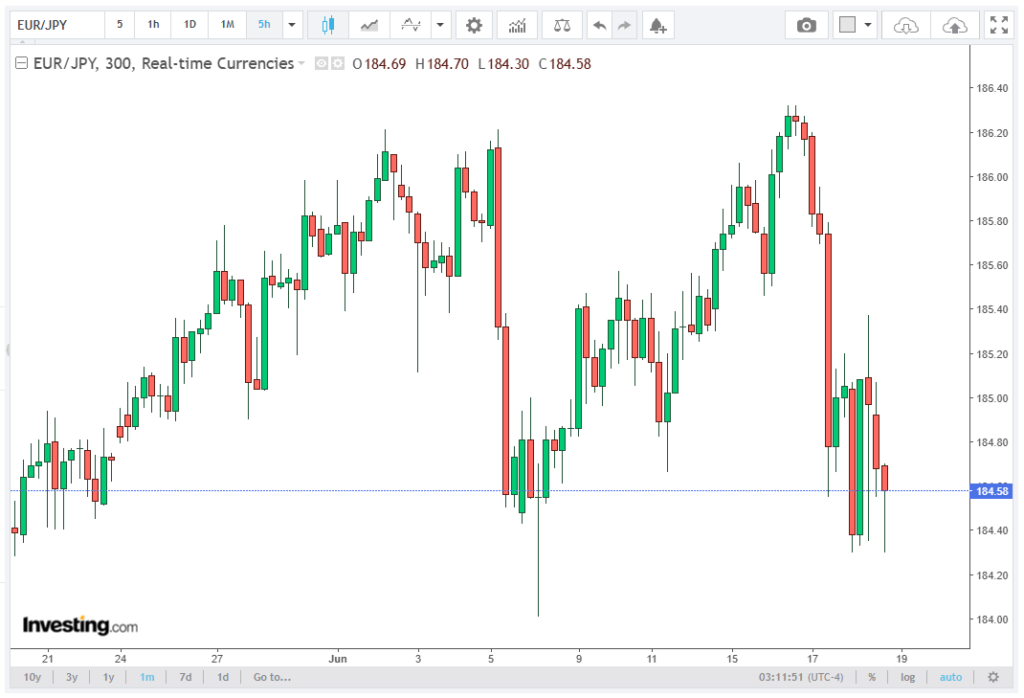
From a short-term trading perspective, EUR/JPY has struggled to maintain gains above the 184.50 psychological zone, with repeated rejections signaling that buyers lack conviction at higher levels.
During Friday’s early European session, sellers stepped in around 184.45, pushing the cross slightly lower and confirming the presence of persistent intraday supply pressure. The inability to reclaim the 184.60 resistance threshold highlights weakening bullish momentum and suggests that rallies are being actively faded.
The price structure now reflects a market that is transitioning from range stability into a more directionally bearish phase, especially as intraday lower highs continue to form.
Technical Analysis: Bearish Momentum Dominates
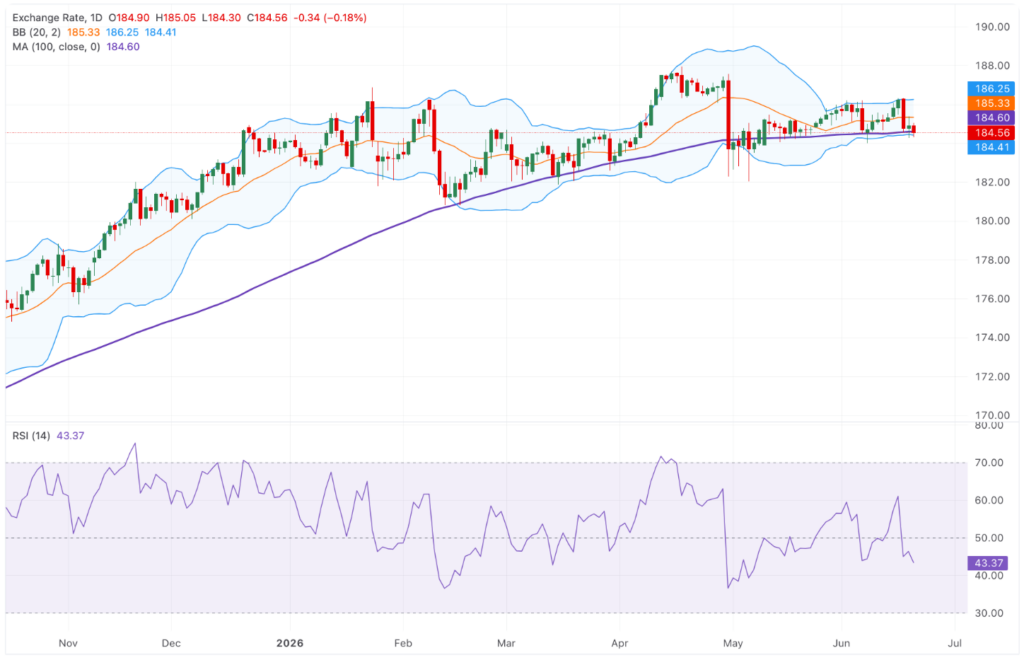
On the daily timeframe, the technical outlook for EUR/JPY remains clearly tilted to the downside. The pair is trading below both its 100-day Simple Moving Average (SMA) and the 20-day Bollinger Band midline, signaling that medium-term momentum has shifted in favor of sellers.
The Relative Strength Index (RSI) sits near 43, reflecting soft bearish momentum without yet entering oversold territory. This is important: it suggests that there is still room for further downside before exhaustion signals appear, meaning the current move may have extension potential rather than reversal risk.
Price structure is also significant. The rejection from the upper range zone and failure to reclaim key moving averages confirm that EUR/JPY is currently operating within the lower-to-mid portion of its recent consolidation range, with downside pressure gradually increasing.
Key Technical Levels: Resistance and Support Zones
The market is now tightly defined by a clear set of technical boundaries. On the upside, immediate resistance is located at 184.60, which aligns closely with the 100-day SMA. A daily close above this level would be required to invalidate the short-term bearish bias.
If that occurs, momentum could shift toward the mid-Bollinger band near 185.33, followed by a stronger upside extension toward the upper Bollinger band near 186.25. However, failure to reclaim 184.60 keeps sellers in control and preserves downside pressure.
On the downside, initial support is seen at 184.40, which corresponds to the lower Bollinger band. A decisive break below this level would be technically significant, as it would confirm a breakdown from the current compression zone.
If downside continuation unfolds, the next key targets include the May 7 swing low at 183.50, followed by a deeper structural support zone at the March 31 low near 182.83. These levels represent the next major areas where buyers may attempt to re-enter the market.
Outlook: Bearish Bias Intact but Range Still in Play
The near-term outlook for EUR/JPY remains characterized by a modestly bearish bias supported by both fundamentals and technical indicators. The combination of intervention risk, rising safe-haven demand for JPY, and weakening technical momentum keeps pressure on the cross.
However, despite the downside tilt, the pair is not yet in a full trend breakdown. The presence of nearby support around 184.40–184.00 suggests that price action may remain choppy unless a clear catalyst triggers a decisive break.
For now, traders are likely to focus on whether EUR/JPY can recover above 184.60 to stabilize sentiment, or whether continued selling pressure pushes the pair toward deeper support levels near 183.50 and below.
Until then, the dominant market theme remains clear: bearish momentum persists, and rallies are likely to face selling pressure in the near term.