
Retail Sales in the United Kingdom rose +1.2% month-over-month (MoM) in May, according to the Office for National Statistics, materially above the +0.5% consensus and reversing the prior -1.0% (revised from -1.0%) contraction.
The magnitude of the beat implies a +70bps positive surprise, one of the stronger deviations in recent print cycles. Vaulltier’s brokers provide a detailed breakdown of this topic in the article.
In volume terms, this shift represents a meaningful rebound in real consumption momentum, particularly given that April marked a contractionary base. The two-month swing from -1.0% to +1.2% implies a cumulative +2.2 percentage point inflection, indicating volatility but also potential stabilization in household demand.
Core Retail Sales Confirm Broad-Based Strength
The core Retail Sales series (ex auto fuel) increased +1.2% MoM, compared with -0.1% previously (revised from -0.4%) and against expectations of +0.4%. The core beat of +80bps versus consensus is statistically significant in high-frequency retail tracking models.
On a rolling basis, the acceleration from -0.1% to +1.2% suggests a trend break in underlying discretionary spending, not purely fuel-driven volatility. This matters for real-time GDP nowcasting, where retail volumes carry a weighted contribution to monthly output estimates.
Year-on-Year Acceleration and Base Effects
On an annual basis, Retail Sales expanded +3.2% YoY, sharply higher than the revised +0.1% prior and above expectations of +1.9%, implying a +130bps upside deviation versus consensus.
Core annual sales rose +4.6% YoY, accelerating from +1.1% previously and exceeding forecasts of +3.3%. This creates a +3.5 percentage point annual spread between core and headline prior momentum, signaling stronger discretionary consumption relative to headline aggregates.
From a decomposition standpoint, this implies that nominal spending growth is outpacing prior inflation drag, suggesting real retail volumes are recovering at the margin, even under restrictive financing conditions.
Macro Transmission: Consumption vs Monetary Policy
For the Bank of England, the key transmission channel from Retail Sales is through demand-side inflation persistence. A sustained +1.0% to +1.2% MoM retail regime is historically consistent with above-trend consumption growth, particularly when paired with tight labor markets.
At current policy rates, marginal consumption sensitivity should be negative; however, the observed rebound suggests low elasticity of demand to borrowing costs in the short run. This increases the probability of a higher-for-longer rate path, especially if services inflation remains sticky.
From a rates pricing perspective, stronger Retail Sales can re-anchor expectations for terminal rates by reducing the probability of near-term easing. Even a 10–15bps repricing in forward OIS curves can materially impact GBP valuation through rate differential channels.
FX Market Response: GBP Price Action Disconnect
The British Pound initially reacted positively to the data, but broader flow dynamics dominated thereafter. The GBP/USD pair traded around 1.3195, down approximately -0.08% intraday, indicating that macro data failed to override prevailing USD strength and positioning pressure.
From a microstructure standpoint, this divergence suggests that retail data impact was absorbed within the first-order reaction window, with subsequent price action driven by carry positioning, momentum flows, and volatility compression strategies.
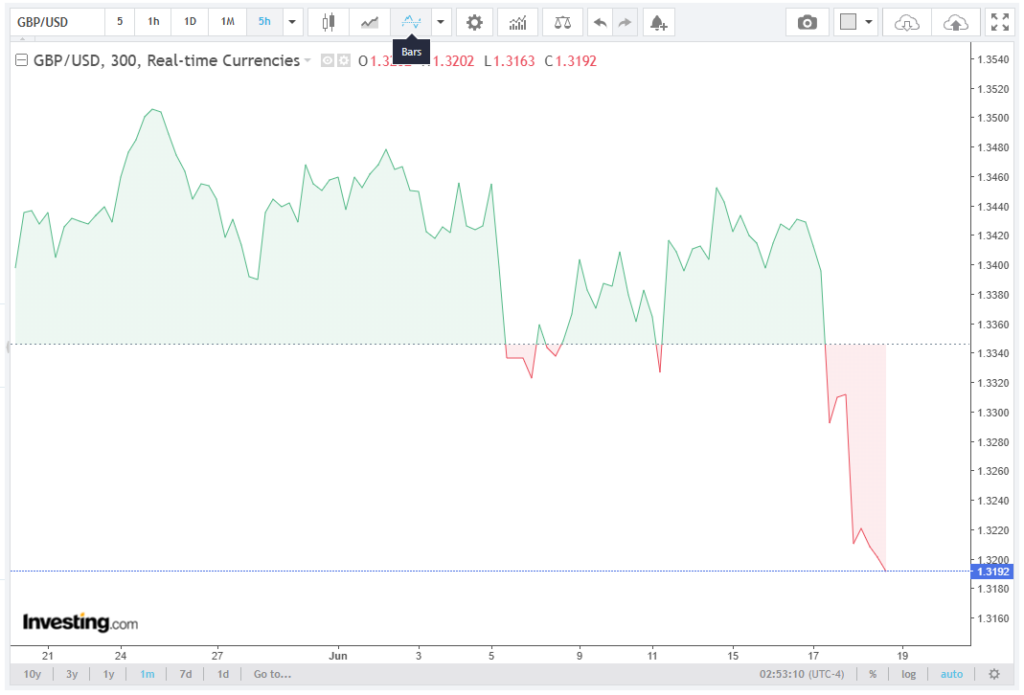
Despite the data, spot remains constrained by lower highs and lower lows on short-term structure, implying that macro surprise was insufficient to trigger trend reversal, mechanics.
Technical Structure: Downtrend Integrity Maintained
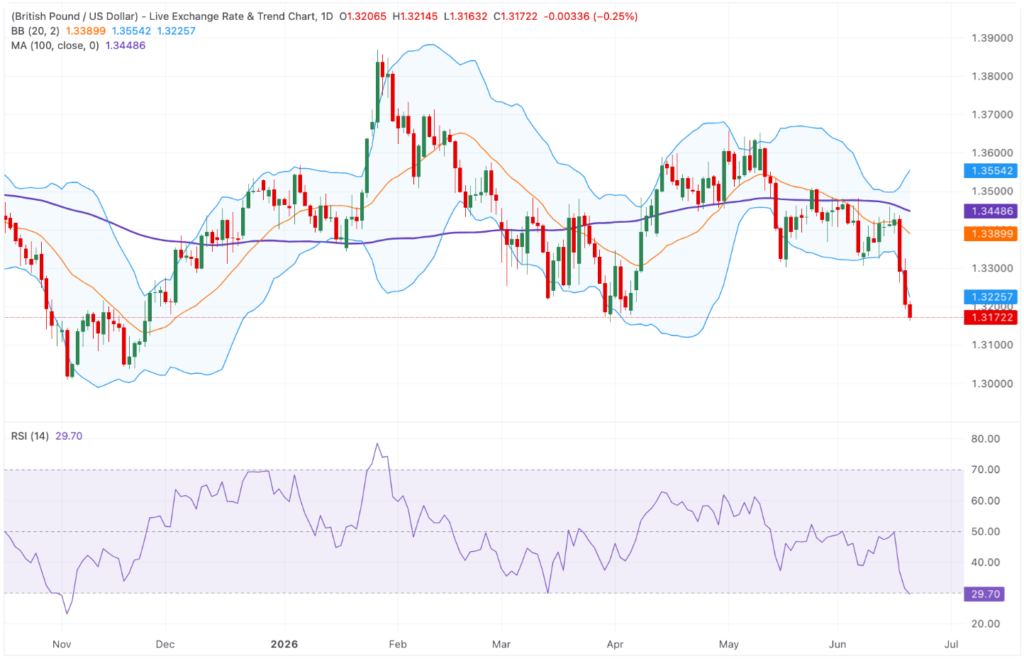
On the daily timeframe, GBP/USD remains structurally bearish, trading below both the 20-day Bollinger midline (≈1.3390) and the 100-day moving average (≈1.3450). Price is currently pressing beneath the lower Bollinger band (~1.3225), indicating sustained downside volatility expansion.
The RSI (14-period) is positioned near 30, reflecting oversold conditions, but not yet confirming bullish divergence. Historically, RSI in the 28–32 zone within a strong downtrend often leads to only mean-reverting corrections of 0.5–1.5%, rather than full trend reversals.
Immediate resistance remains layered: 1.3225, then 1.3390, followed by 1.3450, forming a dense supply zone approximately 250–300 pips above spot. Until price reclaims at least the 20-day mean (1.3390), trend continuation risk remains dominant.
Conclusion: Macro Improvement vs Structural Trend
The May Retail Sales data from the United Kingdom and the Office for National Statistics clearly signals short-term consumption resilience, with both headline and core metrics posting +1.2% MoM expansions and annual growth accelerating to +3.2% and +4.6% respectively.
However, FX pricing in GBP/USD continues to reflect a dominant bearish technical regime, with spot constrained below key moving averages and operating within a lower volatility band expansion phase.
The net implication is a fundamental–technical divergence: macro data is improving at the margin, but not yet at a magnitude sufficient to disrupt established trend structure or materially reprice forward interest rate expectations.