
Gold remained close to $4,020 per ounce on Monday as traders weighed two competing forces. Continued tension in the Middle East supported demand for defensive assets, while higher oil prices increased concern that inflation could remain stubborn and interest rates may stay elevated.
Brokers from AchievementsAI.com examine whether gold can regain momentum above $4,025 or whether firmer bond yields and changing rate expectations could pull the metal back toward support.
The Market Is Caught Between Safety and Rates
Gold would normally benefit from a more uncertain geopolitical backdrop. Investors often turn to the metal when risk appetite weakens.
This time, the reaction has been muted. Spot gold traded around $4,018.75, while August futures held near $4,023.20, even as oil climbed above $90 per barrel.
Rising energy prices can add to inflation. If policymakers believe price pressures are becoming harder to control, they may keep borrowing costs high or tighten policy further.
That creates a difficult backdrop for gold because the metal pays no interest.
The Daily Chart Is Still Holding Together
Gold continues to trade near its 20-day Exponential Moving Average, making this an important short-term reference point.
A close above the indicator would suggest that buyers still have enough strength to prevent a deeper correction.
The 50-day EMA sits below the market and provides broader support. As long as gold remains above it, the wider technical structure remains intact.
The immediate problem is a lack of follow-through. Buyers have defended support but have not yet pushed the market clearly through resistance.
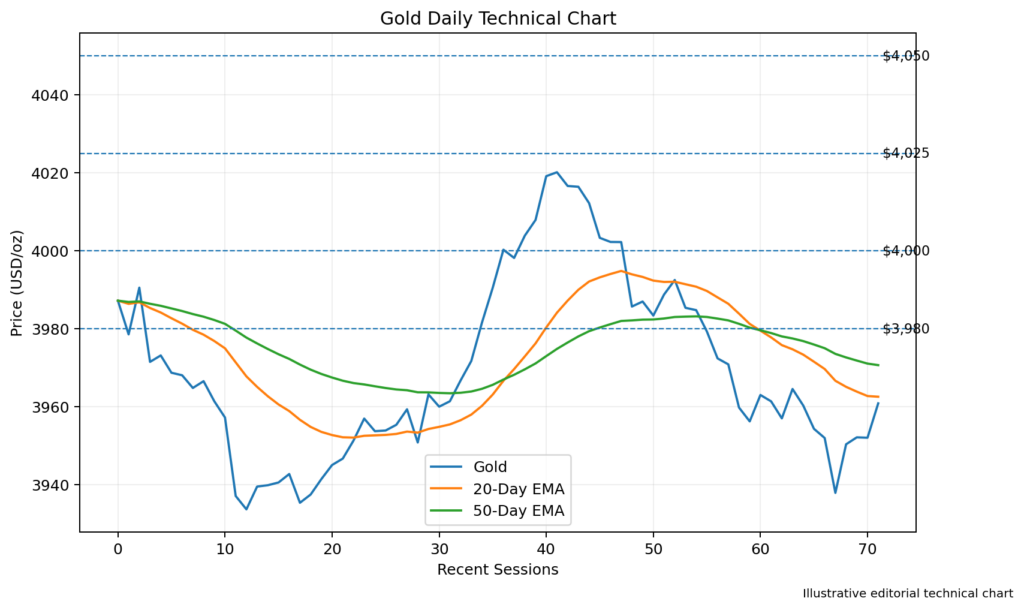
Image 1: Gold Daily Chart With the 20-Day and 50-Day EMAs, Support at $4,000 and Resistance Near $4,025
RSI Reflects a Neutral Market
The 14-day Relative Strength Index remains close to the neutral 50 level after the recent sideways movement.
A move above 60 would suggest momentum is improving and could support another attempt at higher resistance. If RSI falls below 40, the risk of a deeper pullback would increase.
A higher gold price alongside a weaker RSI reading could also warn that the recovery is losing energy.
Resistance Begins Around $4,025
The first barrier sits near $4,025, close to the latest futures price and recent intraday trading.
A firm move above this area may bring $4,050 into focus. If buyers clear that level, the next targets could appear around $4,080 and $4,100.
The $4,100 level is likely to attract more attention because it represents a major psychological barrier.
The main resistance levels are $4,025, $4,050, $4,080, and $4,100.
A move through these areas would probably require weaker bond yields, a softer dollar, or stronger defensive demand.
Support Remains Close to $4,000
The first major support level is $4,000. Gold has repeatedly reacted around this area, making it an important dividing line for the short-term outlook.
A limited retreat toward $4,000 would not automatically end the broader recovery.
A daily close below it, however, could expose $3,980 and then $3,950. The 50-day EMA may also become relevant if selling pressure increases.
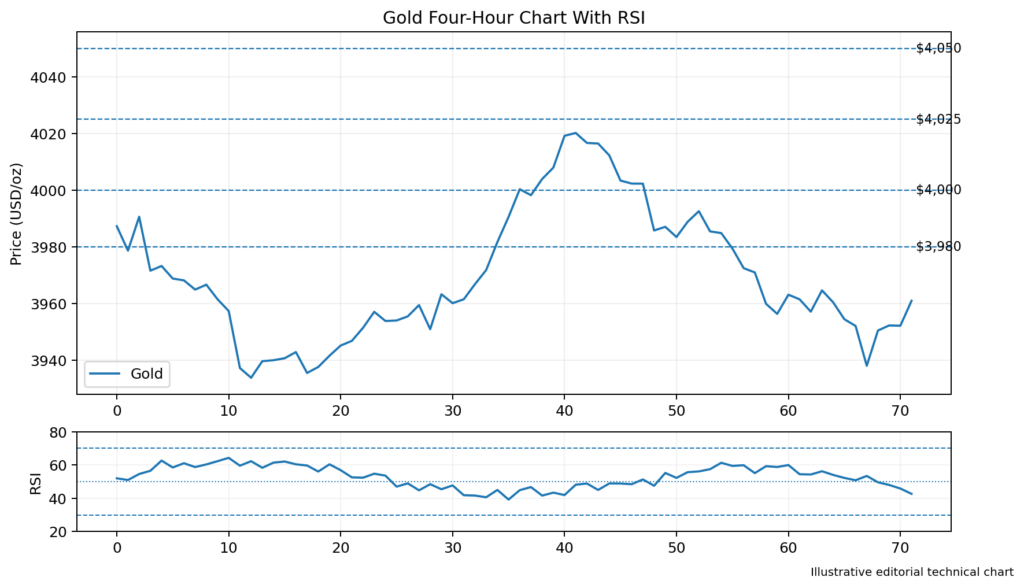
Image 2: Gold Four-Hour Chart With RSI, Support at $4,000 and $3,980, and Resistance at $4,025 and $4,050
Oil Prices Are Driving the Debate
Brent crude moved above $90 per barrel as concern grew about shipping disruptions and tanker activity in the Strait of Hormuz.
Higher oil can support gold through increased uncertainty, but it can also hurt the metal if markets respond by pricing tighter monetary policy.
US Treasury yields remained elevated, with the 10-year yield near 4.55% and the 30-year yield above 5%. Higher yields make interest-bearing assets more competitive compared with gold.
Rate Expectations Remain Unsettled
Recent US inflation data reduced expectations of an immediate rate increase, but the oil rally has complicated the outlook.
Several policymakers have suggested that higher rates may still be necessary if inflation pressure returns. This has prevented gold from benefiting fully from the uncertain backdrop.
The next move may depend on whether energy costs feed into broader inflation measures.
If oil remains high but inflation elsewhere continues cooling, gold may regain support. If price pressure spreads, bond yields could stay firm and limit the upside.
Trading Implications
Gold retains a neutral-to-positive bias while it remains above $4,000 and the 50-day EMA.
A confirmed move through $4,025 could expose $4,050 and $4,080. Improving RSI would strengthen that scenario.
A break below $4,000 would weaken the immediate picture and shift attention toward $3,980 and $3,950.
Conclusion
Gold is holding near $4,020, but the market remains caught between defensive demand and concern about higher interest rates.
Resistance is positioned at $4,025, $4,050, $4,080, and $4,100. Support can be found near $4,000, $3,980, and $3,950.
The reaction around $4,000 and $4,025 should show whether buyers are ready to take control or whether the metal needs another pullback first.