
Germany’s two-year government bond yield remains close to a two-year high as investors reassess the outlook for European interest rates. The yield recently stabilised around 2.78%, while money markets moved closer to pricing two additional rate increases by early 2027.
Brokers from AchievementsAI.com examine whether the short-dated yield can extend toward 2.85% or whether easing inflation concerns and a cautious European Central Bank could trigger a pullback.
The Trend Still Favours Higher Yields
The recent chart remains positive. Germany’s two-year yield has climbed steadily as traders reduced expectations that European borrowing costs would stay unchanged for long.
The yield is holding above its 20-day Exponential Moving Average, which suggests the latest rise still has short-term support.
The 50-day EMA sits lower and provides a broader reference point. As long as the 20-day average remains above it, the medium-term structure continues to favour higher yields.
However, the market has moved quickly. That leaves the yield vulnerable to a pause if incoming inflation data fails to confirm the more aggressive rate outlook.
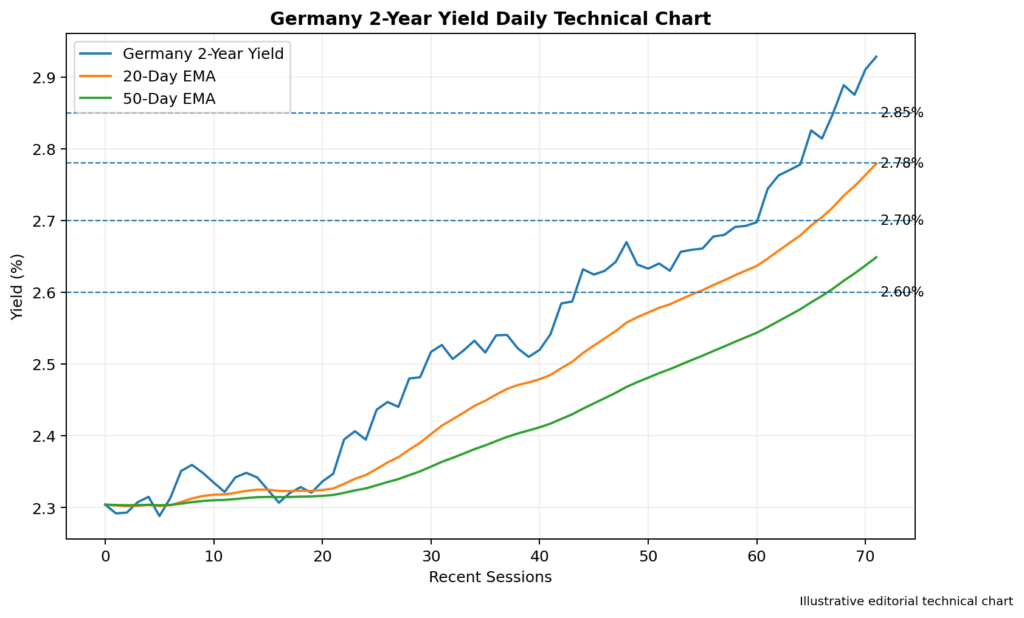
Image 1: Germany Two-Year Yield Daily Chart With the 20-Day and 50-Day EMAs, Support at 2.70% and Resistance Near 2.78%
RSI May Be Approaching Overbought Territory
The 14-day Relative Strength Index has strengthened with the yield.
A reading above 50 confirms that upward momentum remains intact. If RSI moves beyond 70, the market would enter overbought territory.
That would not guarantee an immediate reversal, but it could show that traders have moved too quickly in pricing future rate increases.
A more useful warning would appear if the yield reaches a new high while RSI forms a lower peak. That type of bearish divergence could signal that the rise is losing momentum.
Resistance Sits Near 2.78%
The first barrier is the recent area around 2.78%. A sustained break above it could bring 2.85% into view.
If the yield clears 2.85%, the next target may appear near 2.90%. Beyond that, the psychological 3.00% level would become the larger reference point.
A move that far would probably require persistent inflation pressure, stronger economic data, or clearer signals that the ECB intends to tighten policy further.
The main resistance levels are 2.78%, 2.85%, 2.90%, and 3.00%.
Support Could Appear Near 2.70%
The first support area is located around 2.70%. A retreat toward this level would still fit with the wider upward trend.
Below that, 2.60% may attract buyers and could align with the rising 20-day EMA.
A more decisive break beneath 2.60% would weaken the current structure and place 2.50% back in focus.
That type of decline would likely require softer inflation data or a shift in expectations around the timing of future rate decisions.
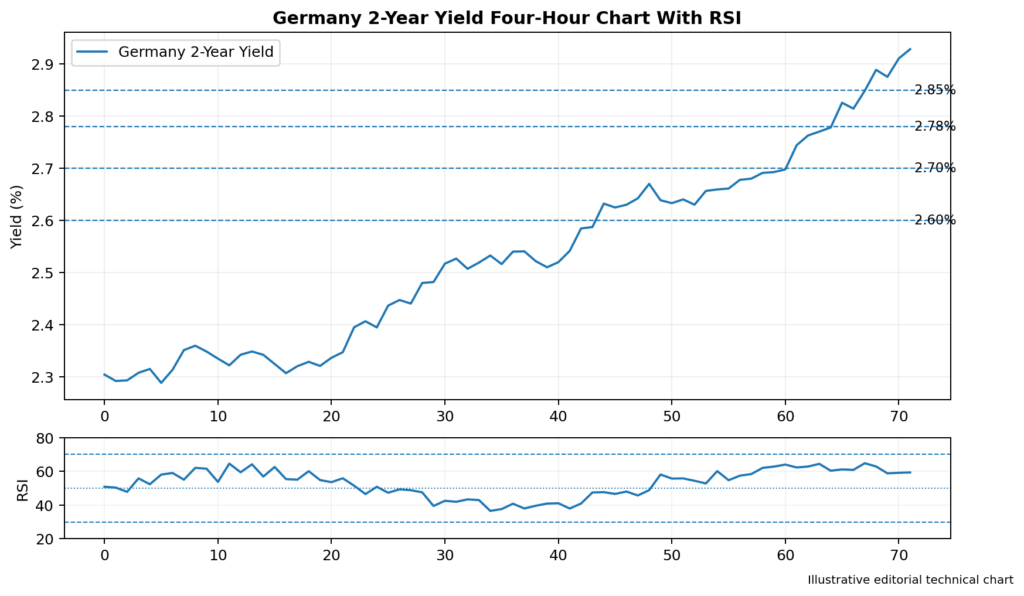
Image 2: Germany Two-Year Yield Four-Hour Chart With RSI, Support at 2.70% and 2.60%, and Resistance at 2.78% and 2.85%
Oil Prices Have Changed the Rate Debate
The latest rise in European yields has been closely linked to higher energy prices.
Brent crude moved above $90 per barrel, reviving concern that fuel costs could push inflation higher again. This helped markets price the ECB deposit rate reaching 2.75% by February 2027, up from the current 2.25%.
Traders are also assigning a greater chance to a rate increase in September, even though the ECB is still expected to leave policy unchanged at its next meeting.
The link between oil prices and short-term European yields has therefore become stronger again.
Inflation Risks Are Not Yet Broad-Based
The pressure is mainly coming from energy rather than clear evidence of widespread price acceleration.
An ECB survey indicated that companies expect slower growth in selling prices and wages, suggesting that second-round inflation effects remain limited for now.
This distinction matters. If higher oil prices remain isolated, policymakers may be less willing to react aggressively.
If energy costs begin feeding into wages, services, and consumer prices, the argument for further tightening would become stronger.
Wider Bond Markets Are Also Moving
Longer-dated European yields have risen alongside the two-year benchmark.
Germany’s 10-year yield recently traded near 3.13%, while Italy’s equivalent yield moved close to 3.96%. The spread between Italian and German debt widened to around 80 basis points.
This shows that investors are not only reassessing near-term rates. They are also demanding more compensation for inflation and fiscal uncertainty across the region.
Trading Implications
The German two-year yield retains a bullish bias while holding above 2.70% and its main moving averages.
A confirmed break above 2.78% could expose 2.85% and 2.90%. Stronger RSI readings would support that move, although overbought conditions may increase the chance of a pause.
A fall below 2.70% would weaken the immediate outlook and shift attention toward 2.60%.
Conclusion
Germany’s two-year yield remains close to 2.78% as markets price a firmer European rate path.
Resistance is positioned at 2.78%, 2.85%, 2.90%, and 3.00%. Support can be found near 2.70%, 2.60%, and 2.50%.
The technical trend still favours higher yields, but the next move will depend heavily on whether energy-driven inflation spreads into the wider economy.