
Gold prices remained resilient above the $4,000 level despite renewed strength in the US Dollar, as escalating geopolitical tensions in the Middle East continued to shape investor sentiment. While safe-haven demand has provided support, higher oil prices and inflation concerns have reinforced expectations that central banks may maintain a cautious monetary policy stance.
In its latest market outlook, BCR Limited examines the current gold market, focusing on the balance between geopolitical uncertainty, inflation expectations, and the technical levels that could influence price action in the coming sessions.
Geopolitical Tensions Continue to Support Safe-Haven Demand
The conflict between the United States and Iran remained the dominant catalyst at the beginning of the week, with both countries exchanging military strikes for a ninth consecutive day. The renewed closure of the Strait of Hormuz also pushed crude oil prices higher, increasing concerns about global energy supplies and inflationary pressures.
Although periods of geopolitical uncertainty often support gold, the current environment has produced a more balanced reaction. The stronger US Dollar has limited bullion’s upside, preventing prices from extending gains despite elevated geopolitical risks.
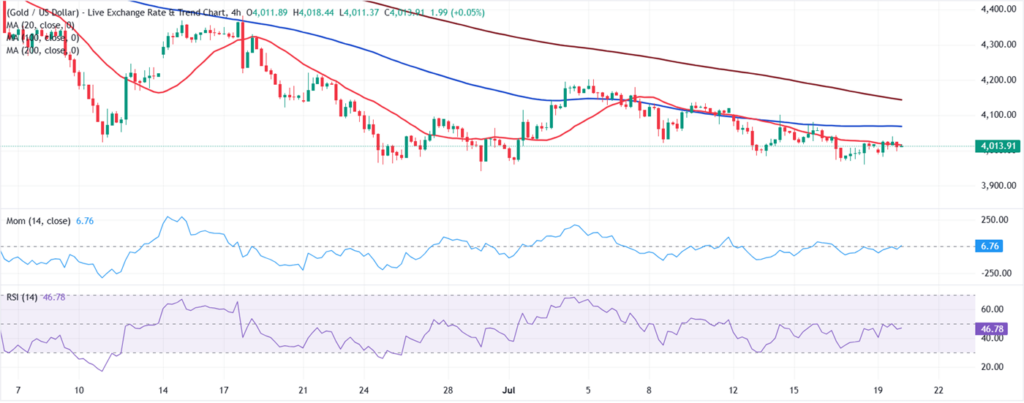
Gold briefly declined toward $3,982 during the Asian session before recovering above $4,010, illustrating the market’s reluctance to commit strongly in either direction.
Inflation Data Takes Centre Stage
Beyond geopolitical developments, investors are closely monitoring inflation releases from major economies.
Canada’s latest Consumer Price Index showed annual inflation easing to 2.8%, while the Bank of Canada’s preferred core inflation measure also moderated slightly. Markets will now turn their attention to upcoming inflation reports from New Zealand and the United Kingdom, looking for additional clues regarding the next steps from major central banks.
Inflation expectations remain one of the most influential drivers for precious metals. Softer inflation could support expectations for a more accommodative monetary environment over time, while persistently elevated price pressures may reinforce higher interest rate expectations and strengthen the US Dollar.
This balance between inflation and monetary policy continues to shape sentiment across the gold market.
Technical Outlook Remains Cautious
From a technical perspective, gold continues to trade within a fragile structure.
On the four-hour chart, XAU/USD remains below its 20-period, 100-period, and 200-period Simple Moving Averages, indicating that recent rebounds remain corrective rather than signaling a broader trend reversal.
Momentum has improved modestly, with the Momentum indicator moving back into positive territory. However, the Relative Strength Index remains close to 46, suggesting that buying pressure has stabilized without yet establishing a clear bullish advantage.
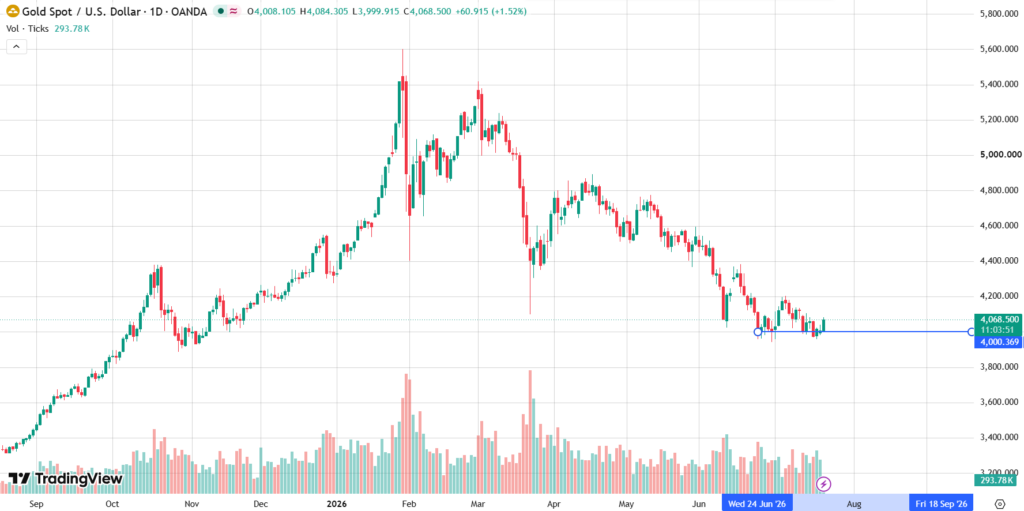
The daily chart presents a similar picture. Gold continues trading beneath all major moving averages, reinforcing the broader corrective phase that has developed over recent weeks. While downside momentum has moderated, the overall technical structure still favors caution until stronger resistance levels are reclaimed.
Key Price Levels to Monitor
Several technical levels are likely to remain important over the near term.
Initial resistance appears near the 20-period SMA around $4,016, followed by the 100-period SMA near $4,068. A more significant recovery barrier remains close to the 200-period SMA around $4,144, where sellers may become increasingly active.
On the downside, the June low near $3,941 represents the first important support area. Holding above this region would help preserve the current consolidation, while a deeper decline could increase bearish momentum and encourage a broader correction.
Although analysts consider a move toward $3,000 unlikely in the immediate future, any decisive breakdown below major support levels would significantly alter the longer-term technical outlook.
Risk Management Remains Essential
Periods of heightened geopolitical uncertainty often generate sharp swings across commodity markets, making disciplined portfolio management increasingly important.
For long-term investors, gold continues to play an important diversification role during periods of elevated inflation uncertainty and geopolitical stress. However, changing monetary policy expectations and fluctuations in the US Dollar can quickly influence short-term price movements, reinforcing the importance of maintaining balanced portfolio allocations rather than reacting to daily volatility.
Conclusion
Gold continues to consolidate just above the $4,000 level as geopolitical tensions provide underlying support while a stronger US Dollar limits further upside. Inflation data scheduled throughout the week may offer additional direction as investors reassess expectations for global central bank policy.
While technical indicators suggest that downside momentum has eased, the broader trend remains cautious until prices recover above key moving averages and investor confidence strengthens further.
In the meantime, geopolitical developments, inflation releases, and currency movements are likely to remain the primary drivers of gold market sentiment.