
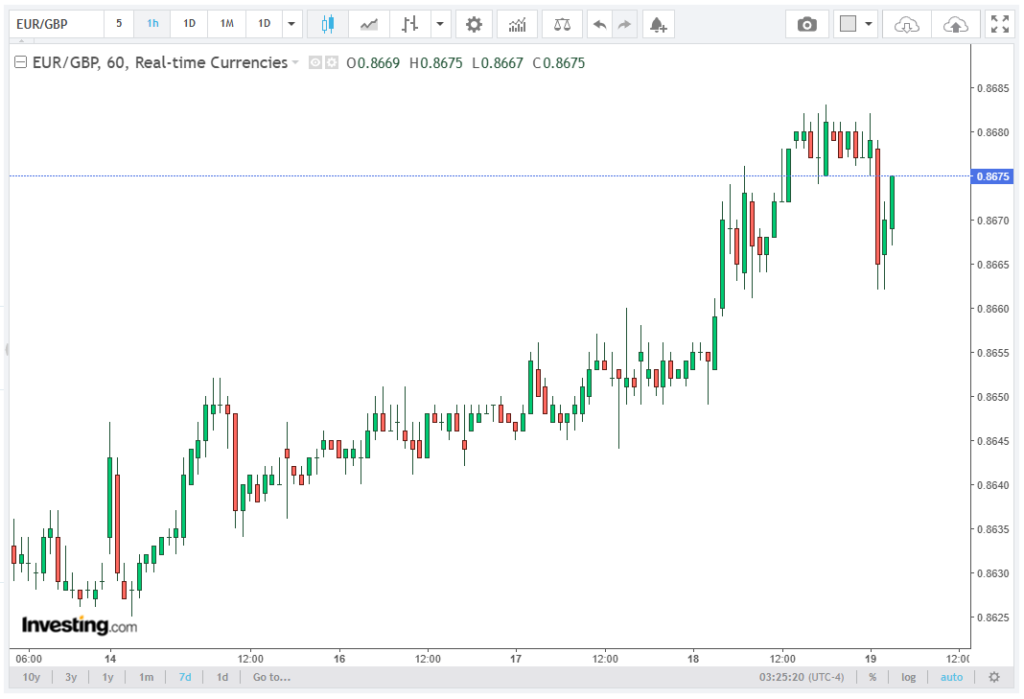
The Euro (EUR) has managed to trim earlier losses against the British Pound (GBP) on Friday, with the EUR/GBP exchange rate recovering from intraday lows near 0.8660 to trade around 0.8670.
The modest rebound highlights a market that is still digesting a mixed batch of UK macroeconomic data, where strong consumer activity was counterbalanced by deteriorating fiscal signals. Vaulltier’s experts present an in-depth examination of this topic within the article.
Despite upbeat domestic indicators, the Pound’s momentum has been capped, suggesting that investors remain cautious about the broader UK macro-financial outlook. The price action reflects a delicate equilibrium between positive demand-side data and rising fiscal and policy uncertainty.
EUR/GBP Price Action: Technical Stability Above Session Lows
From a technical perspective, the EUR/GBP pair showed resilience after testing support around 0.8660, a level that attracted dip-buying interest. The subsequent rebound toward 0.8670 indicates that bearish momentum for the Euro was losing strength even in the face of stronger-than-expected UK data.
Traders appear to be reassessing the sustainability of Pound strength, particularly given the offsetting impact of fiscal concerns. The failure of GBP to extend gains following the Retail Sales beat suggests that markets are reluctant to price in a durable bullish trend for Sterling without confirmation from broader macro fundamentals.
UK Retail Sales: Strong Consumer Demand Supports Sterling
One of the key drivers of intraday Sterling strength came from the latest UK Retail Sales report, which significantly outperformed expectations.
According to the Office for National Statistics (ONS), retail consumption increased by 1.2% in May, more than double the 0.5% forecast, and a sharp reversal from the 1.0% decline in April. This rebound signals a meaningful recovery in consumer activity after a weak prior month.
Excluding fuel, underlying sales also rose by 1.2%, compared with a 0.1% contraction previously, underscoring broad-based strength across retail categories. This improvement suggests that household spending momentum remains relatively resilient despite elevated interest rates and persistent cost-of-living pressures.
In normal circumstances, such a strong print would typically provide sustained support for the Pound Sterling, reinforcing expectations of robust domestic demand. However, the market reaction has been tempered by other macroeconomic developments.
Public Sector Borrowing: Fiscal Concerns Weigh on GBP Sentiment
Offsetting the positive retail data, the UK also reported an unexpected increase in Public Sector Net Borrowing, raising concerns over the country’s fiscal trajectory.
Borrowing rose to GBP 23.29 billion in May, up from GBP 23.03 billion in April, significantly above expectations for a decline to GBP 18.5 billion. This surprise increase suggests that government finances remain under pressure despite improving economic activity in some sectors.
Rising borrowing levels may reignite concerns about the UK fiscal deficit, particularly at a time when interest rates remain elevated and debt servicing costs are high. For currency markets, this introduces a structural headwind for the Pound, as persistent deficits can undermine investor confidence in long-term fiscal sustainability.
Eurozone Input: German PPI Shows Mixed Inflation Dynamics
On the Euro side, attention has been focused on the latest German Producer Price Index (PPI) data, which provides a forward-looking gauge of upstream inflation pressures in Europe’s largest economy and is often used as an early indicator of broader price trends.
The data showed that factory-gate inflation rose to 2.2% year-on-year in May, up from 1.7% in April, but still came in below the expected 2.5% increase. Every month, PPI growth slowed sharply to 0.3%, down from 1.2% previously, indicating a noticeable loss of momentum compared to the prior month.
This mixed inflation signal suggests that while cost pressures are beginning to re-emerge in parts of the Eurozone industrial sector, the overall pace remains uneven, fragmented across industries, and weaker than market forecasts had anticipated.
For the European Central Bank (ECB) outlook, such data reinforces a broadly cautious policy stance, with little immediate pressure to tighten monetary policy aggressively in the near term, though it keeps attention on whether inflationary pressures could rebuild later in the year.
Outlook: Range-Bound Trading with Asymmetric Risks
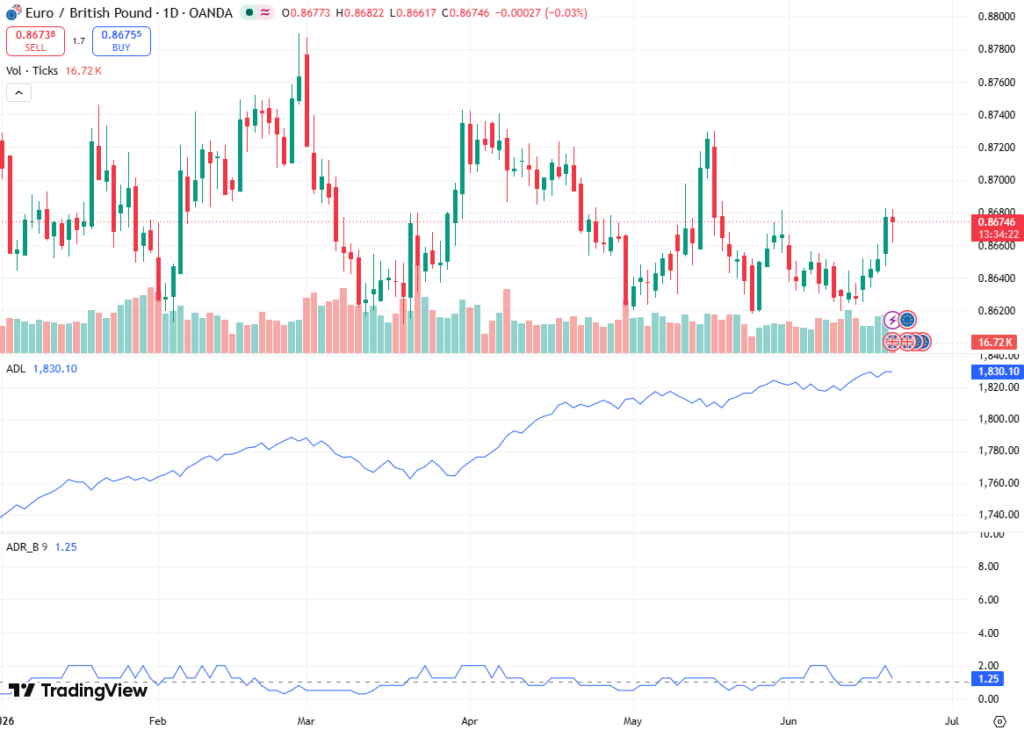
Looking ahead, the EUR/GBP pair is likely to remain in a narrow consolidation range, with markets weighing competing forces on both sides.
For the Pound, upside is supported by strong consumer demand, but capped by rising fiscal deficits and uncertain monetary policy direction. For the Euro, subdued inflation expectations and cautious ECB positioning limit aggressive strength, but also provide relative stability.
In the near term, traders will likely continue to monitor incoming UK fiscal data, BoE communication, and broader Eurozone inflation trends for directional cues. Until clearer macro divergence emerges, EUR/GBP may struggle to break decisively away from the 0.8650–0.8700 range, maintaining a technically balanced but fundamentally sensitive trading environment.