
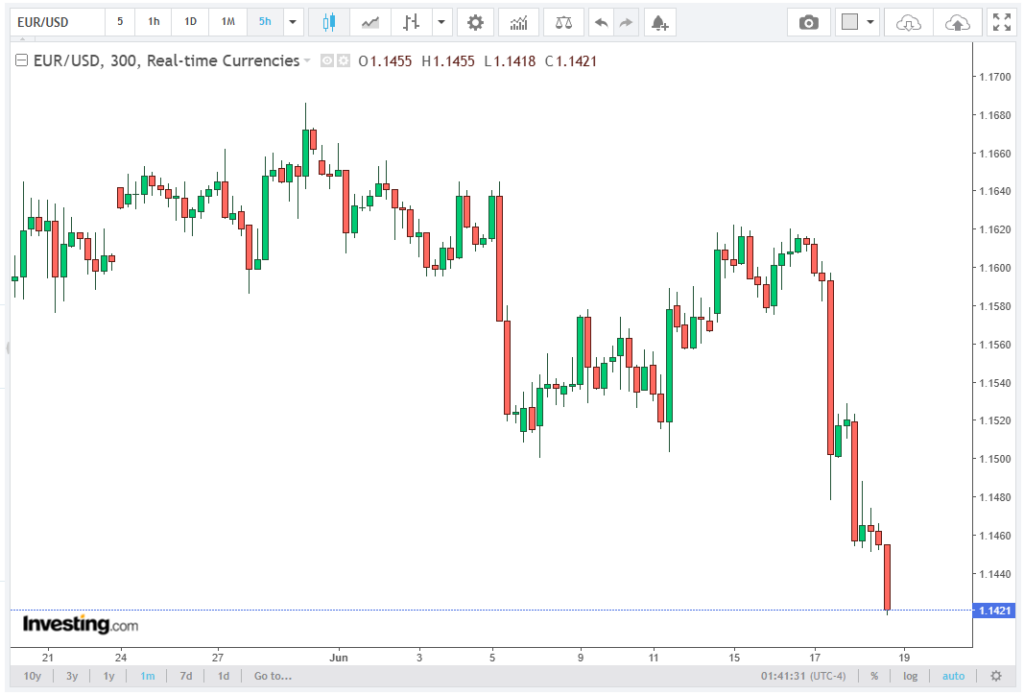
The EUR/USD pair continues to trade in negative territory, slipping toward 1.1425 during the early European session on Friday. The broader tone remains distinctly bearish, with sellers maintaining control as the pair struggles to recover above key short-term resistance levels.
Despite the presence of an oversold momentum signal, downside pressure has not yet fully exhausted, keeping the market biased toward further weakness. Rubinax’s experts present a detailed examination of this topic in the article.
The inability of EUR/USD to reclaim the 1.1450 threshold highlights persistent selling interest and reinforces the notion that the pair is still operating within a corrective downtrend. Market participants remain cautious as macro-political uncertainty and safe-haven flows continue to shape near-term price action.
Fundamental Drivers: Geopolitical Risk Supports USD
A key driver of recent price action is renewed geopolitical uncertainty around US–Iran peace talks. Reports say Bürgenstock negotiations were disrupted, with the Swiss Foreign Ministry confirming the meeting will not proceed as planned. US Vice President JD Vance also reportedly canceled his trip tied to the talks.
Additional signals were added to the instability narrative. Iranian media suggested delegation logistics were unsettled, while regional reports pointed to rising tensions in southern Lebanon delaying diplomatic progress.
These developments are boosting USD safe-haven demand, putting pressure on EUR/USD. In risk-off environments, investors rotate into USD-denominated assets, strengthening the dollar and weighing on risk-sensitive currencies like the EUR.
Overall, the pair remains in a risk-off macro regime, where geopolitical headlines dominate, outweighing euro-supportive fundamentals such as relative monetary stability in Europe.
Technical Overview: Bearish Structure Remains Intact
From a technical standpoint, EUR/USD shows a clear bearish structure on the daily chart. Price remains below the 20-day Bollinger Band midpoint and the 100-day SMA, confirming a strong downtrend bias.
The pair is pressing the lower Bollinger Band, signaling sustained downside momentum. This can reflect either bearish continuation or early momentum exhaustion, but there are still no confirmed reversal signals.
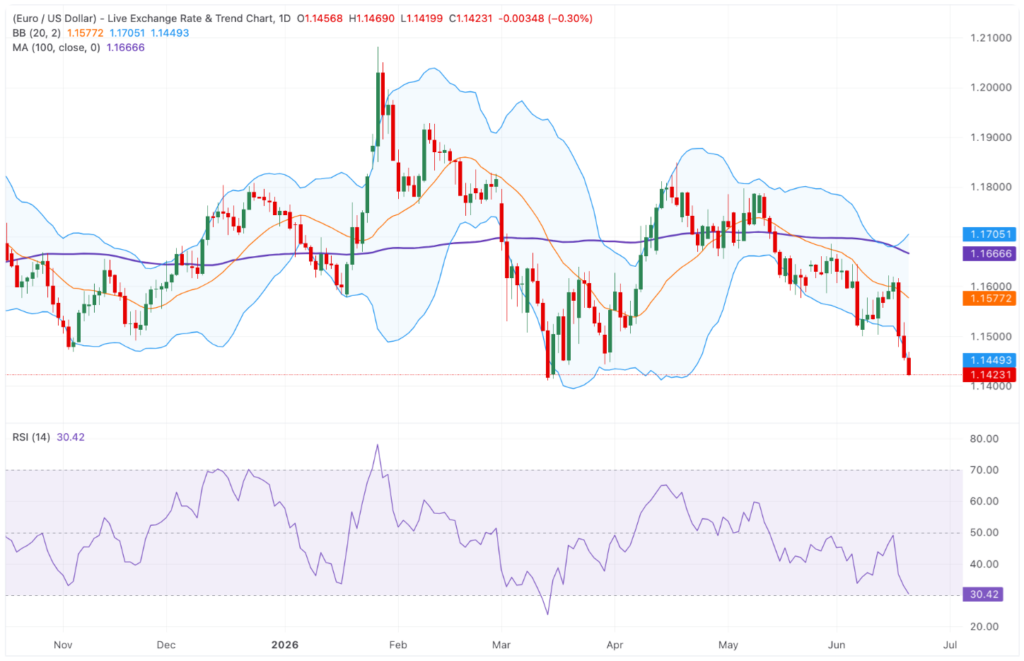
The RSI (~30.6) is in oversold territory. This often signals selling exhaustion risk, but in strong trends, oversold readings can persist. Here, it indicates sellers remain in control, though the risk of a short-term bounce is rising.
Overall, EUR/USD is in a late-stage bearish phase, where further downside is possible, but the market is increasingly vulnerable to consolidation or corrective rebound.
Key Resistance Levels: Recovery Barriers at 1.1450 and Above
On the upside, the first major barrier is located at 1.1450, which aligns closely with the lower Bollinger Band resistance zone. This level now acts as the immediate ceiling for any attempted recovery. A sustained break above this area would be required to signal a meaningful shift in short-term momentum.
Beyond 1.1450, the next critical resistance is found at the 20-day Bollinger SMA near 1.1577. A move toward this level would indicate that bearish pressure is easing and that the market is transitioning into a consolidation phase rather than a trending decline.
Further up, the 100-day SMA at 1.1665 represents a significant medium-term resistance zone. This level has historically acted as a key dynamic supply area, and a recovery toward it would require a substantial shift in macro sentiment and sustained USD weakness.
At the top of the broader structure lies the upper Bollinger Band near 1.1705, which forms a strong technical supply ceiling. Only a decisive breakout above this region would invalidate the current bearish framework and suggest a potential medium-term reversal.
Key Support Levels: 1.1411 as Immediate Pressure Point
On the downside, the first key support level is the March 13 low at 1.1411, a near-term structural floor where buyers may defend further declines.
A sustained break below 1.1411 would likely accelerate bearish momentum, opening the path to deeper downside targets and signaling a continuation of the broader corrective phase, potentially triggering stop-loss selling.
If weakness extends further, the next major support zone sits at the April 23, 2025, low near 1.1308, a significant historical level that could attract longer-term dip-buying interest if tested.
Outlook: Bearish Bias Persists but Oversold Signals Emerging
The near-term outlook for EUR/USD remains firmly bearish, with price action still constrained by a combination of technical resistance and macro-driven USD strength. However, the emergence of oversold RSI conditions introduces the possibility of a short-term technical rebound or consolidation phase.
For now, the market structure suggests that sellers maintain control as long as the pair trades below 1.1450. Only a sustained recovery above this level would begin to neutralize downside pressure and shift momentum toward a more balanced outlook.
Until then, EUR/USD is likely to remain vulnerable to further downside tests, with 1.1411 acting as the key battleground for determining whether the current bearish cycle extends or stabilizes.