
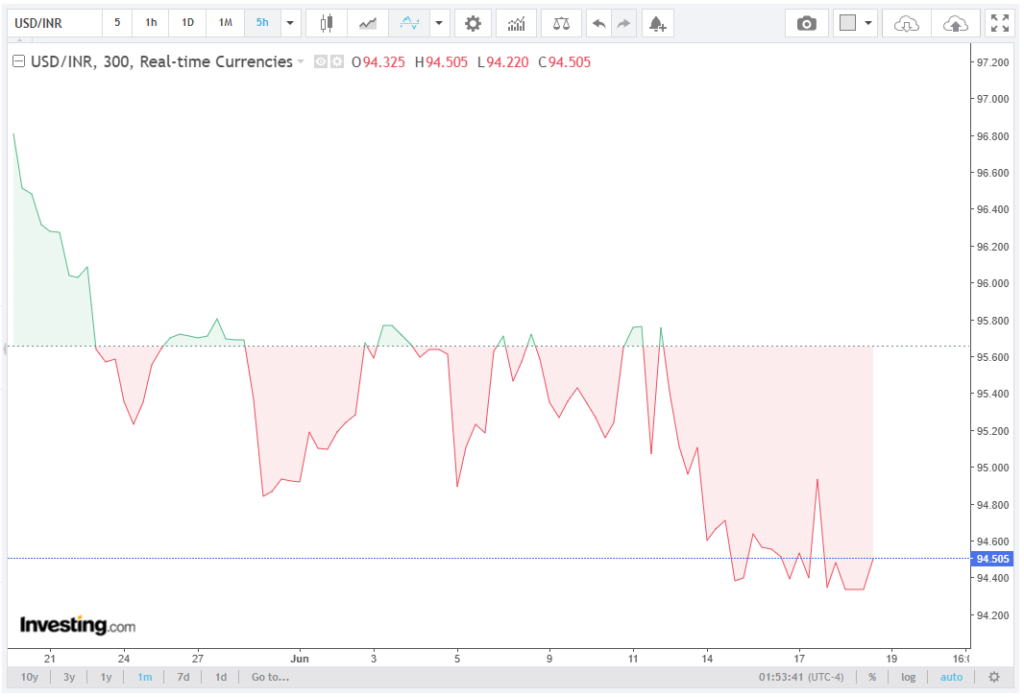
The Indian Rupee (INR) extended its gains for a second consecutive session on Friday, strengthening against the US Dollar (USD) as shifting foreign exchange dynamics drove fresh volatility in the USD/INR pair. The currency pair remained under sustained bearish pressure, with spot trading near 94.30, reflecting broad-based dollar supply in the domestic market.
The latest move lower in USD/INR has been largely attributed to a combination of robust FCNR-B inflows, fixing-related dollar selling, and aggressive exporter liquidation, all of which outweighed the support typically offered by a firm global USD environment.
At the same time, external macro factors such as easing crude oil prices and evolving Federal Reserve (Fed) expectations are shaping near-term direction. Readers can find an in-depth overview of this subject in the article prepared by Rubinax’s brokers.
Strong FCNR-B Inflows and Aggressive Dollar Supply
A key driver of the Rupee’s strength has been sustained Foreign Currency Non-Resident Bank (FCNR-B) inflows, which have injected significant foreign currency liquidity into the domestic banking system. These inflows, typically attracted by relatively stable interest differentials and hedging opportunities, have increased USD supply in the spot market.
Market participants note that fixing-related flows from both private and foreign banks have further intensified downward pressure on USD/INR. As banks adjust their positions around benchmark fixing windows, systematic dollar selling has contributed to intraday weakness in the pair.
In parallel, exporters have accelerated dollar liquidation, converting receivables into rupees at favorable levels. This wave of aggressive unwinding has created a temporary imbalance in FX flows, amplifying Rupee strength.
Dealers also suggest that the Reserve Bank of India (RBI) has intermittently stepped in to absorb excess liquidity, preventing excessive appreciation while maintaining orderly market conditions.
Overall, the convergence of FCNR-B inflows, bank-driven selling, and exporter conversions has created a strong supply-side dynamic for the Rupee.
US Dollar Strength and Hawkish Federal Reserve Outlook
Despite domestic support factors for the Rupee, the broader US Dollar index has remained firm as markets increasingly price in a hawkish Federal Reserve (Fed) stance.
In his first major press briefing, newly appointed Fed Chair Kevin Warsh reiterated that price stability remains the central priority of monetary policy, signaling continued vigilance against inflation persistence. This tone has reinforced expectations that the Fed may maintain restrictive conditions longer than previously anticipated.
The Federal Open Market Committee (FOMC) recently voted unanimously to hold rates in the 3.5%–3.75% range, but the decision carried a distinctly hawkish undertone. Nearly half of policymakers indicated that at least one additional rate hike could still be required before year-end, depending on inflation dynamics.
As a result, traders have begun to reprice US yield expectations, providing underlying support to the USD. This creates a counterbalancing force for USD/INR, limiting the pace of Rupee appreciation despite strong domestic inflows.
Technical Analysis: USD/INR Tests Key Support Zone
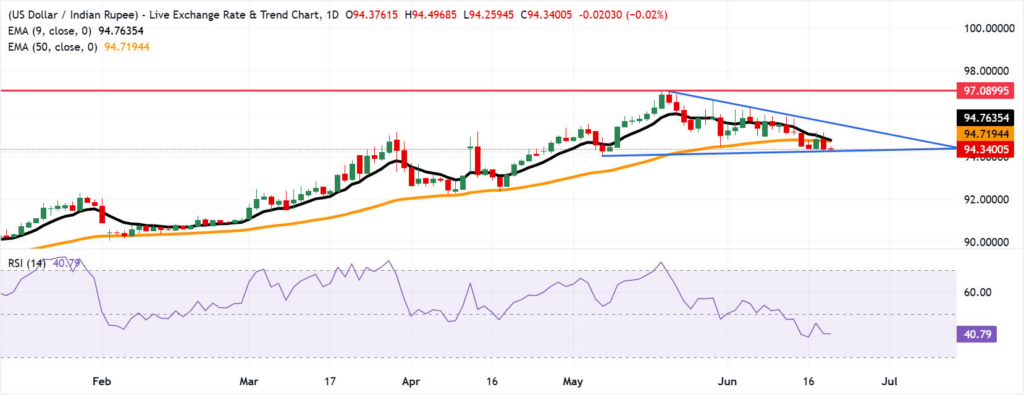
From a technical standpoint, USD/INR continues to display a bearish near-term structure, with price action consolidating below key moving averages. The pair is currently trading around 94.30, testing the lower boundary of a descending triangle pattern.
The spot rate remains below both the 9-period EMA and the 50-period EMA, reinforcing a short-term downtrend bias. This positioning suggests that sellers continue to dominate momentum, with rallies likely to face immediate supply pressure.
The Relative Strength Index (RSI) on the 14-day timeframe is hovering just above 40, indicating weak momentum without entering oversold territory. This reading suggests that while downside pressure is present, there is still room for further depreciation before exhaustion signals emerge.
On the upside, the first major barrier is located at the 50-period EMA near 94.72, followed closely by the 9-period EMA at 94.76. This tight resistance cluster forms a significant technical ceiling, and a sustained break above it would be required to neutralize the current bearish bias.
On the downside, immediate support lies at the descending triangle base around 94.30. A decisive break below this level could open the door for further Rupee appreciation, potentially accelerating stop-loss-driven selling in USD/INR.
Conclusion: Mixed Forces Keep USD/INR Volatile
The downtrend bias pair remains caught between strong domestic inflows and firm external downtrend bias support. On one hand, FCNR-B inflows, exporter dollar selling, and lower crude oil prices are reinforcing Rupee strength. On the other hand, expectations of a hawkish Fed policy trajectory continue to underpin the US Dollar, limiting downside momentum in the pair.
In the near term, the trajectory of USD/INR will likely depend on the sustainability of foreign inflows versus renewed global dollar demand, with technical levels around 94.30–94.76 acting as a critical battleground for market direction.