
The USD/JPY pair continues to trade in a notably tight consolidation range around the 161.60 level during Wednesday’s European session, reflecting a delicate balance between competing macroeconomic forces. This subject is explored in depth by Rubinax’s brokers in the accompanying article.
The market is currently characterized by a tug-of-war between a broadly supportive US Dollar (USD) and increasingly hawkish expectations for the Bank of Japan (BoJ), which are providing underlying support for the Japanese Yen (JPY).
Despite persistent USD strength in global currency markets, USD/JPY has struggled to establish a clear directional breakout. Instead, price action suggests range-bound behavior, with traders hesitant to commit to large directional positions ahead of further clarity from central banks.
The tightening range around 161.60 signals a market in equilibrium, where neither bullish USD momentum nor JPY appreciation catalysts are strong enough to decisively dominate sentiment in the short term.
BoJ Hawkish Shift Supports the Japanese Yen
A key driver behind the Yen’s relative resilience is the evolving stance of the Bank of Japan (BoJ). According to the latest Summary of Opinions (SoP) from the June policy meeting, a majority of BoJ officials now favor additional interest rate hikes to combat persistent inflation risks in Japan.
One particularly notable signal came from a BoJ board member who argued that Japan’s policy rate should be raised toward the estimated neutral rate of around 2% as soon as possible. This remark is significant, as it implies that the BoJ may be transitioning away from its historically ultra-loose monetary policy stance and toward a more normalized rate environment.
At the same time, the BoJ recently executed a 25 basis point (bps) rate hike, bringing interest rates to 1%, marking another step in its gradual policy normalization cycle. While still low by global standards, the direction of travel is increasingly supportive of the JPY.
However, internal disagreement remains evident. Newly appointed BoJ board member Toichiro Asada, aligned with Prime Minister Sanae Takaichi, voted against the rate hike, citing potential downside risks to inflation and employment, particularly linked to geopolitical uncertainty in the Middle East. This dissent highlights that the BoJ’s tightening path is not yet uniform or uncontested.
US Dollar Index Strength Caps Downside in USD/JPY
While the Yen has gained some support from BoJ expectations, the US Dollar Index (DXY) continues to provide a counterbalance. At the time of writing, the DXY is trading around 101.50, marking its highest level in over a year, with a modest daily gain of approximately 0.1%.
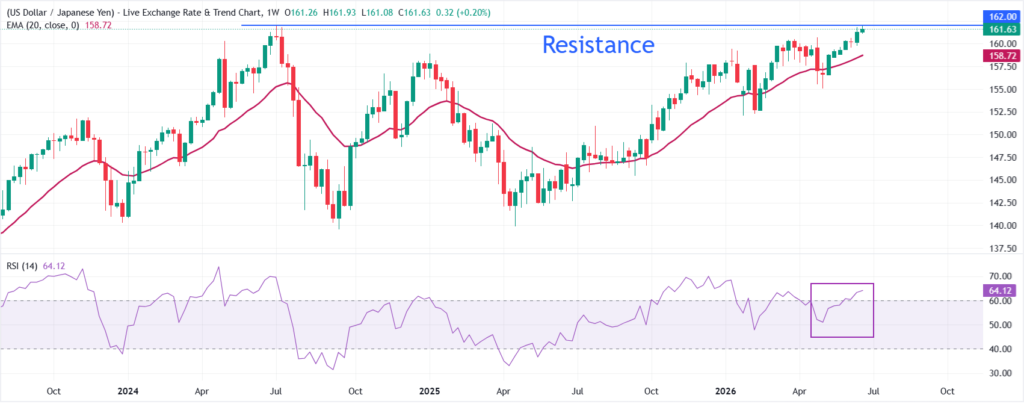
This sustained strength in the Greenback reflects continued demand for USD assets amid global uncertainty and relatively attractive US yield differentials. As long as the USD remains firm, it limits the downside potential in USD/JPY, even as BoJ tightening expectations increase.
A Reuters report further reinforces this dynamic, suggesting that the BoJ is almost certain to deliver another rate hike by December, which may gradually strengthen the Yen over the medium term. However, until that policy move materializes, the USD strength continues to act as a stabilizing force for the pair.
USD/JPY Technical Analysis: Tight Range Signals Impending Breakout
From a technical standpoint, USD/JPY remains firmly locked in a consolidation phase, with price action compressing around the 161.60 pivot zone. This type of structure typically precedes a volatility expansion phase, although direction remains uncertain.
The immediate support zone is seen near 160.80–161.00, where buyers have repeatedly stepped in to defend the downside. A sustained break below this region could open the door toward a deeper correction, potentially targeting lower support clusters.
On the upside, resistance is building around 162.20–162.50, where previous rallies have stalled. A decisive break above this zone would likely signal renewed USD dominance and could trigger momentum-driven buying, extending the bullish trend.
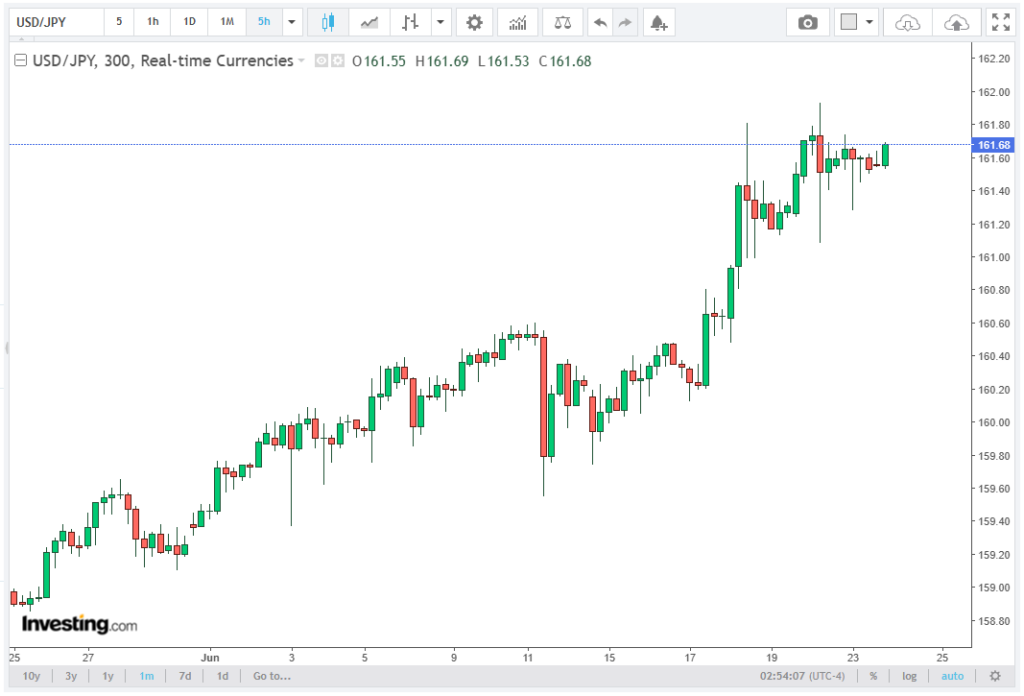
The narrowing price range suggests a volatility squeeze, often associated with declining intraday momentum and increased sensitivity to macroeconomic headlines. Traders should expect that once the range resolves, the resulting move may be sharp and directional.
Outlook: Policy Expectations to Drive Next Major Move
Looking ahead, the trajectory of USD/JPY will likely depend on the relative evolution of BoJ tightening expectations versus US monetary resilience. If the BoJ continues to signal a path toward a 2% neutral rate, the Yen may gradually strengthen, increasing downside pressure on the pair.
However, persistent US Dollar strength, supported by high yields and stable economic indicators, may continue to cap JPY gains in the near term.
For now, the market remains in a compressed trading range around 161.60, with investors awaiting a decisive catalyst. The eventual breakout from this range is likely to define the next medium-term directional trend for USD/JPY, making upcoming central bank commentary and macroeconomic data releases critical to watch.