
The EUR/USD exchange rate remained under significant selling pressure, trading near 1.1200 after declining more than 4.3% from its September high. The pair’s persistent weakness reflects a combination of diverging monetary policy expectations, elevated geopolitical risk, rising crude oil prices, and deteriorating technical momentum.
Market participants are now positioning for critical inflation data that could determine the US dollar’s near-term direction. This article presents the perspective and thorough analysis of one of F24 Group’s experts, Joseph Zainberg.
The primary market catalyst is the upcoming US Consumer Price Index (CPI) report, which could influence expectations for the Federal Reserve’s interest rate trajectory.
Higher-than-expected inflation would likely reinforce the case for maintaining restrictive monetary conditions or implementing an additional rate increase, potentially widening the yield differential between US and eurozone assets. This dynamic would generally favor the US dollar over the euro.
With EUR/USD trading near 1.1200, market sentiment remains tilted to the downside. However, the sustainability of the bearish trend will depend on whether incoming economic data validate expectations of persistent US inflation and relative monetary policy divergence.
US CPI Report and Federal Reserve Rate Expectations
The upcoming US inflation report represents the principal fundamental risk for EUR/USD. Consensus expectations indicate that headline CPI inflation will increase from 3.4% to 3.6%, while core CPI inflation will rise from 2.4% to 2.5%. The projected acceleration in both measures would indicate that inflationary pressures remain persistent.
An upside surprise could increase market-implied probabilities of an additional Federal Reserve rate hike. Higher expected policy rates typically support Treasury yields and improve the relative attractiveness of dollar-denominated assets.
If the US two-year Treasury yield rises relative to its German equivalent, the resulting widening of the US-German yield spread could strengthen the dollar and push EUR/USD lower.
Conversely, an inflation reading below expectations could trigger a short-covering rally. A downside surprise would potentially reduce expectations of additional monetary tightening, weaken US yields, and encourage a recovery toward nearby technical resistance.
The German CPI report will provide additional information about eurozone inflation, with economists forecasting an annual inflation rate of 3.3%. Meanwhile, comments from Federal Reserve officials Susan Collins, Tom Barkin, and Christopher Waller could influence expectations concerning future policy decisions.
With US markets closed for Columbus Day, immediate trading activity may be affected by reduced liquidity before attention shifts toward these catalysts.
EUR/USD Technical Analysis: Bearish Momentum Intensifies
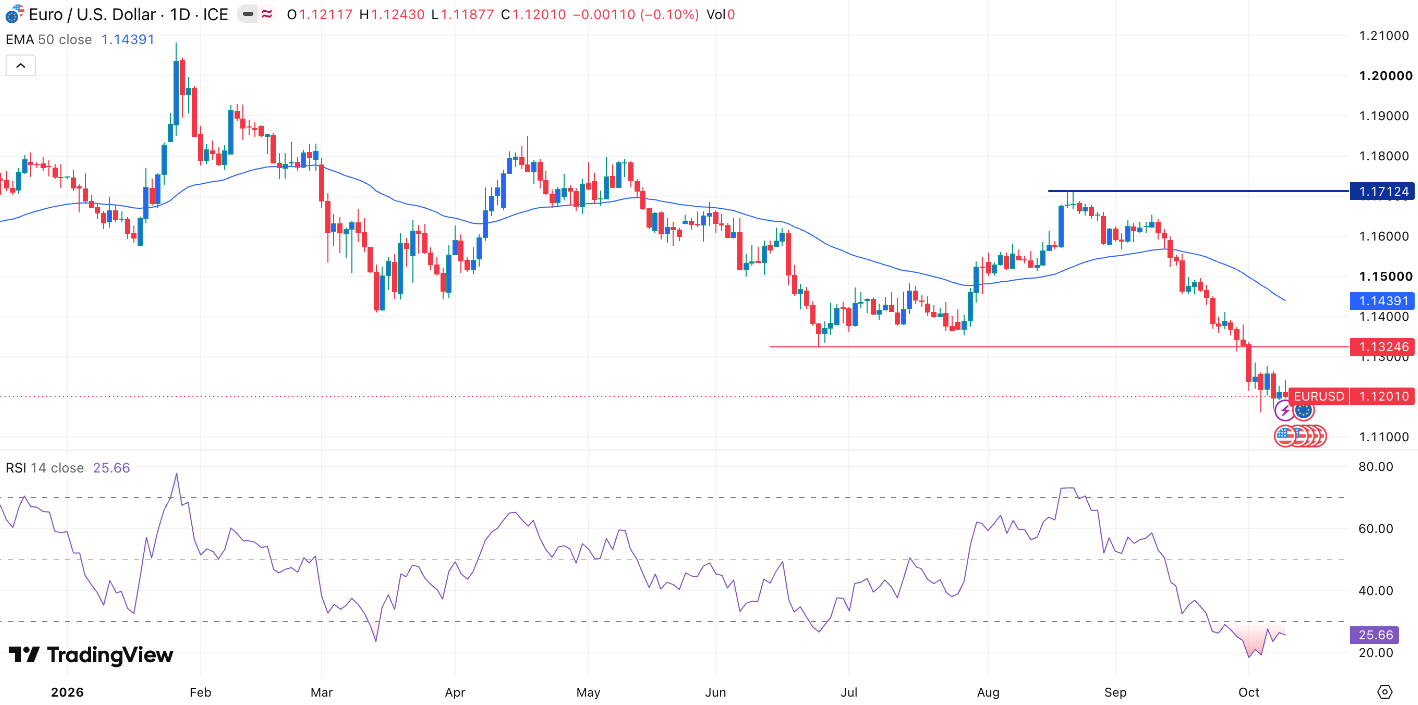
The daily chart shows a clear deterioration in EUR/USD price structure, with the pair falling from approximately 1.1712 in August to 1.1200. This represents a decline of 0.0512, or approximately 512 pips, from the August high.
The broader downward movement suggests that selling pressure has become established rather than remaining a short-lived corrective fluctuation.
The decisive breakdown below 1.1325 support, previously identified as a significant price floor, represents an important bearish signal. The pair is now trading approximately 125 pips below this level, indicating that sellers have maintained control following the support breach.
Unless EUR/USD reclaims 1.1325, the former support zone could act as resistance during recovery attempts.
Additional confirmation comes from the pair’s position below the 50-day Exponential Moving Average (EMA) and the Supertrend indicator. These trend-following indicators suggest that the prevailing market direction remains negative.
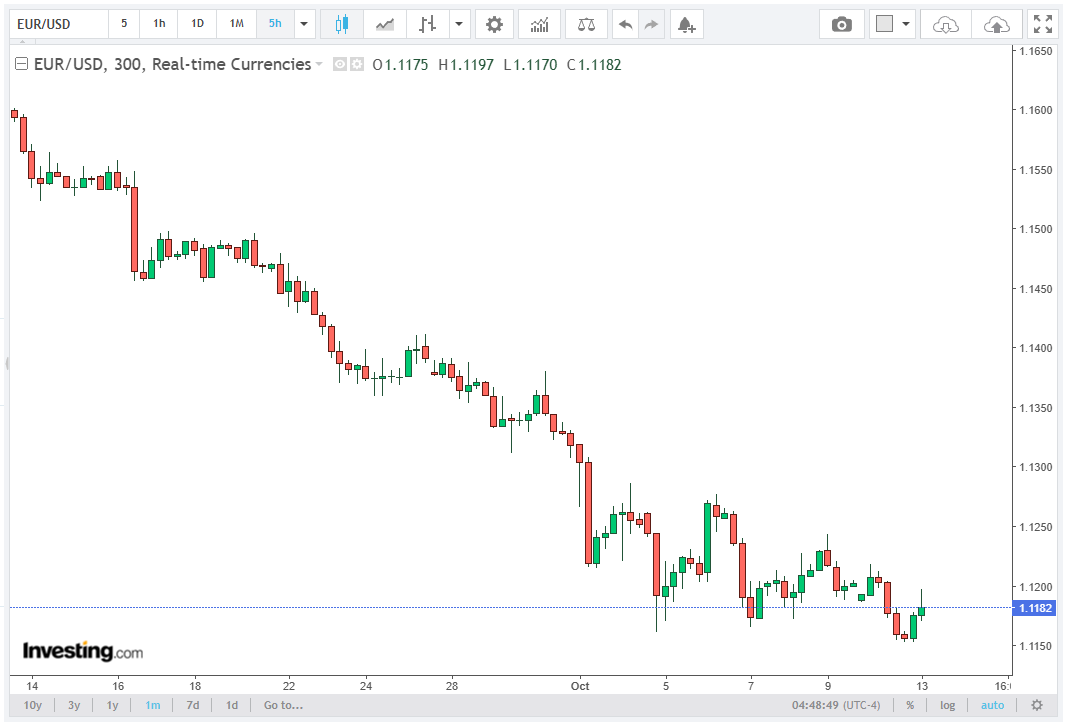
Continued trading beneath both measures would reinforce the probability of further downside, particularly if bearish momentum accelerates following the CPI release.
The Relative Strength Index (RSI) remains in oversold territory, indicating that recent selling pressure has been unusually strong. However, an oversold RSI reading does not independently confirm a reversal. In established downtrends, momentum can remain depressed while prices continue to establish lower lows.
From a technical perspective, 1.1100 represents the next major downside target. A sustained break below 1.1200 would strengthen the bearish continuation scenario, while a recovery above 1.1325 would weaken the immediate negative structure. The 1.1200, 1.1325, and 1.1100 levels therefore represent important reference points for monitoring price action.
Conclusion: EUR/USD Remains Vulnerable to Further Losses
The EUR/USD outlook remains bearish as the pair trades near 1.1200, below its broken 1.1325 support, the 50-day EMA, and the Supertrend indicator.
Forecast US CPI increases to 3.6% headline inflation and 2.5% core inflation could strengthen expectations of tighter Federal Reserve policy, supporting the dollar and exposing 1.1100 as the next downside objective.
Nevertheless, oversold RSI conditions and the possibility of an inflationary downside surprise introduce short-term reversal risk. A sustained recovery above 1.1325 would challenge the bearish thesis, whereas continued weakness below 1.1200 would reinforce the prevailing downward trend.