
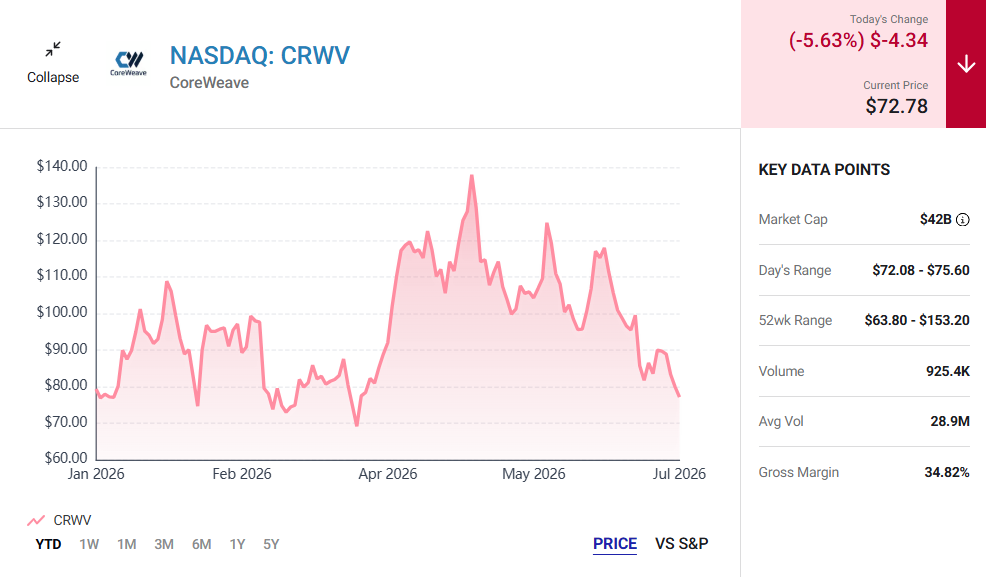
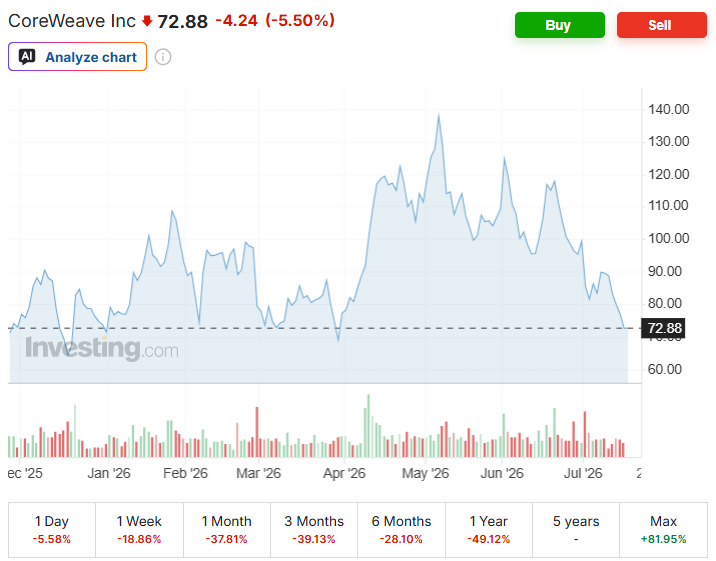
CoreWeave has been a wild ride since its IPO in April 2025. The stock rocketed to one all-time high after another in its early months, riding the broader wave of AI enthusiasm, then reversed hard as sentiment shifted, and now sits roughly 50% below its peak.
Brokers from Rubinax take a closer look at whether the sell-off in this AI cloud stock has gone too far, or not far enough, and what the underlying business looks like beneath the volatile price action. The obvious question is whether this is a genuine buying opportunity or simply a value trap dressed up as a discount.
What CoreWeave Actually Does
CoreWeave operates as a neocloud, renting out AI-focused data center capacity to companies that need serious computing horsepower. Two of its biggest customers are Meta Platforms and Microsoft, both of which lease CoreWeave’s infrastructure to expand their own AI workloads.
Nvidia is also a major backer, holding roughly $3.6 billion worth of CoreWeave stock as of its most recent regulatory filing. Against CoreWeave’s current market cap of around $42 billion, that’s a meaningfully large stake for a company that famously crosses paths with nearly every player in AI.
The Headline That Spooked the Market
Recent weeks brought heavy media coverage around one specific concern: reports suggest Meta is building its own cloud infrastructure business, something Meta’s leadership has previously said would only happen if the company found itself with excess AI computing capacity to lease out.
One way to work through that excess would be scaling back or ending its arrangement with CoreWeave, and that possibility is a big part of why the stock has sold off so sharply in recent days.
That said, there’s a reasonable counterargument here. The AI industry remains compute-constrained across the board right now, meaning demand for processing power still exceeds available supply almost everywhere.
Having extra computing capacity isn’t really a burden in that environment; it’s a valuable asset. That backdrop makes it more likely that Meta’s existing contract with CoreWeave plays out roughly as originally planned, rather than getting torn up.
The Real Question Isn’t Revenue
From a pure growth standpoint, CoreWeave’s numbers look genuinely impressive. Analysts expect 147% revenue growth this year and another 98% growth next year. Those are the kind of figures that usually justify a premium valuation on their own.
The complication is profitability, not revenue. Wall Street projects the company will lose $4.64 per share this year, as it continues pouring capital into building out data center capacity as fast as it can.
Those losses aren’t a sign of a broken business model so much as a deliberate choice: CoreWeave is prioritizing market share and infrastructure buildout over near-term profits, and it likely won’t flip the switch to profitability until it decides it has captured enough of the market to justify slowing down.
What the Valuation Actually Says
This is where the discount starts to look interesting. CoreWeave currently trades at 7.1 times sales, a notably cheap multiple for a company growing this fast. Run a hypothetical scenario where the company hits a 30% profit margin, and that valuation translates to roughly 24 times earnings, a reasonable multiple for a business with this kind of growth trajectory.
Push the analysis forward using next year’s revenue estimates instead, and the stock is valued at just 1.9 times forward sales. Apply that same hypothetical 30% margin, and CoreWeave would be trading at roughly 6.3 times forward earnings, a genuinely inexpensive figure if the company can execute.
So, Bargain or Trap?
The honest answer is that it depends on your time horizon and your appetite for ongoing losses. CoreWeave’s growth story remains intact, its customer relationships with major AI players appear durable despite the recent scare, and its valuation on a sales basis looks reasonable relative to its growth rate.
Yet profitability is likely years away, not quarters, and shareholders need to be comfortable watching the company keep booking losses while it builds out its footprint.
For investors weighing whether to step in here, the more useful anchor point isn’t the stock’s post-IPO highs from last year. It’s where the stock trades today, against where its business is realistically headed over the next several years.
Judged against that standard, CoreWeave looks less like a stock that’s fallen out of favor and more like one that’s simply being repriced for a longer, more capital-intensive road to profitability than early investors have initially assumed.