
Taiwan Semiconductor Manufacturing, known as TSMC, makes the world’s most advanced AI chips, and its latest quarterly results just delivered the clearest evidence yet that AI adoption is still accelerating.
Ever since the AI boom took off in early 2023, investors have debated whether the spending surge is sustainable or headed for a correction. Brokers from Rubinax walk through what the numbers actually show, and why the stock’s reaction to a blowout quarter wasn’t as straightforward as the headline figures suggest.
TSMC sits at the center of that debate because nearly every leading AI chip runs through its foundries.
A Genuinely Record-Breaking Quarter
The headline numbers here are hard to argue with. TSMC generated roughly $40.2 billion in revenue for the quarter, up 36% year over year.
Profitability expanded even faster than sales: gross margin climbed to 67.7%, up from 58.6% a year earlier, while net profit margin surged to 55.6%, up from 42.7%. That combination pushed diluted earnings per share to a record, up 77% year over year and 23% quarter over quarter.
Demand was especially strong in TSMC’s most advanced manufacturing processes. Its 3-nanometer, 5-nanometer, and 7-nanometer chips accounted for 30%, 33%, and 11% of revenue respectively, and chips built for high-performance computing, the category that includes AI workloads, made up 66% of total revenue. Smartphone chips, once TSMC’s bread and butter, now account for just 22%.
So Why Did the Stock Sell Off?
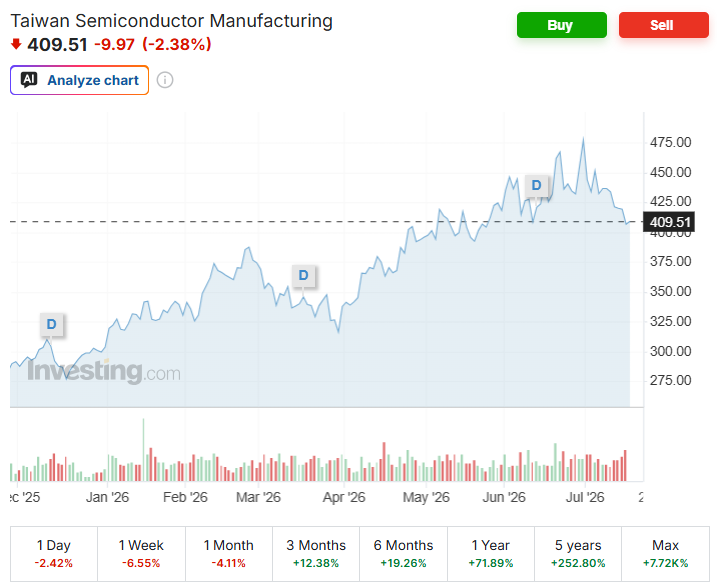
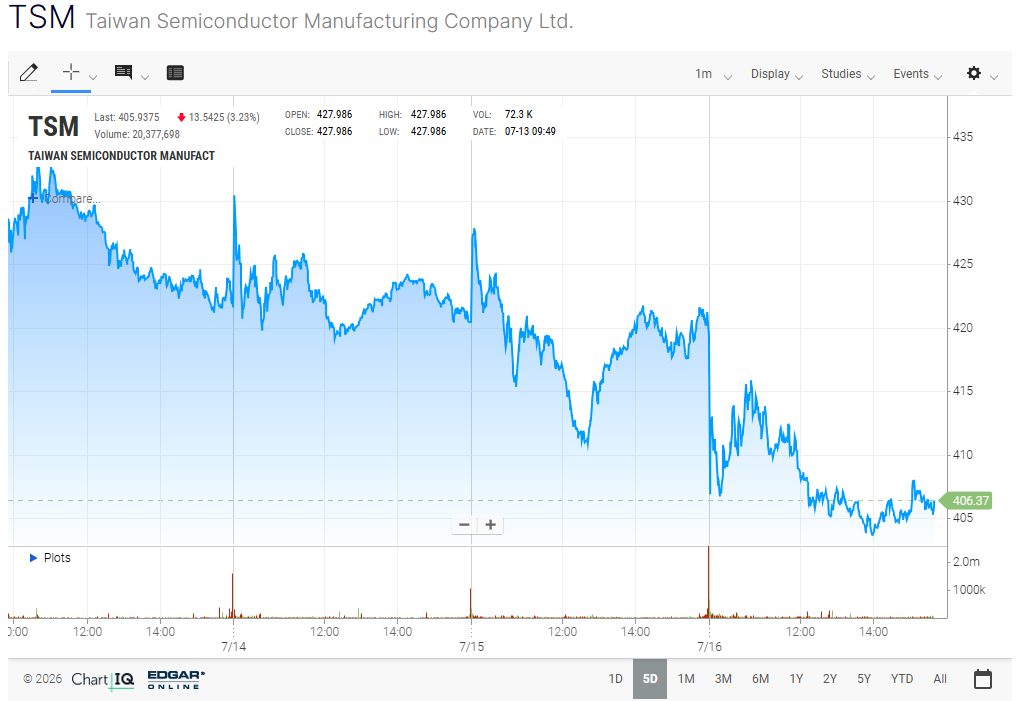
Despite those numbers, TSMC shares fell after the report. The reason comes down to spending, not sales. Management raised its capital expenditure forecast to a range of $60 billion to $64 billion, up from a prior estimate of $52 billion to $56 billion, and signaled that spending over the next three years will run significantly higher than the past three years combined.
That’s the kind of announcement that makes some investors nervous, even when it’s driven by genuine demand rather than desperation. Heavier capex typically pressures margins in the near term, since the company is paying upfront for capacity that won’t generate revenue immediately. In other words, the market punished TSMC for investing aggressively in growth it’s already seeing, which is a fairly common pattern for capital-intensive businesses riding a real demand wave.
TSMC also confirmed an additional $100 billion investment in its Arizona facility, bringing its total commitment there to $265 billion. That expansion is aimed at building next-generation 2-nanometer production capacity, along with advanced packaging facilities to serve major U.S. customers. It’s a long-term bet on staying ahead technologically, not a defensive move.
Guidance Backs Up the Growth Story
Looking ahead, TSMC is forecasting third-quarter revenue of $44.6 billion to $45.8 billion, which would represent roughly 37% growth at the midpoint. Management also guided for gross and operating margins of 66% and 57%, respectively. Those numbers are hard to reconcile with the idea that AI chip demand is cooling off. If anything, they point in the opposite direction.
Valuation Still Looks Reasonable
Here’s the detail that stands out most: despite functioning as a near-monopoly in advanced chip manufacturing and posting a fifth consecutive quarter of record profits, TSMC’s stock isn’t priced like a company cornering an essential piece of AI infrastructure.
Shares currently trade at 34 times trailing earnings and 25 times forward earnings. For a business that sits at the center of practically every advanced AI chip produced globally, that’s a relatively modest multiple.
The Bigger Picture for Investors
TSMC’s results matter well beyond its own stock price. Because its foundries produce chips for nearly every major AI hardware company, its quarterly numbers function as a real-time gauge of AI demand across the entire industry.
A quarter this strong, paired with guidance that points to continued acceleration rather than deceleration, is a meaningful data point for anyone trying to separate genuine AI-driven growth from speculative hype.
The heavier capex spending is worth watching, since it will likely compress margins somewhat in the near term. But that trade-off looks less like a warning sign and more like a company positioning itself to meet demand it’s already seeing firsthand.
For investors trying to gauge whether the AI buildout still has legs, TSMC’s latest quarter offers about as clear an answer as the market is likely to get.