
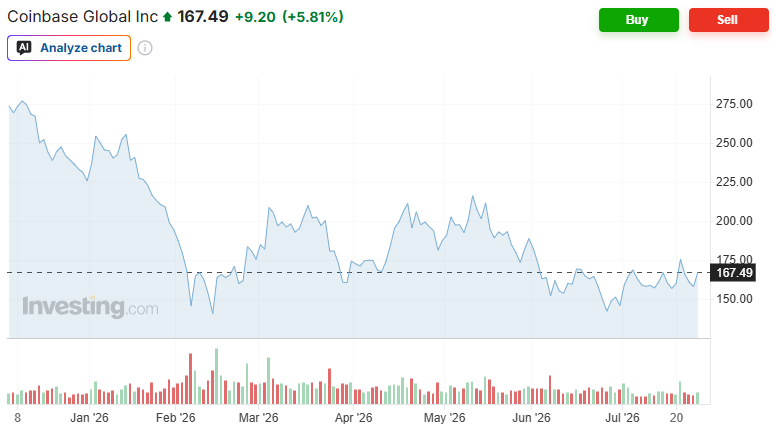
Coinbase stock has lost more than 60% of its value over the past 12 months, as macro headwinds and a cooling crypto market chipped away at investor confidence. Brokers from Bankolla dive into why this steep pullback might not be the buying opportunity contrarian investors are hoping for, and what would need to change before the stock finds solid footing.
Why the Sell-Off Has Been So Brutal
Coinbase’s revenue model is tightly linked to trading activity, with transaction fees on spot crypto trades making up the bulk of its income. That structure means performance is highly sensitive to interest rate expectations, more so than many traditional financial firms.
When interest rates fall, liquidity increases and investors tend to shift toward higher-risk assets like cryptocurrencies, driving trading volumes and boosting Coinbase’s revenue. Conversely, rising rates reduce risk appetite, pulling capital back into safer assets and cooling crypto markets quickly.

This year, that relationship has worked against the company. Renewed inflation concerns have forced markets to reprice expectations toward potential rate hikes, rather than the cuts many had anticipated earlier. As a result, crypto momentum has weakened, leading to lower trading activity and increased revenue pressure for Coinbase despite underlying adoption trends remaining intact.
A Crowded Field of Competitors
Beyond macro pressure, Coinbase faces intensifying competitive headwinds. The platform is up against Binance, which continues to dominate global trading volumes, alongside traditional brokerages expanding into crypto and fintech apps offering low-cost alternatives.
This increasingly crowded landscape compresses margins and raises customer acquisition costs, making it harder for Coinbase to defend market share, let alone expand it. Even if crypto sentiment improves, competition limits how much of that upside flows through to revenue.
The key risk is structural: greater competition reduces pricing power, particularly on transaction fees, which remain Coinbase’s core income stream. In practical terms, that means higher volumes may not translate into proportional revenue growth, challenging the company’s long-term scalability despite broader industry tailwinds.
Regulatory Clouds Still Hanging Overhead
Stablecoins accounted for nearly a fifth of Coinbase’s revenue in 2025, positioning them as a meaningful growth driver but one now facing rising uncertainty.
The key issue is regulatory. Critical stablecoin legislation remains stalled in the U.S. Senate, leaving the future framework for this segment unclear. Without defined rules, growth visibility is limited, and Coinbase’s ability to expand this revenue stream remains constrained.
Beyond the U.S., global crypto regulation is evolving unevenly, adding another layer of unpredictability. Different jurisdictions are moving at different speeds, creating fragmented compliance requirements and increasing operational complexity.
For investors, the takeaway is straightforward: a significant revenue pillar is now tied to unresolved policy decisions. That uncertainty makes it harder to assess Coinbase’s trajectory heading into the second half of the year, even as broader crypto adoption trends remain intact.
The Financial Picture Isn’t Pretty Either
Coinbase has moved to cut costs and reduce headcount, but the impact has been limited so far.
Despite those efforts, the company reported back-to-back quarterly losses in Q4 2025 and Q1 2026, underscoring how deeply its performance is tied to trading activity levels rather than just internal efficiency.
The takeaway is clear: cost discipline alone cannot fully offset a weak trading environment. When volumes fall, revenue pressure builds quickly, and expense reductions can only go so far.
This highlights a structural challenge Coinbase’s earnings remain highly cyclical, rising and falling with crypto market sentiment. Until trading activity rebounds meaningfully, profitability is likely to remain uneven, even with tighter cost control in place.
Is the Valuation Actually a Bargain?
Despite the sharp pullback, Coinbase’s valuation remains relatively elevated. Shares trade at roughly 21× forward adjusted EBITDA, a level that assumes a meaningful recovery in trading activity.
Growth expectations also appear modest. Analysts project ~5% annual revenue growth and ~7% EBITDA growth through 2028, figures that fall short of what investors typically expect from a high-volatility, high-risk sector like crypto.
The challenge is that these forecasts rely heavily on a market that is inherently unpredictable. Crypto cycles are driven as much by sentiment and macro conditions as by fundamentals, making long-term projections difficult to trust with high confidence.
For investors, the key takeaway is clear: the recent decline alone doesn’t guarantee value. Without a sustained recovery in trading volumes and clearer regulatory direction, the current valuation may still leave limited room for error.
What It Would Take for a Real Turnaround
Coinbase built a genuine early mover advantage in crypto exchanges, but that edge alone isn’t enough to offset its current headwinds.
A sustainable rebound likely depends on interest rates stabilizing, stalled stablecoin legislation finally passing, and the company finding new ways to widen its competitive moat. Until those pieces fall into place, the stock may continue to struggle even as the broader market looks for signs of a bottom.