
AbbVie is set to report second-quarter earnings before the market opens on July 31, hoping to build on the momentum from a strong first-quarter beat. Brokers from Bankolla dive into whether the recent rally sets the stock up for further gains, or whether investors should brace for some post-earnings turbulence.
What Wall Street Expects This Time
Analysts expect AbbVie to deliver earnings of around $3.61 per share, marking a strong 21.5% year-over-year increase. That rebound reflects a well-executed transition strategy rather than a surprise turnaround.
The key driver has been AbbVie’s ability to offset the loss of exclusivity for Humira, once its top-selling drug. While biosimilar competition has weighed on Humira sales, the company has successfully leaned on newer immunology treatments to fill the gap.
Drugs like Skyrizi and Rinvoq have gained traction, helping to stabilise revenue and restore growth momentum. This shift highlights AbbVie’s pipeline strength and commercial execution, positioning it to navigate one of the biggest patent cliffs in the pharmaceutical sector.
For investors, the story is no longer about decline; it’s about how effectively AbbVie can sustain this next phase of growth.
The Growth Engines Picking Up the Slack
AbbVie’s immunology portfolio led by Rinvoq and Skyrizi is now the core engine behind its earnings recovery. These therapies have rapidly scaled, replacing lost revenue from Humira and restoring growth momentum.
The strategy is not stopping there. AbbVie’s pending $10.9 billion acquisition of Apogee Therapeutics reinforces a clear long-term direction: double down on immunology as a durable growth pillar.
Rather than acting as a temporary fix for the Humira patent cliff, this move signals continued investment in next-generation treatments, expanding both pipeline depth and future revenue streams.
For investors, the message is clear AbbVie is transitioning from defending against decline to actively building its next phase of growth, with immunology at the centre of that strategy.
A Warning Sign Worth Watching
Not everything is lining up perfectly. Just weeks ago, management flagged one-time charges that are expected to weigh on the upcoming earnings report.
Despite that caution, shares have continued to climb, pushing expectations higher and leaving less room for disappointment. That disconnect raises the risk of a “sell the news” reaction if results fail to clear the market’s elevated bar.
In other words, the issue isn’t just performance, it’s positioning. When sentiment runs ahead of fundamentals, even solid results can trigger downside if they fall short of increasingly optimistic forecasts.

Why a Strong Quarter Could Still Send Shares Lower
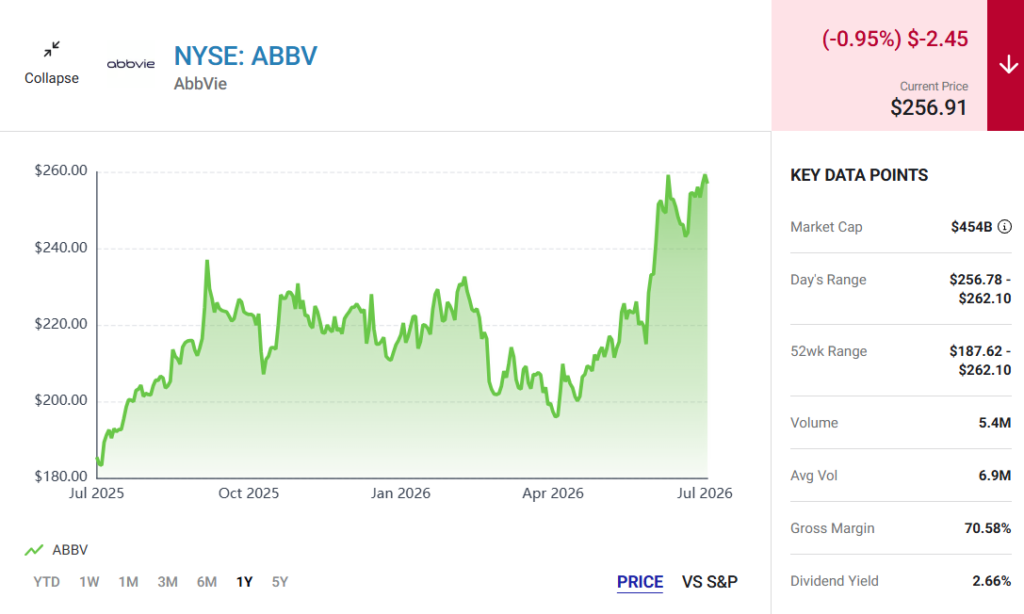
AbbVie has been on a powerful run, and that momentum can become a double-edged sword heading into earnings. Stocks that rally sharply beforehand often face profit-taking pressure, regardless of how strong the actual results are.
Even a modest earnings miss or guidance that simply fails to exceed elevated expectations could trigger a pullback. In this setup, the bar isn’t just high it’s rising.
The key risk isn’t necessarily weak performance, but a mismatch between expectations and delivery. When sentiment and positioning run ahead of fundamentals, it creates multiple paths to short-term downside even if the core business continues to execute well.
The Numbers Behind the Stock Right Now
AbbVie is trading near $256.91, just shy of its 52-week high of $262.10, with a market capitalisation of $454 billion, a setup that reflects strong recent momentum but also leaves little margin for disappointment.
The stock’s ~2.7% dividend yield becomes especially relevant in this context. When valuations are stretched and short-term volatility rises around earnings, that income component can help anchor investor sentiment and cushion potential downside.
Still, with shares hovering near peak levels, the focus shifts to whether results can justify the current premium. If expectations slip even slightly the combination of elevated positioning and pre-earnings optimism could amplify near-term swings, regardless of the underlying business strength.
The Smartest Move for Investors Right Now
For long-term holders, a post-earnings dip isn’t a sell signal. The more disciplined approach is to stay invested and continue collecting AbbVie’s dividend while its immunology-led growth story plays out. Short-term volatility doesn’t alter the broader trajectory.
For those still on the sidelines, any pullback driven by profit-taking could present a more compelling entry point. The underlying business remains intact, with earnings growth supported by its expanding portfolio.
In both cases, the focus should remain on long-term fundamentals rather than near-term price swings. Market reactions around earnings can be noisy, but they rarely redefine the core investment case when the company continues to execute.