
Robinhood’s newly launched blockchain has posted numbers most crypto networks would envy. Brokers from Bankolla dive into why this early success is actually a warning sign for Ethereum, the very network the new chain depends on.
A Fast Start by Any Measure
Robinhood Markets moved quickly into crypto infrastructure with the launch of its Layer-2 network, the Robinhood Chain, on July 1, built using Arbitrum technology on top of Ethereum.
The early traction has been notable. In just a few weeks, the network has reached $257.4 million in total value locked (TVL) a level that many competing chains take years to achieve. Activity has been equally strong, with $4.5 billion in decentralised exchange trading volume recorded in the seven days ending July 20.
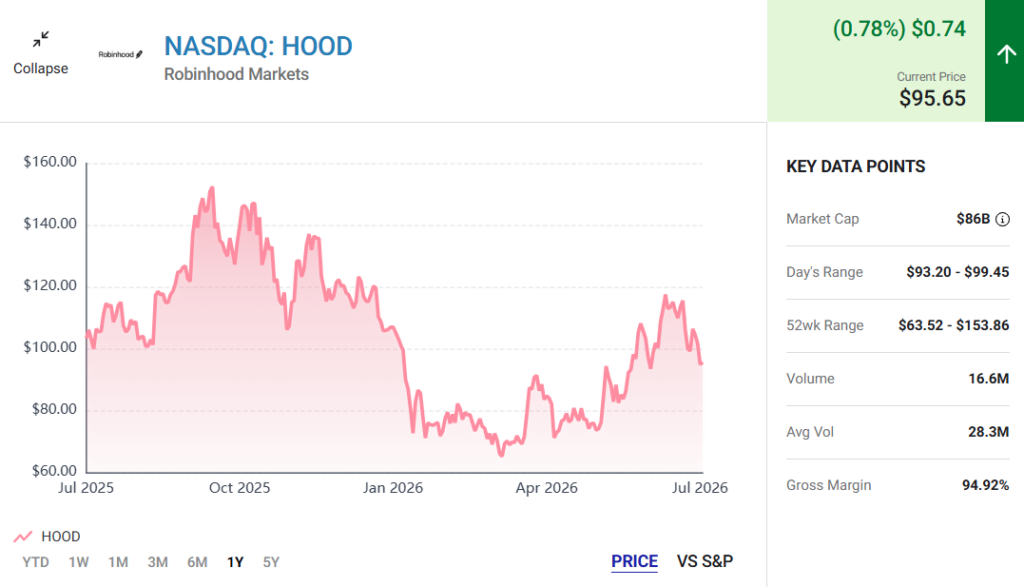
The key takeaway is speed of adoption. Rapid capital inflows and trading activity suggest strong user demand and effective distribution through Robinhood’s platform.
However, while usage metrics are impressive, the more important question for investors remains who ultimately captures the economic value generated by that growth.
How Layer-2 Networks Actually Work
Layer-2 networks process transactions away from Ethereum’s main chain to ease congestion, similar to how a side street diverts traffic from a busy main road. Transactions get bundled together for efficiency before being sent back to the main chain.
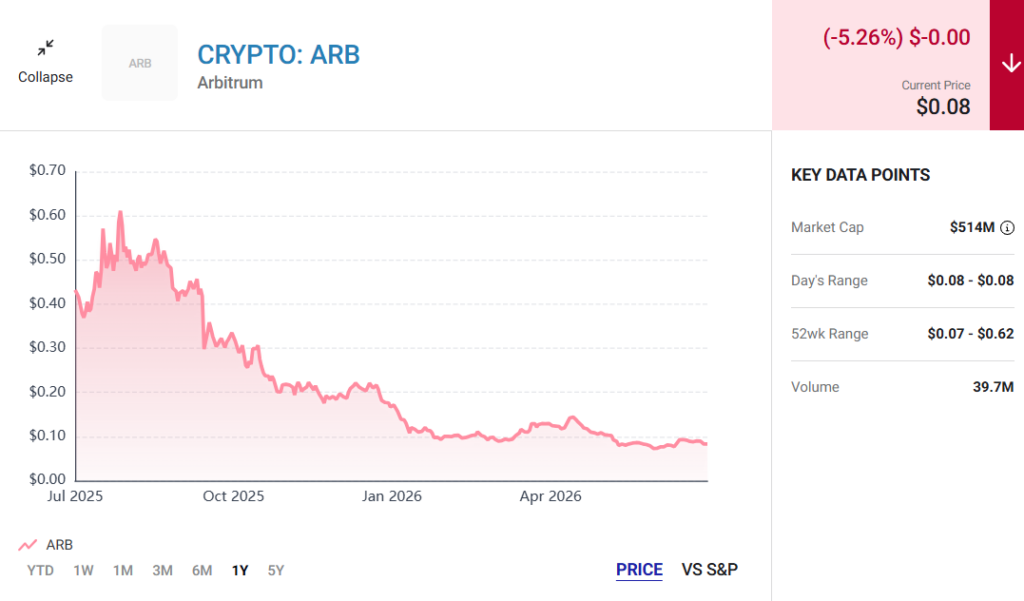
In this case, Robinhood Chain runs on Arbitrum’s Orbit technology stack, with gas fees denominated in Ether, which is where the trouble for Ethereum begins.
Where the Money Actually Goes
The fee breakdown makes the economics clear. Robinhood Chain captures the vast majority of value generated on its network, leaving only a small fraction for the underlying infrastructure.
Out of roughly $816,000 in cumulative fees, about $80,000 flowed to Arbitrum, while Ethereum received just ~$1,538. That distribution highlights a critical imbalance: the base layer securing the ecosystem captures only a negligible share of the value being created on top of it.
The structure 90% of revenue retained by Robinhood, 10% shared with Arbitrum, and an even smaller residual reaching Ethereum undermines the traditional argument that increased activity strengthens ETH through fee burn and scarcity.
In practical terms, usage is rising, but value accrual is being redirected elsewhere. Until Ethereum captures a larger share of Layer-2 economics, growth at the application layer does not meaningfully translate into stronger fundamentals for ETH holders.
A Structural Problem, Not a Temporary One
This isn’t a quirk that will fix itself over time. Ethereum’s recent Fusaka upgrade added a fee floor meant to direct more value back to Ether holders from Layer-2 activity, but that floor is set far too low to meaningfully change Robinhood Chain’s economics.
Closing the gap would require sweeping changes to Ethereum’s tokenomics, supply mechanics, and staking yields, according to one crypto strategist, and no such overhaul is currently on the table.
Why Rising Ethereum Prices Are Missing the Point
Ethereum’s recent price strength has been driven largely by the idea that more network activity automatically translates into higher value for ETH holders. However, that assumption breaks down in this case.
The fee structure of the Robinhood Chain, built on Layer-2 infrastructure, directs a significant portion of economic value toward Arbitrum participants and Robinhood shareholders, rather than back to Ethereum itself. This weakens one of the core pillars of the bullish thesis fee-driven scarcity where higher usage leads to more ETH being burned and supply tightening.
The key issue is value capture. Activity may be increasing across the broader ecosystem, but if Ethereum is not capturing a proportional share of that value, the direct benefit to ETH holders remains limited.
Until mechanisms change to better align usage with on-chain value accrual, rising activity alone is not enough to justify a stronger long-term investment case for Ethereum.
What Would Actually Change the Math
There is a scenario where this dynamic reverses in a meaningful way. If Ethereum’s developers redesign the network to capture a larger share of Layer-2 activity revenue, and redirect that income toward reducing Ether’s circulating supply similar to a stock buyback the impact could be significant.
In that case, increased usage on external platforms, including those built by companies like Robinhood, would directly benefit Ether holders by tightening supply and potentially supporting price appreciation.
However, that outcome depends on structural changes that have not yet been implemented. For now, much of the value generated on Layer-2 networks remains outside Ethereum’s direct economic capture.
Until that shifts, growth on these chains does little to materially strengthen the long-term investment case for holding Ether itself, despite rising adoption across the broader ecosystem.