
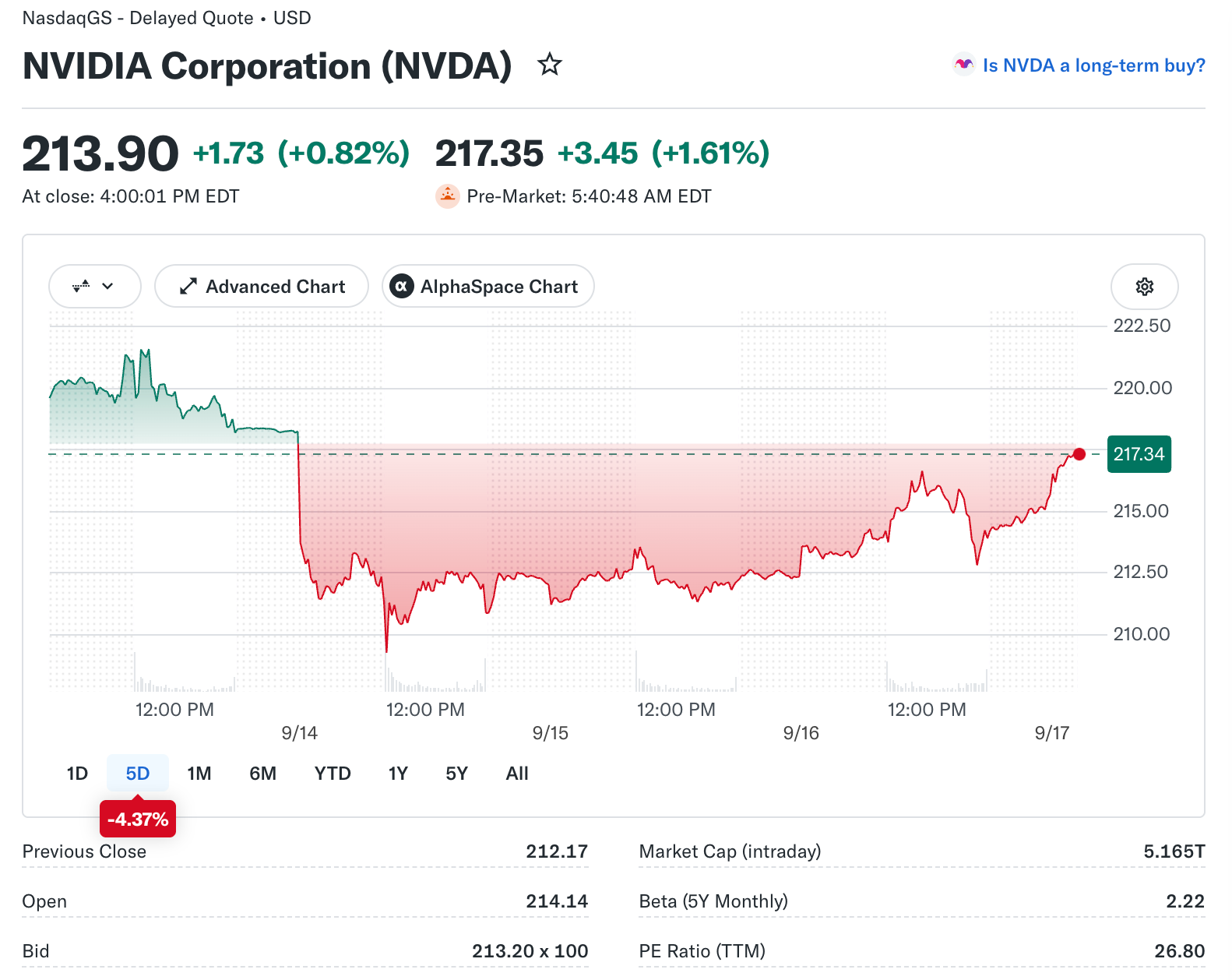
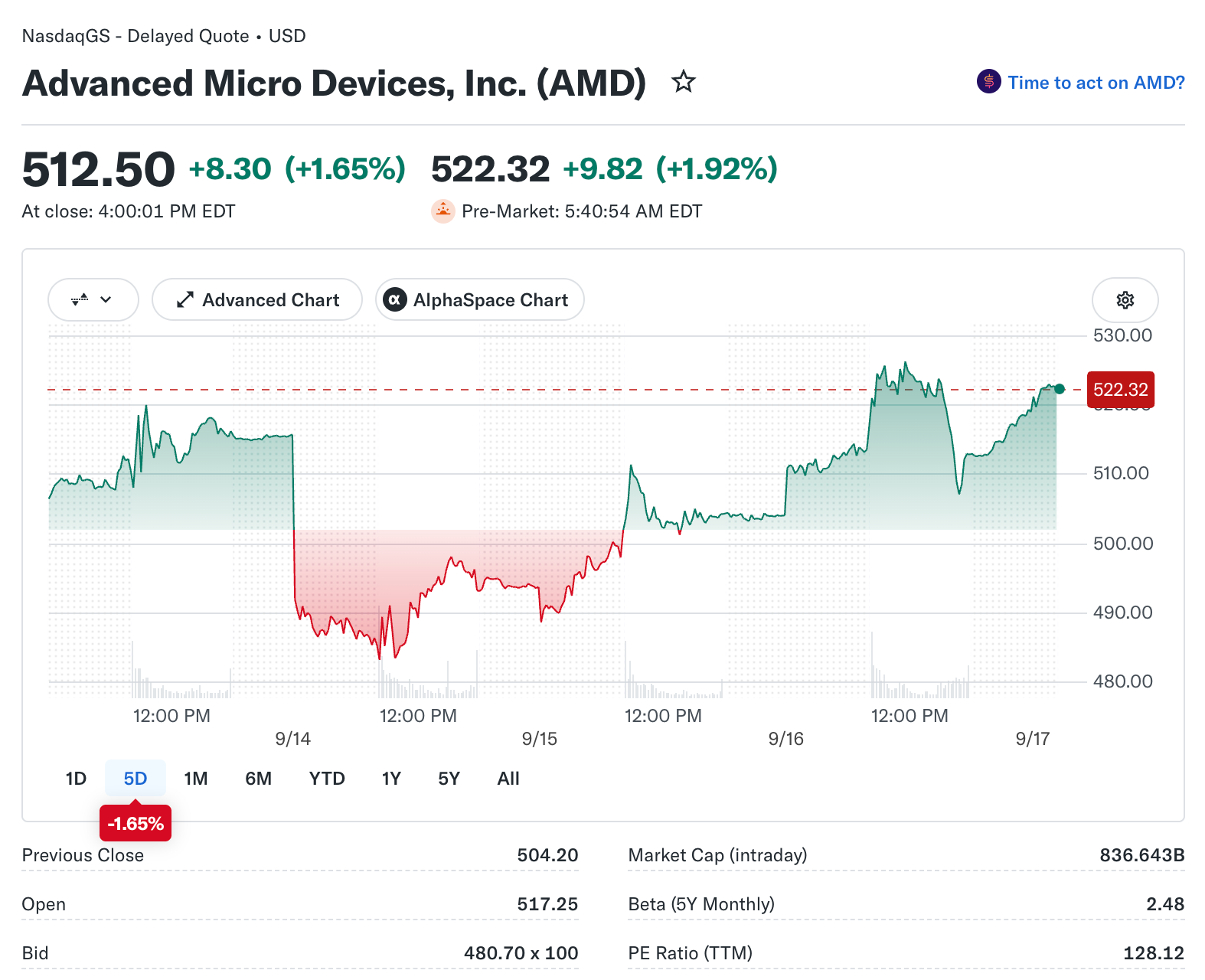
Semiconductor names took a hit this week that had almost nothing to do with interest rates. NVIDIA fell 3.36% on Monday, wiping out roughly $176.6 billion in market value in a single session. Broadcom and AMD followed with drops of 4.77% and 4.4%, dragging the Nasdaq down 0.56% as broader worries about the pace of AI development resurfaced.
A senior financial analyst at NOQANA says the selloff reflects growing unease about how fast AI infrastructure spending can actually scale. Chip stocks had spent much of 2026 climbing on the assumption that hyperscaler capital spending would keep expanding without interruption. Any hint that pace might slow, even briefly, is enough to trigger a sharp reaction across the entire sector.
That reaction looks especially sharp given how far these stocks had already run. NVIDIA closed a recent session at $227.98, up nearly 16% over the prior month and more than 22% year to date heading into this pullback. A stock moving that fast in one direction tends to overreact just as quickly once sentiment turns, even slightly.
The Valuation Gap Analysts Keep Pointing To
A financial expert at the brand underlines an unusual detail sitting beneath this week’s selloff. By one widely used valuation model, NVIDIA currently trades at roughly 45.6% below its estimated fair value, even after accounting for this week’s decline.
That kind of gap between price action and underlying valuation metrics suggests the drop may reflect sentiment shifts more than any deterioration in the company’s actual business.
The numbers behind that valuation gap are substantial. NVIDIA’s most recent quarterly report showed $96 billion in revenue, with data center demand continuing to outpace available supply. Cloud industry backlog tied to AI infrastructure now sits above $2 trillion, and top hyperscalers are tracking toward nearly $800 billion in combined capital spending for 2026 alone.
Why Broadcom’s Numbers Complicate the Bearish Case
A lead broker at the brand discusses why Broadcom’s own results make this week’s pullback harder to justify on fundamentals alone. The company’s most recent quarter delivered $29.59 billion in revenue, up 85.5% year over year, with AI semiconductor revenue climbing 221% to reach $16.7 billion. That segment now makes up 56% of total revenue, a sharp jump from 49% just one quarter earlier.
Management’s forward guidance looks even more aggressive. Broadcom projects AI semiconductor revenue reaching $21.7 billion in the current quarter, with a multi-year trajectory pointing toward roughly $115 billion in fiscal 2027 and $230 billion by fiscal 2028.
Numbers of that scale rarely align with a sector genuinely losing momentum, which makes this week’s price action look more like a sentiment reset than a fundamental repricing.
The Political Backdrop Adding Extra Noise
A junior financial expert at the brand points out that political commentary has added an unusual layer of volatility to this sector recently.
Comments describing opposition to new data center construction as overstated made headlines this week, feeding directly into an already tense debate about how fast AI infrastructure should expand. High-profile industry figures have also been publicly engaging with policymakers on exactly these questions.
That kind of political attention rarely resolves quickly, and it tends to keep chip stocks more volatile than their underlying earnings trends alone would suggest. Investors should expect continued swings tied to headlines about data center approvals, energy policy, and infrastructure permitting well beyond this single week’s news cycle.
What the Memory Chip Market Reveals About Real Demand
A senior broker at the brand explains that memory chip suppliers offer a useful cross-check on whether AI demand is genuinely slowing or simply pausing after a strong run. Global semiconductor sales recently posted their fifteenth consecutive monthly record, a streak that would be difficult to sustain if underlying demand were actually weakening.
Tight memory supply, particularly for high-bandwidth memory used in AI workloads, has continued pushing pricing higher across the sector. One investment bank recently reiterated buy ratings on both NVIDIA and Micron, raising price targets to $275 and $443 respectively, citing demand for next-generation AI processors that continues to outpace available supply.
That kind of institutional confidence, arriving in the same week as this selloff, suggests professional investors view the pullback as a buying opportunity rather than a signal of deteriorating fundamentals.
Reading the Setup Heading Into Next Month
A financial analyst at the brand takes a closer look at what comes next for this sector. Broadcom’s next earnings report and Micron’s quarterly results, both due before month’s end, will offer the clearest test yet of whether this week’s selloff was justified or overdone.
Given how tightly these stocks now trade on forward guidance rather than trailing results, either report carries the potential to move the entire sector sharply in either direction. Investors watching this space should treat this week’s decline as a volatility event rather than a trend reversal, at least until upcoming earnings prove otherwise.