
Brent crude remains elevated after a sharp change in market structure highlighted growing concern about near-term supply. Prices recently pushed above $85 per barrel before easing toward $83.60, while prompt contracts continued to trade at a substantial premium to later deliveries.
Brokers from Fondesia.com analyze whether Brent can sustain its recovery above $80 and examine the technical levels likely to shape the next move. The first-month contract recently traded $8.92 above the sixth-month contract, the widest premium since June 10, and a clear sign of strong backwardation.
Backwardation Supports the Bullish Case
Backwardation occurs when near-dated futures trade above contracts for later delivery. This structure usually indicates that immediate barrels are considered more valuable because nearby supply is relatively tight.
The change is notable because parts of the Brent curve had been in contango earlier in July. Moving quickly from a prompt discount to a large premium suggests that expectations have shifted considerably.
Backwardation does not guarantee that spot prices will continue rising. However, it strengthens the bullish argument because it reflects pressure in the physical market rather than only speculative demand in longer-dated futures.
Technical Outlook Above $80
The $80 level is now the most important psychological support. Holding above it would preserve the short-term bullish structure and may encourage buyers to enter on moderate pullbacks.
The nine-day and 20-day Exponential Moving Averages are likely turning higher after the recent advance. If the shorter EMA remains above the longer one, the alignment would support continued upward momentum.
Brent has also moved rapidly away from its recent lows. This can leave the price extended above the moving averages and increase the probability of consolidation before another attempt higher.
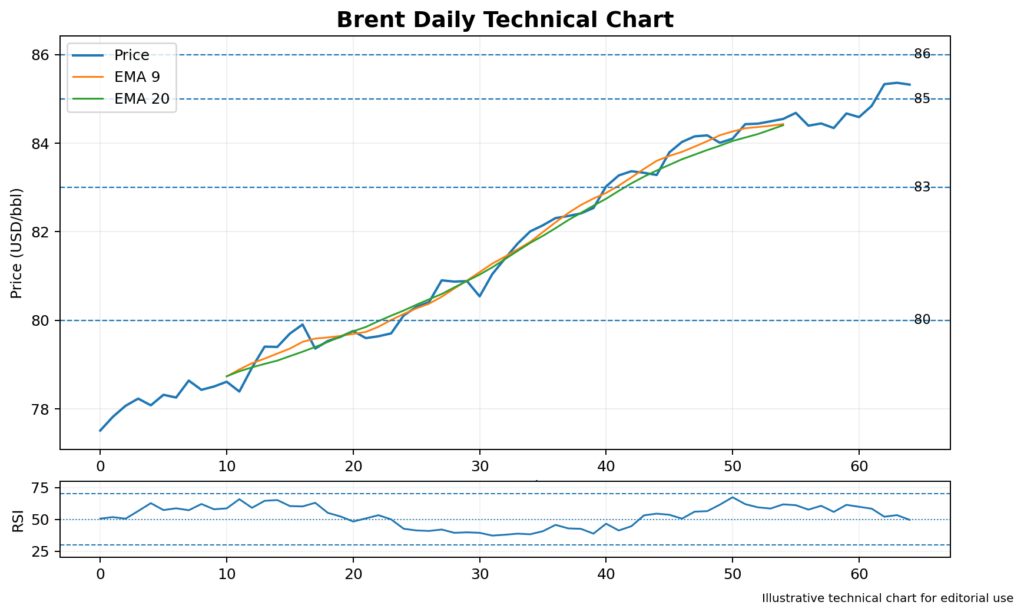
Image 1: Brent Daily Chart With the 9-Day EMA, 20-Day EMA, $80 Support and Resistance Near $85
RSI May Be Approaching Overbought Territory
The 14-day Relative Strength Index can help determine whether the rally has become stretched. A reading above 70 would place Brent in overbought territory.
An overbought reading would not necessarily signal an immediate reversal. Strong commodity trends can keep RSI elevated for several sessions. It would, however, suggest that late buyers may face a less favorable entry point.
A pullback in RSI toward 60 while Brent remains above $80 could represent healthy consolidation. A fall below 50 would indicate that momentum has weakened more materially.
Traders may also watch for bearish divergence if Brent records a higher price high while RSI forms a lower peak.
Resistance Levels in Focus
Initial resistance is located around $85 to $86, where the latest rally met selling pressure. A confirmed close above $86 could open the way toward $88.
Beyond that level, the main psychological target is $90. A move into this region would attract attention because it could intensify concern about transport costs, inflation, and pressure on energy-importing economies.
The key upside levels are $85, $86, $88, and $90. Continued backwardation and further disruption to physical flows would strengthen the chance of testing these targets.
Support and Correction Risk
Immediate support sits near $83, close to the market’s recent trading area. Below that, attention would shift back to $80.
A sustained break below $80 would weaken the current bullish structure and expose approximately $78. Deeper support could be found around $76.30, an earlier settlement region.
A retreat toward $80 would not automatically end the wider recovery. The reaction around this level would show whether buyers still view pullbacks as opportunities or whether sentiment has changed.
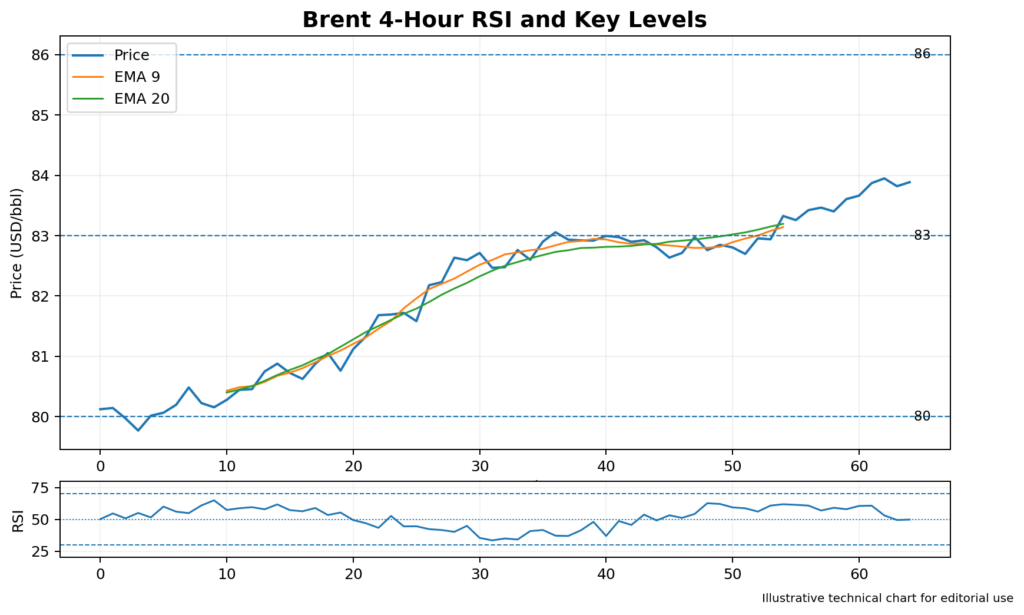
Image 2: Brent Four-Hour Chart With RSI, Support at $83 and $80, and Targets at $86 and $90
Supply Concerns Meet Inventory Data
The recent rally has been driven by concern about crude flows through an important Middle Eastern shipping route. Reduced tanker activity and renewed disruption fears have made prompt supply more valuable.
However, US inventory data provided a counterweight. Government figures showed a crude draw of 1.7 million barrels, smaller than the expected 2.6 million-barrel decline. Brent fell by more than a dollar after the release, showing that traders remain sensitive to evidence of adequate supply.
The demand outlook is another source of uncertainty. Slower growth in major importing economies could limit consumption even if the nearby supply remains tight.
Trading Implications
Brent maintains a bullish technical bias while it remains above $80, particularly if backwardation stays elevated and short-term moving averages continue rising.
A break above $86 could expose $88 and $90. An overbought RSI or bearish divergence, however, may signal that a temporary correction is developing.
On the downside, $83 and $80 are the most important immediate supports. A decisive move beneath $80 would suggest that the latest rally is losing strength.
Conclusion
Brent crude remains technically firm despite easing from its recent peak. Strong backwardation continues to indicate tight near-term supply, while inventory data and demand uncertainty are limiting enthusiasm.
Resistance is positioned at $85, $86, $88, and $90. Support can be found near $83, $80, $78, and $76.30.
The bullish structure remains intact above $80, but the market is vulnerable to sudden changes in supply expectations. RSI behavior, moving-average support, and the futures curve should provide the clearest signals about whether the advance can continue.