
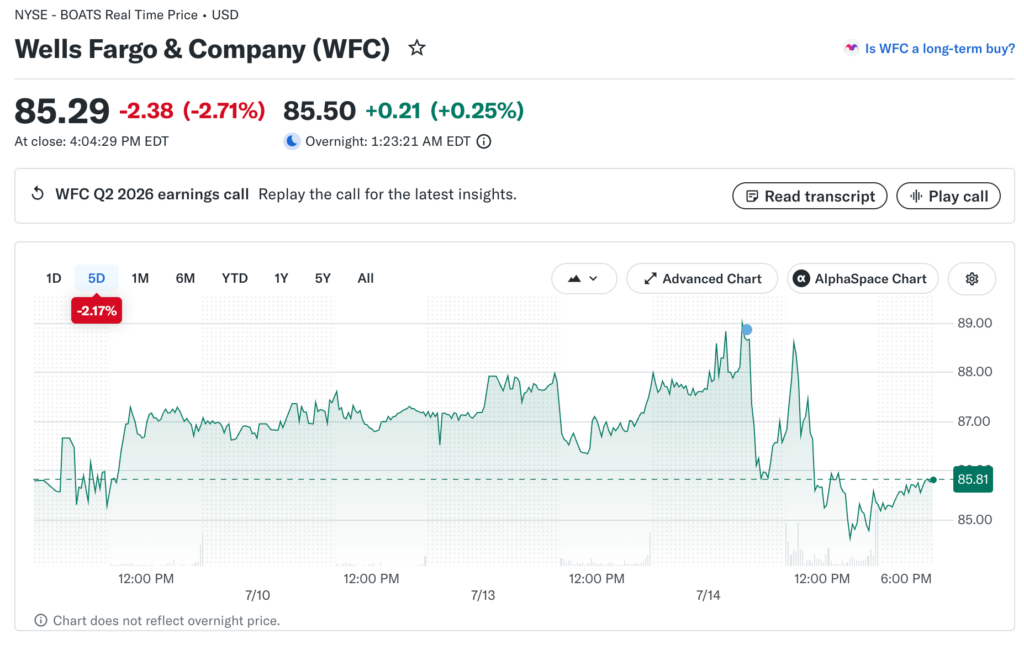
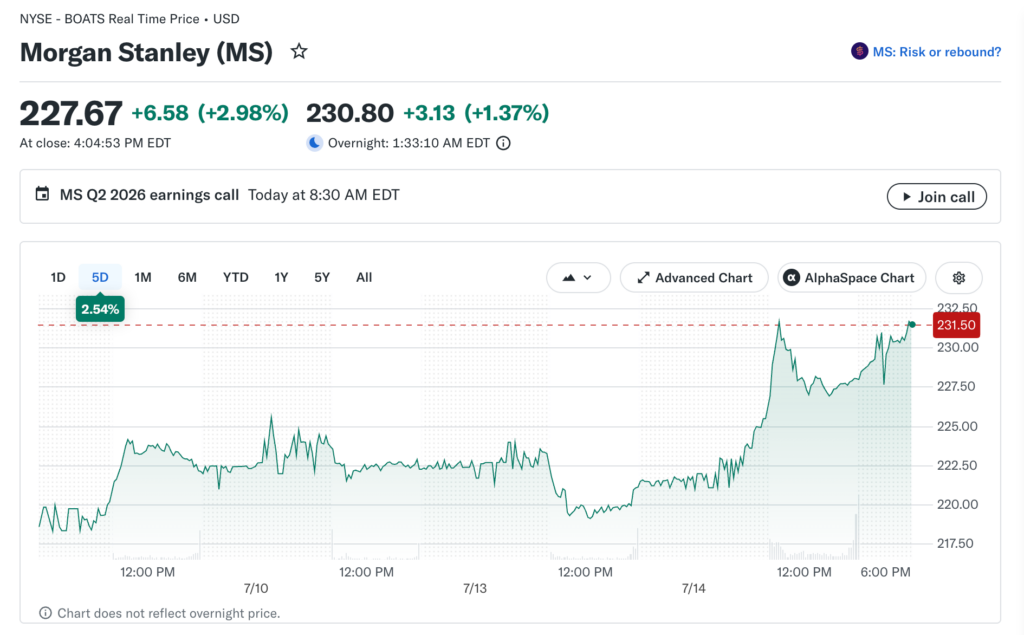
Second quarter bank earnings dominated headlines this week, with Goldman Sachs, Citigroup, Wells Fargo, JPMorgan Chase, and Bank of America all reporting results, alongside Morgan Stanley, BlackRock, PNC Financial Services, and Bank of New York Mellon later in the week.
Strong results at several major banks might suggest lending conditions remain healthy. A senior advisor at Prime Lake Capital notes that headline earnings strength does not automatically translate into favorable borrowing terms for a private client, particularly one exploring portfolio-backed liquidity rather than a standard bank loan.
What Bank Earnings Actually Reveal About Lending
A bank’s overall profitability reflects a broad mix of business lines, including trading revenue, investment banking fees, and consumer lending, not simply how favorably it lends against an individual client’s investment portfolio. Strong headline numbers can mask tighter underwriting standards in specific lending categories.
Investors considering a portfolio-backed loan should look past headline earnings and ask directly about current loan-to-value terms, collateral requirements, and how those terms might shift if broader market volatility increases, rather than assuming a strong earnings season automatically means favorable borrowing conditions.
Why This Week’s Rate Backdrop Matters
June inflation data released this week came in well below expectations, with the annual rate easing to 3.5 percent. Cooling inflation typically shifts expectations for future interest rate decisions, which can affect the cost of portfolio-backed borrowing over time.
An investor exploring this kind of liquidity option benefits from understanding not just the current rate environment, but how a lender’s terms might adjust if rate expectations shift again in the coming months. Risk-managed strategies account for this kind of scenario planning rather than locking in assumptions based on current conditions alone.
Why Timing Questions Matter as Much as Pricing
Beyond loan-to-value ratios, investors should ask how quickly a portfolio-backed facility can be accessed once approved, since some structures require longer processing windows depending on the underlying holdings involved.
A facility with attractive pricing but a slow funding timeline may not serve a genuinely time-sensitive need as well as a slightly less favorable structure that moves faster.
A wealth advisor at Prime Lake Capital walks clients through this tradeoff specifically, since the fastest or cheapest option is not always the one that best matches an individual client’s actual timeline and purpose for the liquidity.
The Role of Collateral Diversity in Loan Terms
Lenders offering portfolio-backed liquidity often price terms more favorably when the underlying collateral itself is diversified across sectors and asset types, rather than concentrated in a small number of volatile holdings.
This creates an additional reason, beyond general risk management, for investors to maintain a genuinely diversified portfolio if they anticipate needing this kind of liquidity option in the future.
A concentrated portfolio, even a large one, can work against an investor seeking favorable lending terms, since lenders view that kind of collateral as more exposed to a single sector’s bad week.
A wealth advisor at Prime Lake Capital raises this point with clients who hold outsized positions in a small number of stocks, since the same concentration that creates investment risk also tends to limit borrowing flexibility later on.
The Structural Advantage of Portfolio-Backed Liquidity
Traditional bank lending, even during a strong earnings season, often involves lengthy underwriting processes and standardized terms that do not account for the specific composition of an individual’s investment portfolio.
Portfolio-backed lending structures, by contrast, are built around the actual holdings an investor already has, allowing for terms tailored more directly to that specific collateral.
This does not mean portfolio-backed lending is automatically cheaper or safer than traditional bank borrowing. Each carries its own risk, including the possibility of a collateral call if portfolio value declines significantly. The comparison depends heavily on an individual investor’s specific circumstances and portfolio composition.
What This Week’s Volatility Adds to the Picture
Alongside bank earnings, markets also digested a sharp single-day decline in IBM shares and continued volatility tied to renewed tension around the Strait of Hormuz. This kind of week, mixing strong bank results with sharp individual stock moves and geopolitical uncertainty, illustrates why liquidity planning benefits from flexibility rather than assumptions locked in during calmer conditions.
A portfolio strategist at Prime Lake Capital reviews portfolio-backed lending options specifically against this kind of volatile backdrop, since collateral value and lending terms can shift meaningfully during exactly the kind of week markets experienced this time around.
Reading Earnings Season for What It Actually Tells Investors
Bank earnings this week offer a genuinely useful signal about the broader financial sector’s health, and that matters for the overall economy. It offers a far less direct signal about what specific lending terms an individual private client might receive against their own investment portfolio.
Investors exploring liquidity options this earnings season benefit from asking directly about their own specific terms, rather than assuming a strong quarter at any single bank applies evenly to their own financial situation.