
The AUD/USD pair remains under significant selling pressure, extending its decline for a third consecutive trading session after weaker-than-expected Australian Consumer Price Index (CPI) data triggered a sharp repricing of RBA policy expectations.
The pair dropped to a fresh two-week low, approaching the 0.6950 psychological zone, with spot prices currently trading around the mid-0.6900s. Vaulltier’s brokers take a closer look at this topic and the factors shaping it in this article.
The latest 0.25% daily decline highlights the deterioration in short-term momentum as sellers continue to dominate price action. The softer inflation figures reduced expectations for additional monetary policy tightening in Australia, weakening demand for the Australian Dollar and accelerating the downside move in AUD/USD.
From a technical perspective, the rejection from higher levels and the failure to sustain gains above the 0.7000 psychological resistance indicate that buyers have lost short-term control.
The pair’s inability to establish acceptance above this major barrier confirms a weakening bullish structure and increases the probability of further downside toward lower Fibonacci levels.
USD Weakness Limits Downside but Macro Risks Remain
The US Dollar Index (DXY) has eased from its recent monthly high, allowing a modest recovery in AUD/USD from the session lows. However, this USD weakness appears limited as markets await the upcoming FOMC interest-rate decision, which remains the primary volatility catalyst.
Despite the temporary USD pullback, expectations surrounding future Federal Reserve policy continue to provide underlying support for the greenback. Renewed inflation concerns, combined with elevated geopolitical risks, have strengthened expectations for at least one possible Fed rate increase in 2026.
This fundamental backdrop creates a challenging environment for the Australian Dollar. While short-term USD weakness may slow the decline, the broader AUD/USD trend remains bearish unless buyers can reclaim important resistance levels.
Key Technical Breakdown Below 0.6965 Support
The most important technical development was the breakdown below the 0.6965–0.6960 support zone. This area previously represented the lower boundary of a two-week consolidation range and aligned with the 38.2% Fibonacci retracement level measured from the June recovery move that followed a multi-month low.
The loss of this support zone represents a significant shift in market structure, suggesting that sellers are gaining control. The pair is now vulnerable to further declines toward the next technical targets, especially if bearish momentum increases following the FOMC decision.
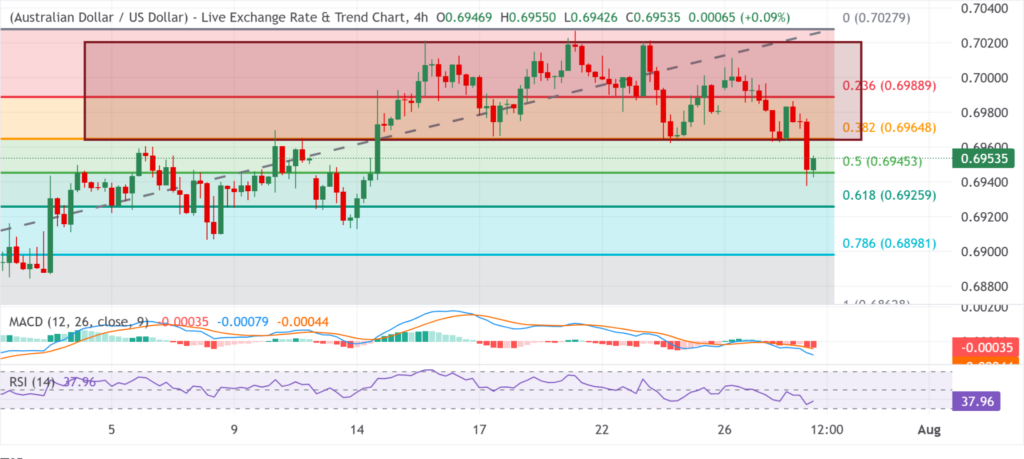
The Relative Strength Index (RSI) currently sits near 38, indicating persistent negative momentum but not yet reaching oversold territory. This suggests that additional downside movement remains possible before the market reaches conditions where buyers may attempt a recovery.
Momentum Indicators Confirm Bearish Pressure
The MACD indicator remains slightly negative, confirming the presence of bearish momentum. However, the indicator is not showing an aggressive expansion in downside momentum, meaning traders should monitor confirmation signals before entering large bearish positions.
A sustained move below the 50% Fibonacci retracement level would strengthen the downside outlook and increase the probability of a continuation toward the 61.8% Fibonacci retracement level at 0.6926.
The immediate technical trigger remains the 0.6935 daily swing low. A decisive break below this level would likely activate additional selling pressure and expose the pair to deeper corrective targets.
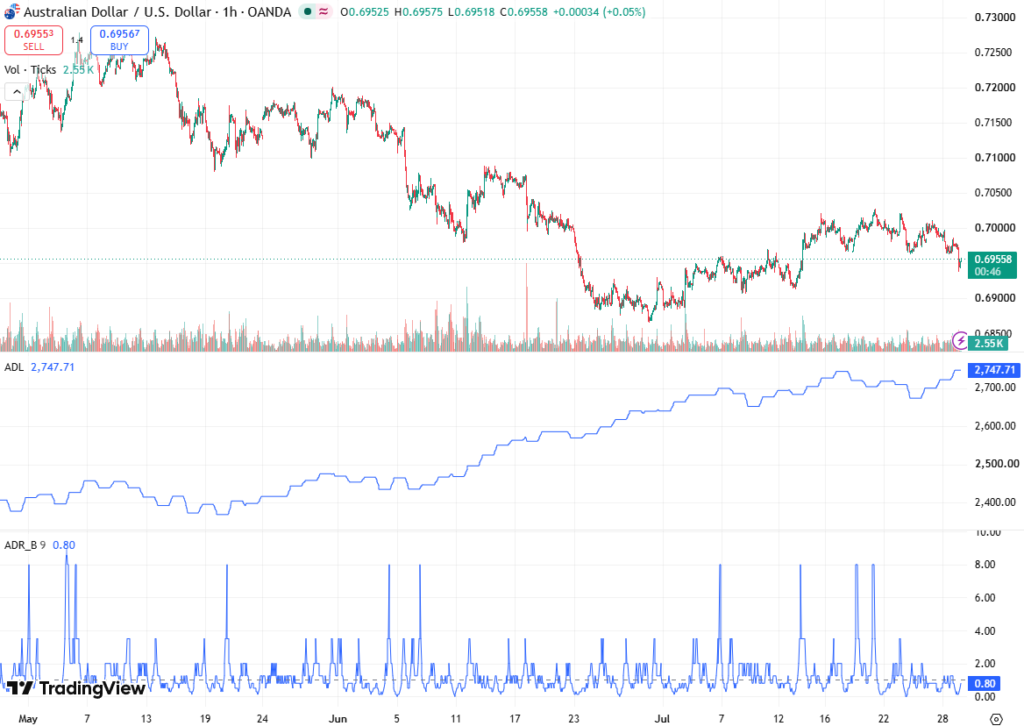
AUD/USD Downside Targets and Resistance Levels
If sellers maintain control, the first major downside objective is located near 0.6926, corresponding to the 61.8% Fibonacci retracement level. A break below this region would shift focus toward the 78.6% Fibonacci retracement level at 0.6898.
Further losses could extend toward the 0.6863 structural support zone, which represents a major area where longer-term buyers may attempt to defend the pair. This level could attract dip-buying interest if price action shows signs of stabilization.
On the upside, the first resistance remains near 0.6960–0.6965, the former support zone that has now turned into potential resistance. Above this, the market would need to reclaim 0.7000 to weaken the current bearish setup and restore a more neutral technical outlook.
AUD/USD Forecast: Bearish Bias Below 0.7000
The current AUD/USD technical outlook favors sellers, with the pair vulnerable near 0.6950 after the CPI-driven breakdown. The combination of weaker Australian inflation data, declining bullish momentum, and a technically damaged price structure continues to support a bearish scenario.
However, traders should remain cautious ahead of the FOMC rate decision, as shifts in Federal Reserve guidance could generate sharp volatility in both the US Dollar and the AUD/USD exchange rate.
A confirmed break below 0.6935 would strengthen the bearish case and open the path toward 0.6926, 0.6898, and potentially 0.6863. Conversely, a recovery above 0.6965 would reduce immediate downside risks, while a move above 0.7000 would be required to signal a meaningful bullish reversal.