
The AUD/USD exchange rate remains under pressure as market participants evaluate Australian government bond yields, US Treasury yields, and shifting expectations for the monetary policy outlook.
Zoey King, one of the experts at F24 Group shares some insights and detailed analysis of this topic in the following article.
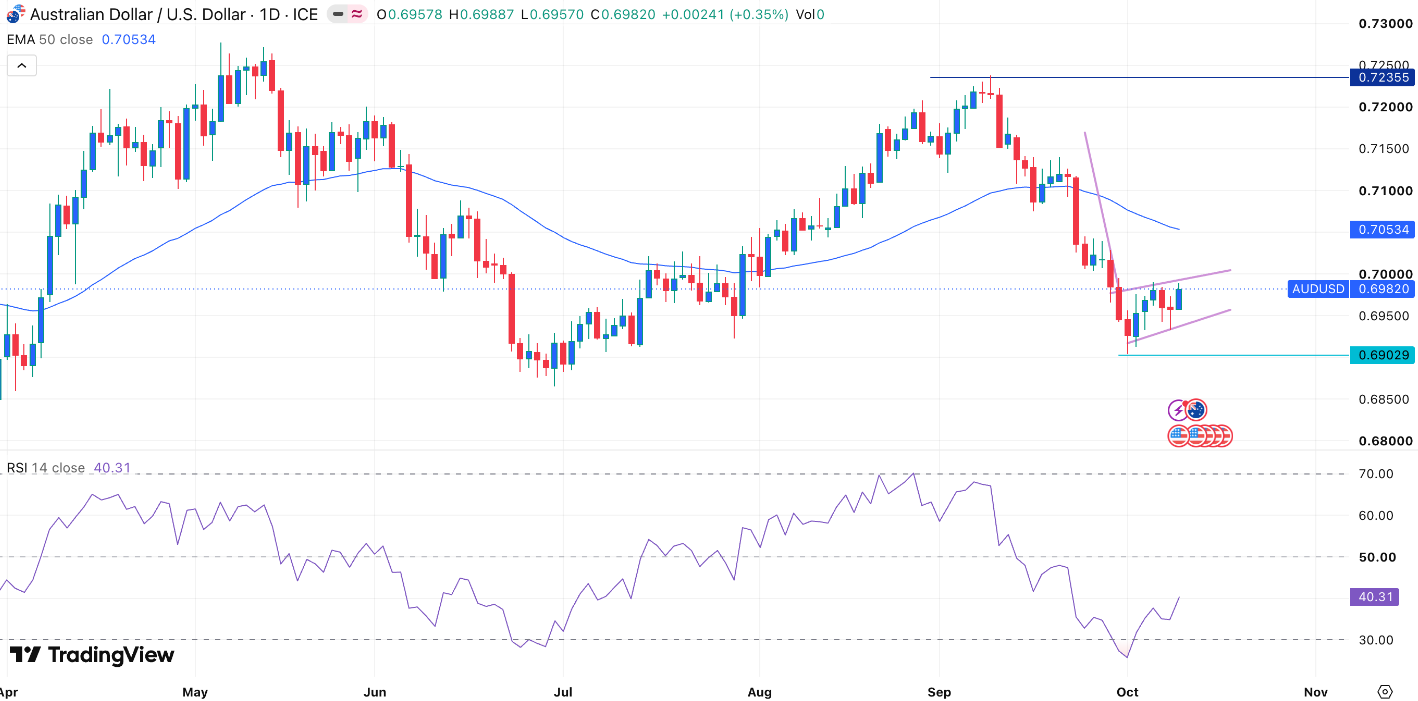
The pair traded near 0.6982, declining from its recent high of 0.7235. This represents a correction of approximately 3.50%, highlighting the deterioration in bullish momentum.
The Australian dollar faces a challenging combination of persistent domestic inflation, restrictive monetary policy, and uncertainty surrounding the Federal Reserve’s interest rate trajectory.
Meanwhile, the upcoming Reserve Bank of Australia (RBA) meeting minutes and US Consumer Price Index (CPI) release could trigger a significant repricing of interest rate expectations.
From a technical perspective, the development of a bearish flag formation, combined with the exchange rate trading below its 50-day Exponential Moving Average (EMA), suggests that downside risks remain elevated. A confirmed breakdown below key support could expose AUD/USD to further losses.
RBA Minutes and Australian Bond Yields
The upcoming RBA minutes will provide additional insight into policymakers’ assessment of inflation persistence, domestic demand, labor market conditions, and the appropriate level of monetary restriction. Particular attention will focus on whether the central bank considers further interest rate increases necessary to restore price stability.
At its latest meeting, the RBA raised its benchmark interest rate by 25 basis points, marking its fourth rate increase of the year. Policymakers have maintained a cautious stance amid elevated inflation, leaving the possibility of additional tightening dependent on incoming economic data.
Australian bond markets have also reflected these concerns. The 10-year government bond yield has climbed to approximately 5.44%, indicating substantial pressure on long-term borrowing costs.
US CPI and Federal Reserve Policy Expectations
The US inflation report represents the principal near-term macroeconomic catalyst for AUD/USD. Consensus expectations point to headline CPI inflation of 3.6%, while core inflation is expected to remain elevated. The difference between actual inflation and market forecasts could determine the direction of US Treasury yields and the dollar.
An upside surprise would likely reinforce expectations that the Federal Reserve must maintain restrictive monetary conditions for longer. This could push US yields higher, increase the relative attractiveness of dollar-denominated assets, and place additional downward pressure on the exchange rate.
Recent employment figures have complicated the outlook. The US economy reportedly added just over 29,000 jobs in September, while the unemployment rate increased to 4.2%. These figures have encouraged investors to reconsider the potential pace of monetary easing.
However, persistent inflation could constrain the Federal Reserve‘s ability to reduce interest rates without risking renewed price pressures.
AUD/USD Technical Analysis: Bearish Flag and Key Price Levels
The daily chart shows that AUD/USD rebounded from a recent low of 0.6902 to approximately 0.6982. Despite this recovery, the pair remains below its 50-day EMA, suggesting that the broader momentum has weakened and that the rebound has not yet established a convincing bullish reversal.
The emerging bearish flag pattern consists of a sharp downward impulse, or flagpole, followed by a relatively shallow upward consolidation within an ascending price channel. This structure typically reflects a temporary correction within an established downtrend.
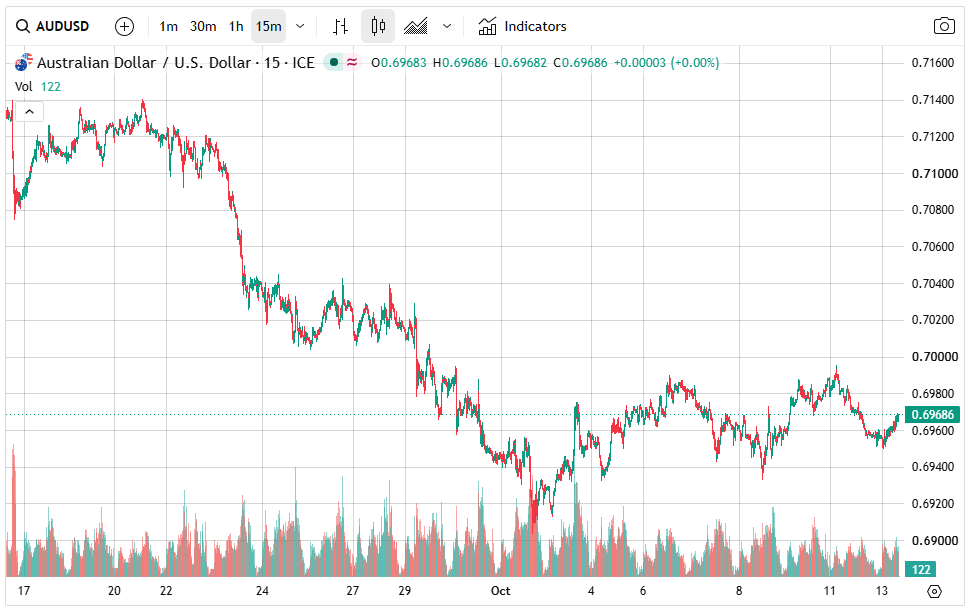
A decisive break beneath the flag’s lower trendline would provide bearish continuation confirmation. The first major downside reference is the 0.6900 psychological support level, located close to the recent trough at 0.6902. A daily close below this zone would strengthen the bearish structure and could expose the pair to further downside.
Using the recent high of 0.7235 and low of 0.6902, the pair’s decline spans approximately 332 pips. This price range provides a useful measure of the preceding downward impulse, although any projected flag target should be calculated from the actual breakout level rather than assumed in advance.
On the upside, 0.7000 represents an important psychological threshold. A sustained recovery above this level, followed by a break above the 50-day EMA and the flag’s upper boundary, would weaken the bearish setup.
Traders should also monitor trading volume, daily closing prices, and momentum indicators to distinguish a genuine breakout from a temporary intraday fluctuation.
Conclusion: Bearish Bias Depends on Breakout Confirmation
The AUD/USD technical outlook remains bearish, with the pair trading near 0.6982, below its 50-day EMA, and potentially forming a continuation pattern. A confirmed breakdown below 0.6900 could extend selling pressure, while stronger-than-expected US CPI inflation may reinforce dollar demand.
However, a hawkish RBA signal or softer US inflation could trigger a corrective rebound. The decisive factors will be relative bond yields, central bank guidance, inflation surprises, and confirmation of the flag breakout.
Until the exchange rate recovers above key resistance, the balance of technical risks favors further downside, although confirmation remains essential before treating the bearish scenario as established.