
The USD/CAD currency pair strengthened, breaking above the 1.4250 resistance level following a significant downside surprise in Canadian employment data. In this article, one of F24 Group’s specialists, John Baker, offers an in-depth examination of the subject.
The breakout reinforces the pair’s short-term bullish structure, as traders reassess the monetary policy outlooks of the Federal Reserve (Fed) and the Bank of Canada (BoC). If buying momentum persists, the exchange rate could advance toward 1.4300, 1.4400, and potentially 1.4500.
The primary catalyst was a sharp deterioration in Canada’s labor market. The combination of weaker employment, declining Canadian bond yields, and relatively elevated U.S. yields has strengthened the bullish case for USD/CAD. Further gains, however, will depend on incoming economic data, interest rate expectations, and developments in global energy markets.
Canadian Employment Miss Intensifies Economic Concerns
Canada recorded a loss of 68,300 jobs, significantly underperforming consensus expectations for an increase of 6,100 positions. This represents a negative employment surprise of approximately 74,400 jobs, placing substantial pressure on the Canadian dollar and raising concerns about the domestic economic outlook.
Meanwhile, the unemployment rate remained at 6.5%, matching expectations. Nevertheless, the unchanged rate does not diminish the severity of the employment contraction. The substantial decline in employment suggests weakening hiring demand, softer household income prospects, and increasing uncertainty about economic growth.
From a macroeconomic perspective, deteriorating employment conditions can constrain consumer spending, weaken domestic demand, and reduce inflationary pressure.
If labor market weakness persists, the Bank of Canada could have greater scope to maintain an accommodative policy stance or consider monetary easing, depending on inflation and broader economic conditions.
Yield Differentials Strengthen the Bullish Outlook
The divergence in government bond yields provides another explanation for the USD/CAD advance. During the session, the U.S. 10-year Treasury yield stood at approximately 5.263%, while Canadian yields declined as investors reassessed the outlook for domestic interest rates.
When U.S. fixed-income assets offer comparatively attractive returns, international capital flows may favor the dollar. Consequently, a widening U.S.–Canadian yield differential can support USD demand while placing additional downward pressure on the Canadian dollar.
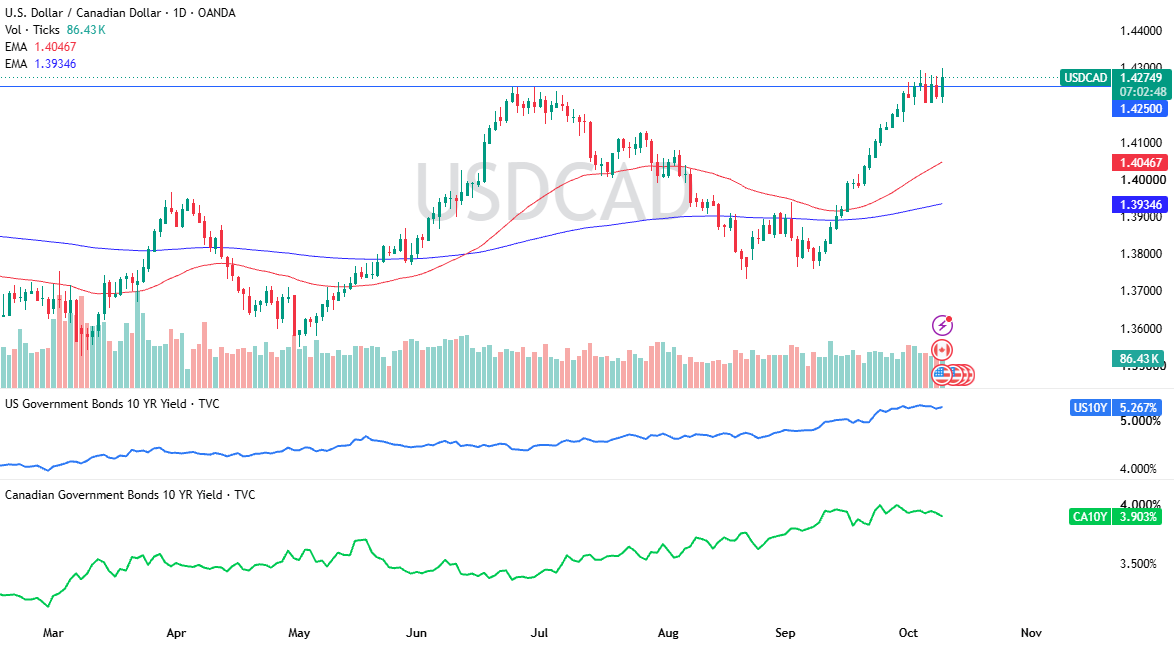
However, the 10-year yield spread does not directly represent the difference between the Fed’s and BoC’s policy rates. Long-term yields incorporate expectations for future short-term rates, inflation, economic growth, and term premiums. Changes in the spread therefore reflect both monetary policy expectations and broader bond-market repricing.
Oil Market Volatility Could Support the Canadian Dollar
Developments in the crude oil market represent a potential counterweight to Canadian-dollar weakness. As a major energy exporter, Canada benefits from stronger petroleum prices through increased export revenues, improved energy-sector profitability, and potentially stronger trade balances.
The Canadian dollar therefore maintains a meaningful relationship with global commodity markets.
Escalating geopolitical tensions involving Iran could raise concerns about energy supply disruptions, increasing the risk premium in crude prices. Sustained oil price gains could partially offset the negative impact of Canada’s employment contraction.
Nevertheless, the relationship between oil and USD/CAD is complicated by the United States‘ substantial petroleum production, which exceeds 14 million barrels per day and may reach approximately 20 million barrels per day under the broader production measure cited in the market commentary.
This reduces the relative advantage that rising oil prices might otherwise provide to Canada.
Technical Analysis: 1.4500 Emerges as a Potential Target
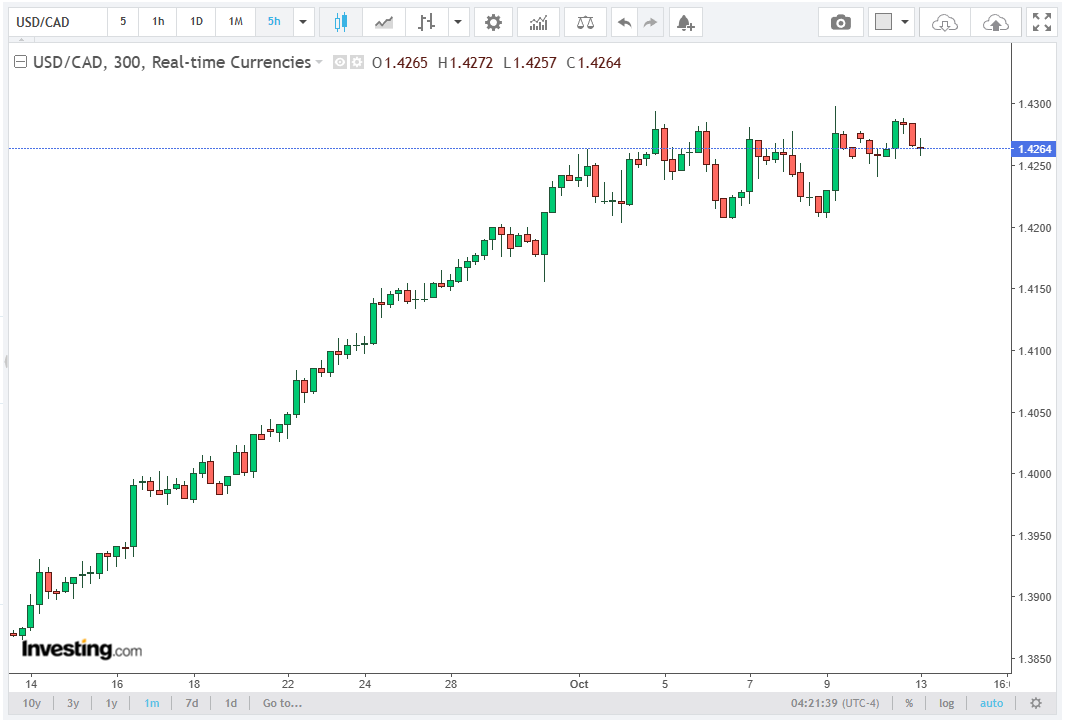
From a technical perspective, the breakout above 1.4250 suggests buyers have strengthened their near-term control. Sustained trading above this threshold would support the continuation of the upward trend, particularly if accompanied by strong momentum and increased buying interest.
The 1.4300 level represents the next psychological reference point, followed by 1.4400 and the more significant 1.4500 resistance zone. An advance from 1.4250 to 1.4500 would represent approximately 1.76% appreciation in USD/CAD, corresponding to Canadian-dollar depreciation against the U.S. dollar, all else being equal.
The 1.4250 level is now an important potential support zone. Consolidation above this threshold would strengthen the bullish continuation scenario, whereas a sustained break below it could indicate a failed breakout, encourage profit-taking, and expose the pair to a corrective retracement.
Conclusion
The latest employment shock has strengthened the bullish outlook for USD/CAD, following Canada’s loss of 68,300 jobs against expectations for a gain of 6,100. The 74,400-job negative surprise, declining Canadian yields, and reported 5.263% U.S. 10-year Treasury yield support the potential for further gains.
Although geopolitical tensions and higher oil prices could cushion Canadian-dollar losses, the balance of fundamental and technical factors favors a test of 1.4300, 1.4400, and potentially 1.4500. A sustained move above 1.4250 would reinforce bullish momentum, while a failed breakout could trigger renewed volatility and short-term selling pressure.