
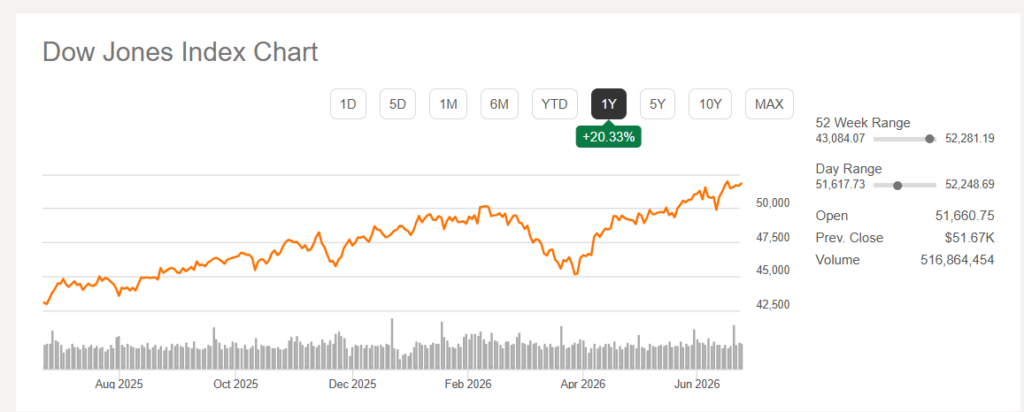
Alphabet is set to join the Dow Jones Industrial Average on June 29, 2026, replacing Verizon Communications in a reshuffle that further tilts the 30-stock benchmark toward big technology and artificial intelligence.
Findtech Group‘s equity research team breaks down the mechanics behind the swap, what it signals about the index’s direction, and where the stock’s valuation stands heading into its new role.
The change, announced by S&P Dow Jones Indices on June 23, marks the first shift in the Dow’s lineup since Nvidia and Sherwin-Williams replaced Dow Inc. and Intel back in November 2024. With Alphabet’s addition, all five of the largest US technology companies by market capitalization, Nvidia, Amazon, Apple, Microsoft, and now Alphabet, will hold seats in the index simultaneously.
Index Reshuffle: How Alphabet Earns Its Dow Seat
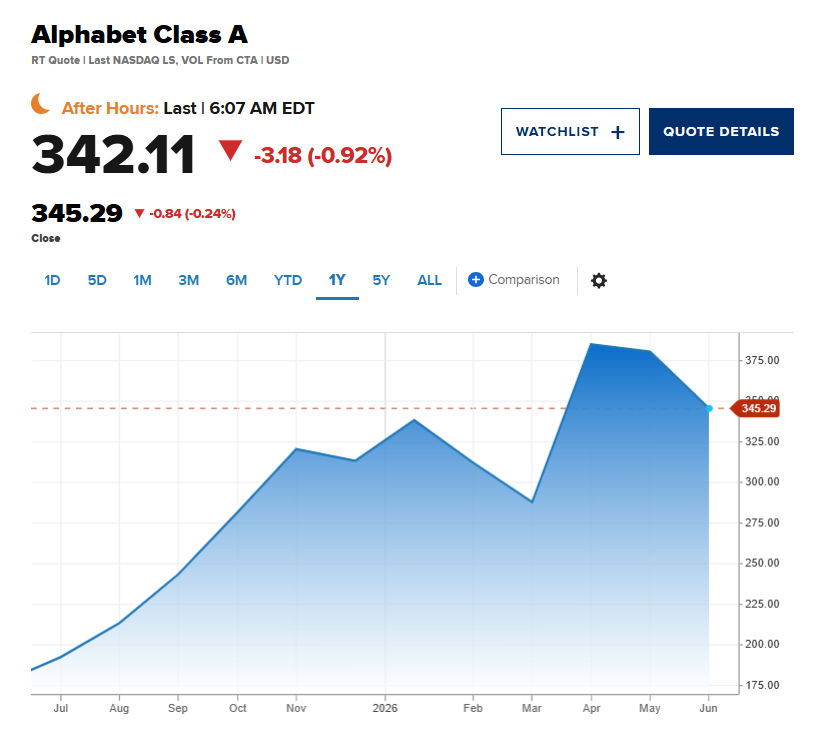
The mechanics of the swap come down to the Dow’s price-weighted structure. Alphabet trades around $345 to $350 a share, compared with roughly $46 to $47 for Verizon, whose stake in the price-weighted index had shrunk to about 0.5%, despite carrying a market capitalization near $195 billion. Because the Dow weights members by share price rather than total market value, Verizon’s influence on daily index moves had become negligible.
S&P Dow Jones Indices said the addition would broaden the index’s exposure to dynamic areas of the economy, citing Alphabet’s reach across advertising, cloud infrastructure, AI, hardware, autonomous mobility, and healthcare technology. A related change will also take effect the same day:
Honeywell International completes its spin-off of Honeywell Aerospace, renaming itself Honeywell Technologies and keeping its Dow seat, while the newly independent aerospace unit joins the S&P 500 in place of Conagra Brands, rather than the Dow itself.
Valuation Framework: P/E and GF Value Signals
Alphabet’s inclusion arrives alongside a stock that screens as expensive by several measures. Shares trade at a trailing P/E of 26.34, above the company’s own five-year median of 24.35. GuruFocus pegs Alphabet’s intrinsic GF Value at roughly $232.91, which would put the stock at about 48% above what that model considers fair value at a current price near $345.
That said, Alphabet’s underlying fundamentals remain strong by most metrics. The company carries a GF Score of 92 out of 100 and a financial strength rating of 9 out of 10, reflecting a business that generates roughly 90% of revenue from Google’s advertising and services, with cloud computing contributing about 10% and growing.
Analyst Sentiment: Rating Momentum Stays Strongly Bullish
Wall Street’s read on the stock has stayed firmly positive through the volatility. Of 33 analyst ratings issued over the past three months, 28 rate the stock a Buy, 5 a Hold, and none recommend selling, keeping Alphabet’s consensus at Strong Buy even as the shares dropped about 5% on June 22 amid a broader tech selloff and reports that two senior AI researchers were preparing to leave for a rival firm.
Upside Catalysts: What Could Push Shares Higher
Alphabet’s inclusion in the Dow Jones Industrial Average provides a modest near-term tailwind, as funds that track the index will need to purchase Alphabet shares and sell Verizon shares to reflect the rebalancing ahead of the June 29 effective date. This creates a temporary source of mechanical buying demand.
Beyond the index-related flow, investors remain focused on the company’s underlying business performance. In particular, continued growth in Google Cloud, stable digital advertising revenue, and signs of stability within Alphabet’s AI research teams following recent departures are likely to be the more important long-term drivers of the stock’s performance.
Downside Risks: What Could Cap the Rally
The valuation gap identified by GuruFocus remains a key risk, as Alphabet shares trade above many fair-value estimates, leaving less room for error if growth in its advertising or cloud businesses slows.
Investors are also paying close attention to recent AI talent departures, which raise concerns about the company’s ability to retain top researchers as competition for artificial intelligence expertise intensifies.
Additionally, continued weakness across the technology and semiconductor sectors could pressure Alphabet’s stock regardless of its Dow inclusion. Together, valuation risk, talent retention challenges, and broader tech-market volatility remain important factors to monitor.
Conclusion: A Symbolic Win With Valuation Caveats
Alphabet’s entry into the Dow Jones Industrial Average represents a significant symbolic milestone, formally recognizing the company as a leading force in artificial intelligence, cloud computing, and digital advertising within one of the market’s most established benchmarks.
The company’s inclusion is supported by strong underlying fundamentals, including a Strong Buy analyst consensus and an impressive GF Score of 92. However, investors should keep valuation considerations in mind. Alphabet shares are currently trading above many fair-value estimates, while emerging concerns around AI talent retention and competition for skilled workers continue to attract attention.
As a result, the Dow addition should be viewed primarily as validation of Alphabet’s scale, market influence, and strategic importance, rather than a signal that valuation risks have disappeared.