
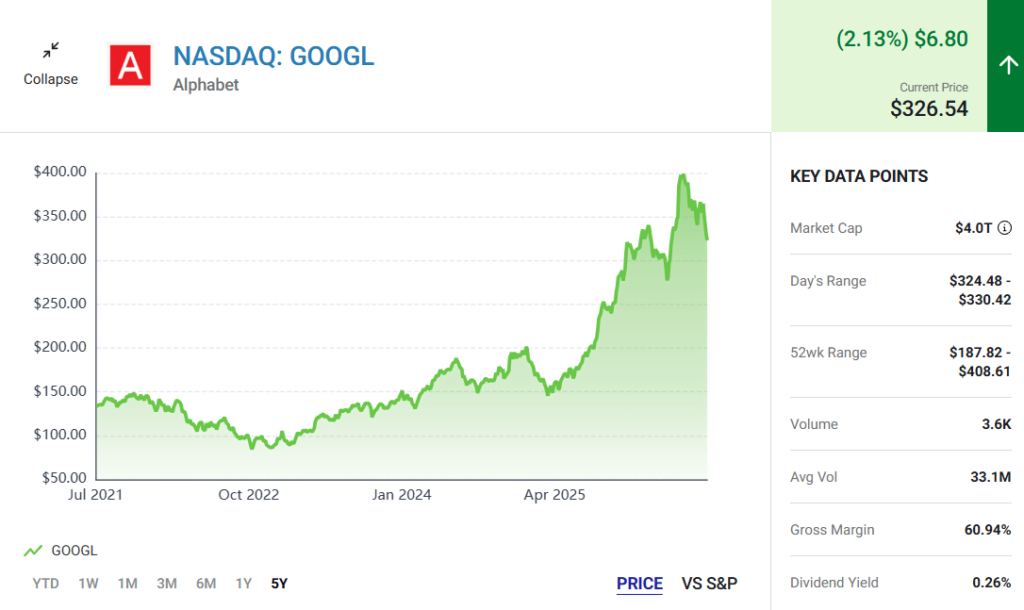
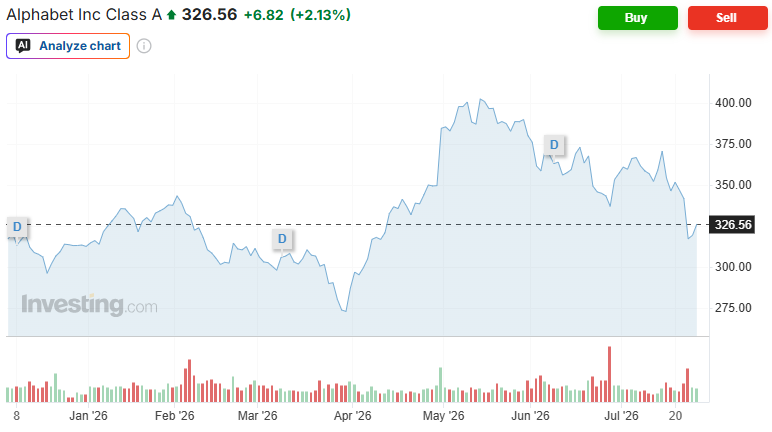
Alphabet stock trades at roughly $320 per share as of this week, putting it at 16 times trailing earnings, a multiple typically associated with slow-growth businesses rather than a company that recently raised its 2026 capital spending guidance to as much as $205 billion. The disconnect has renewed investor interest in Alphabet’s long-term stock performance.
Ten years ago, a $10,000 investment in Alphabet would have purchased roughly 262 shares at a split-adjusted price of about $38 each. That same position is now worth approximately $84,000, reflecting a compound annual return of roughly 24% over the decade, excluding the modest dividend introduced in 2024.
Brokers from Gammance dive into what’s driving that performance, and why the stock’s headline valuation may be more complicated than it first appears.
Growth Remains Firmly Intact
Alphabet’s latest quarterly results demonstrate continued business strength and accelerating momentum, with the company showing no immediate signs of slowing despite its already large scale.
In its most recent earnings report, Alphabet delivered revenue of $119.8 billion, representing a 24% year-over-year increase. This marked the company’s 12th consecutive quarter of double-digit revenue growth, reinforcing the durability of its core businesses, including search, advertising, cloud services, and artificial intelligence initiatives.
The company also reported strong profitability improvements, with operating income rising 30% year over year. Additionally, operating margin expanded to 34%, reflecting improved efficiency and strong cost management. These results highlight Alphabet’s ability to maintain growth while investing heavily in future technologies, particularly artificial intelligence infrastructure.
The combination of strong revenue growth, expanding margins, and continued innovation strengthens the investment case for Alphabet as it positions
Cloud Is Now the Fastest-Growing Segment
Google Cloud has become the strongest-performing segment within Alphabet’s broader business, showing significant acceleration in growth and profitability. In the second quarter, Google Cloud revenue surged 82% year over year to $24.8 billion, compared with 63% growth in the first quarter, highlighting increasing demand for cloud infrastructure and artificial intelligence services.
The segment also delivered major improvements in profitability, with operating income more than tripling to $8.8 billion. At the same time, operating margin expanded to 35.6%, compared with 20.7% a year earlier, demonstrating stronger operational efficiency and improved cost management.
These results position Google Cloud as a key growth driver for Alphabet, supported by rising enterprise adoption, AI-related demand, and expanding high-margin services. The segment’s rapid growth and profitability improvements strengthen Alphabet’s long-term investment outlook.
The Core Business Isn’t Slowing Down Either
Even if investors are paying more attention to Google Cloud’s expansion, Alphabet’s core business sectors are still showing good momentum. YouTube advertising income jumped 13% to $11.1 billion, while Google Search and other revenue increased 17% year over year to $63.3 billion.
These figures underline the continued resilience of Alphabet’s advertising business, which remains a dependable source of revenue growth and cash generation while the company expands its investments in cloud infrastructure and artificial intelligence technologies.
Why the Headline Multiple Is Misleading
Alphabet’s 16-times earnings valuation includes a significant one-time gain that boosts reported profitability, making the headline figure less reflective of underlying business performance.
The company reported $112.1 billion in second-quarter net income, which included a $99.0 billion gain on equity securities. This gain was largely driven by unrealized increases in the value of investment holdings, including Alphabet’s stake in SpaceX.
The investment gains had a major impact on earnings results, contributing $6.26 of the quarter’s $9.11 earnings per share. Without this one-time benefit, Alphabet’s underlying earnings picture would appear substantially different.
Investors evaluating the company’s valuation must therefore consider the impact of these non-operating gains alongside its core business performance, including advertising growth, Google Cloud expansion, and artificial intelligence investments.
A More Accurate Picture of the Valuation
Stripping out those investment gains changes the comparison significantly. Alphabet trades at approximately 24 times forward operating earnings, compared to roughly 21 times for Microsoft and 18 times for Meta Platforms, making it the priciest of the three major platforms currently investing heavily in AI infrastructure, rather than the apparent bargain suggested by its trailing multiple.
Capital Spending Has Reshaped the Balance Sheet
Alphabet’s massive AI investment is already transforming its financial structure, with the company significantly increasing spending to support future growth.
In the second quarter alone, capital expenditures reached $44.9 billion, more than double the previous year’s level, placing pressure on short-term cash generation and resulting in negative free cash flow of $5.9 billion for the period.
To finance this aggressive AI infrastructure expansion, Alphabet raised $49.6 billion through new stock issuance in June and issued $20.3 billion in senior notes.
The company also made a notable change in its capital allocation strategy by pausing share repurchases entirely this year, compared with $13.2 billion in buybacks during the same quarter last year. This shift reflects Alphabet’s decision to prioritize AI infrastructure, data centres, and long-term growth investments over near-term shareholder returns.