
Every bull market eventually gives way to a bear market, and prepared investors understand the importance of having a strategy in place before conditions deteriorate. Analysts from Gammance highlight that not all stocks respond equally during downturns, with some businesses showing an ability to remain relatively resilient even as broader markets decline.
One mega-retailer stands out for its defensive qualities. Its scale, consistent consumer demand, and pricing power can help it decouple from wider market weakness when economic conditions tighten. While no stock is completely immune to volatility, this type of company can play a valuable role in a portfolio by reducing downside risk and providing more stability during uncertain periods.
Meet the Stock Built for Bad Times
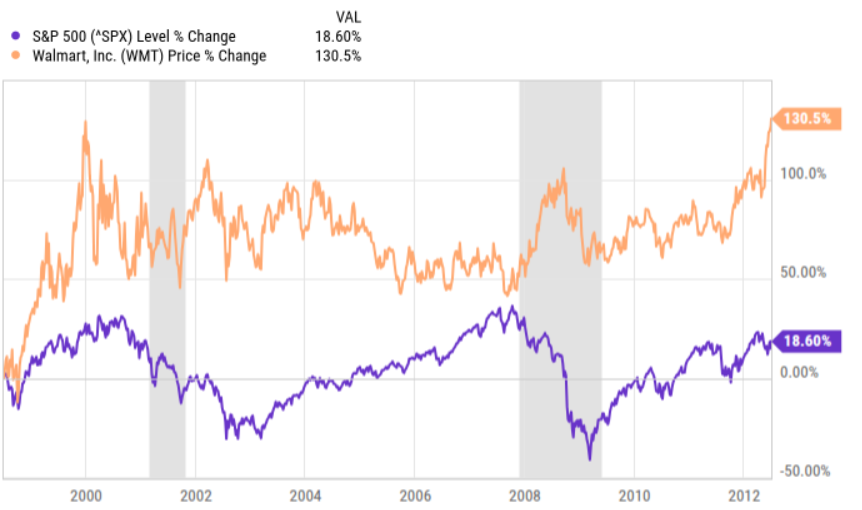
Walmart has repeatedly demonstrated an ability to hold up better than the broader market during periods of severe volatility. During the dot-com crash of 2000 and the early phase of the subprime mortgage crisis, the stock remained volatile but avoided the steep losses that hit many other equities.
This relative resilience stems from its defensive business model, anchored by essential goods, steady consumer demand, and strong pricing power. While not immune to downturns, Walmart has historically shown an ability to limit downside risk, making it a reliable stabiliser in turbulent market conditions.
A Dividend Streak That Just Keeps Growing
Beyond price resilience, Walmart offers something many defensive stocks lack: a dependable and growing cash dividend. The company has increased its per-share dividend for 53 consecutive years, placing it among a select group of long-term income compounders.
While the forward yield of just under 1% may appear modest, the real value lies in its consistency and durability across market cycles. For long-term investors, that reliability provides a steady income stream even during downturns, reinforcing Walmart’s role as a stabilising, income-generating holding rather than a high-yield play.
Why the Business Itself Is Recession-Resistant
Walmart’s resilience isn’t accidental; it’s built directly into its business model. More than half of its revenue comes from groceries, a category consumers cannot cut back on, regardless of economic conditions.
That demand stability is reinforced by Walmart’s massive scale, which gives it strong pricing power with suppliers. This allows the company to consistently offer lower prices than competitors across most food categories, strengthening its position as a cost leader.
The result is a powerful cycle: when economic pressure rises, shoppers actively seek out cheaper options, and Walmart’s combination of necessity-driven products and low prices naturally pulls more customers in. This dynamic helps sustain steady sales and customer loyalty, even when broader retail demand weakens.
Even Wealthier Shoppers Are Trading Down
Interestingly, Walmart’s market share gains haven’t come only from budget-conscious shoppers. Over the past four inflation-heavy years, a meaningful portion of growth has come from households earning over $100,000 annually.
This shift highlights a broader trend: even higher-income consumers are feeling financial pressure. As a result, many are redirecting more of their spending toward lower-priced retailers, with Walmart benefiting from its strong value positioning and wide product range.
The takeaway is clear; Walmart’s appeal is no longer limited to cost-sensitive shoppers. Its ability to attract both low- and high-income customers strengthens its resilience across different economic conditions.

Convenience Is Its Own Competitive Advantage
Physical scale reinforces the defensive case for Walmart. Around 90% of the U.S. population lives within 10 miles of one of its 5,200+ stores, giving the company an unmatched level of geographic reach and accessibility.
Those locations function as one-stop retail hubs, offering everything from groceries and household essentials to prescriptions, clothing, and baby products. This combination of proximity and convenience strengthens customer loyalty, making shopping habits more resilient even during economic stress.
In downturns, that built-in “stickiness” becomes especially valuable. Consumers tend to prioritise affordability and convenience, both of which Walmart delivers at scale, helping sustain consistent foot traffic and revenue stability regardless of broader market conditions.
Setting Realistic Expectations
The restructuring separates technical development from commercial expansion, a distinction that carries significant strategic importance.
Experts in protocol design are not necessarily suited to handle institutional partnerships or business development, so shifting these responsibilities to specialised organisations allows each group to focus on its strengths. This enables new entities to drive adoption and partnerships, while the Ethereum Foundation focuses on maintaining network security and stability.
This approach reflects a more mature operational model. Instead of relying on a single central body, Ethereum is distributing responsibilities across a broader ecosystem. The result is a structure better aligned with the network’s scale, supporting growth in areas like stablecoins and real-world asset tokenisation, while preserving the reliability and resilience that have defined Ethereum over time.