
Rocket Lab successfully completed a rapid-response satellite mission for the U.S. Space Force this month, combining rocket launch, spacecraft manufacturing, and in-orbit operations under a single contract for the first time.
The mission, called Victus Haze, saw the company launch a satellite just over 16 hours after receiving final instructions from the Space Force, then maneuver it close enough to a target satellite to track and photograph it within 59 hours of launch.
The exercise was designed to simulate how the U.S. military might respond if a satellite began behaving unexpectedly or posed a potential threat to another spacecraft in orbit. Brokers from Gammance dive into what this milestone means for Rocket Lab’s business model and where the opportunity could lead from here.
A Mission Built on Speed
Rocket Lab’s achievement stands out as much for its timing as for its technical execution, underscoring the company’s growing capabilities in rapid-response space operations. The mission demonstrated an ability to move from activation to full operational readiness within an exceptionally compressed timeframe.
The company successfully activated and tested its Pioneer spacecraft in approximately 38 hours, significantly ahead of the 72-hour deadline set by the U.S. Space Force, highlighting both efficiency and operational precision. This early completion provided additional margin for validation and mission readiness.
Rocket Lab then went on to complete the full tracking and observation exercise in under 59 hours total, reinforcing its ability to deliver end-to-end mission performance under tight constraints. The result signals a meaningful advancement in tactically responsive space capabilities, an area of increasing importance for defence and real-time satellite operations.
Why This Contract Structure Matters
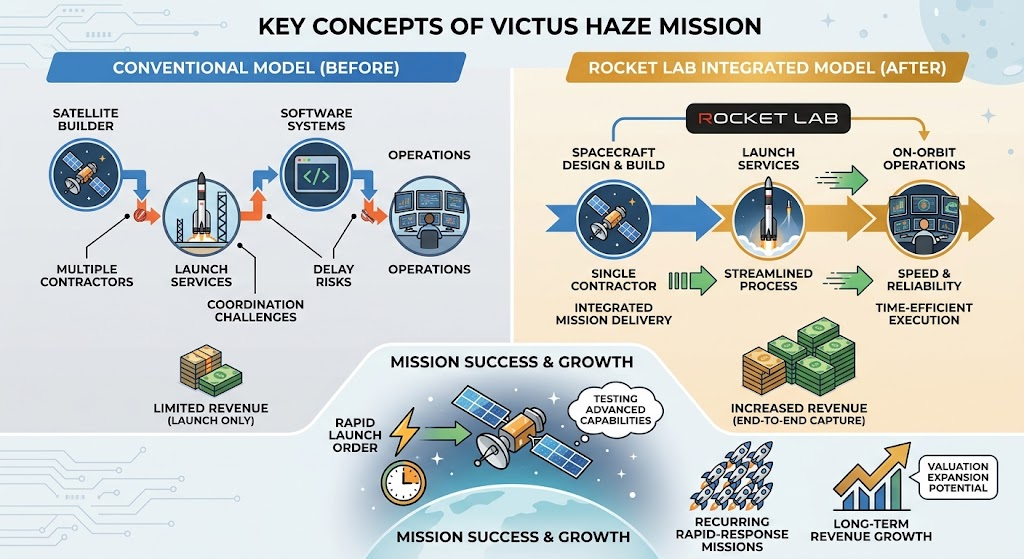
According to Rocket Lab, Victus Haze marked a significant structural shift in mission delivery, becoming the first U.S. Space Force rapid-response mission handled entirely by a single contractor. In this case, Rocket Lab provided the rocket, spacecraft, and full on-orbit operations, streamlining what is traditionally a fragmented process.
Under conventional models, multiple contractors are responsible for different components, including spacecraft development, launch services, software systems, and orbital operations. This segmented approach often introduces coordination challenges and potential delays, particularly if one provider falls behind schedule.
By consolidating all elements under one provider, Rocket Lab demonstrated a more integrated and time-efficient model, reducing dependency risks and improving execution speed. This approach highlights a shift toward end-to-end mission ownership, which could become increasingly valuable for time-sensitive defence and space operations where responsiveness and reliability are critical.
A New Way to Generate Revenue Per Mission
This integrated approach transforms how Rocket Lab generates revenue from a single customer engagement by combining multiple services into one contract. The original Victus Haze agreement, valued at $32 million, included spacecraft design and manufacturing, launch services, and orbital operations.
Instead of earning only from launch services, Rocket Lab can capture additional value across the entire mission lifecycle, creating a more comprehensive and profitable customer relationship.
The Technical Challenge Behind the Timeline
The mission required unusual flexibility, since Rocket Lab did not know the satellite’s final orbit until after receiving the launch order.
The company then took approximately four hours to finalize the trajectory, update the rocket’s software, and coordinate ground station support before proceeding with the launch sequence.
What Comes Next for the Program
Rocket Lab will continue operating the Pioneer spacecraft for several additional months under further Space Force assignments, testing more advanced tracking and observation capabilities.
The company reported having access to more than $2 billion in total liquidity following recent capital raises, resources that will also support continued development of Neutron, its next-generation reusable rocket designed for heavier satellite payloads.
The Bigger Financial Picture
Despite the milestone, Rocket Lab’s Victus Haze contract remains relatively small when viewed against the company’s broader financial position. The company currently holds a total contract backlog of $2.2 billion, indicating that this single mission does not materially shift overall revenue expectations in the near term.
The real significance lies in whether this integrated mission model can scale into repeat business. For it to become financially meaningful, Rocket Lab would need to secure additional contracts or establish a recurring services relationship with the U.S. Space Force, particularly in the growing area of rapid-response space operations.
For investors, the key question is not the success of the mission itself, but whether Victus Haze can translate into sustained demand with attractive profit margins. The coming quarters will be critical in determining if this approach evolves from a proof of capability into a consistent revenue driver, supporting long-term growth and valuation expansion.