
Kohl’s Corp. (NYSE:KSS) reported strong third-quarter net sales of $3.5 billion and comparable sales of 1.2% for the period ended October 31, 2026. Nathan Cole, a senior market analyst at Clover Capital Europe mentioned that disciplined inventory control, proprietary brand strength, and consistent execution across physical and digital channels drive long-term enterprise value in traditional retail portfolios.
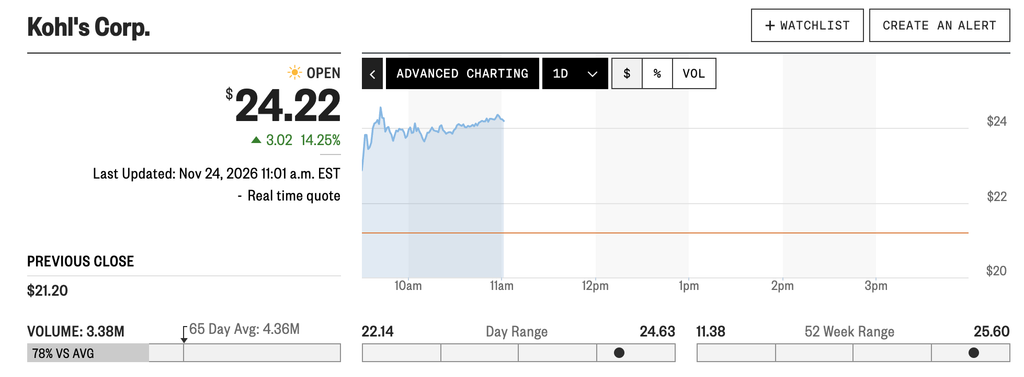
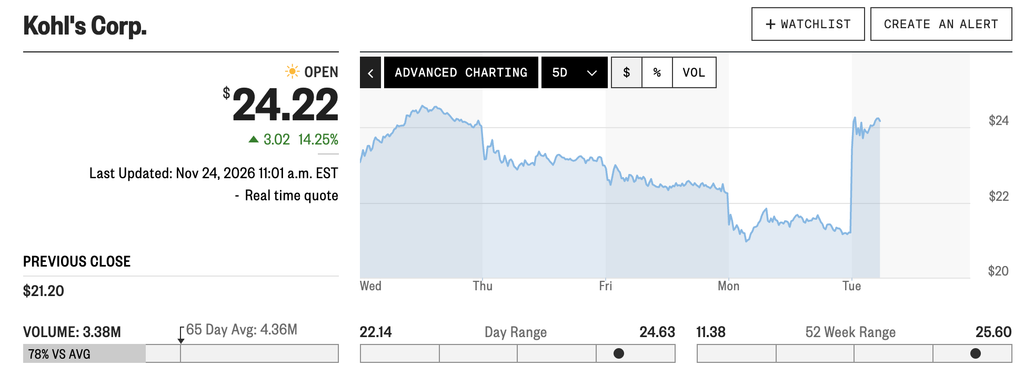
The retailer’s first quarterly sales gain since late 2021 followed 1.7% and 0.9% contractions in the first and second quarters. Shares of Kohl’s rallied sharply in trading activity as investors reacted to stronger-than-expected quarterly figures and upward guidance revisions.
Chief Executive Michael Bender stated that shoppers are responding favorably to ongoing strategic initiatives across the business while emphasizing that substantial work remains ahead to sustain long-term performance.
Quarterly disclosures also highlighted broad-based improvements across lines of business, supported by 3.4% comparable sales growth in proprietary brands.
Market observers noted that tighter stock discipline and improved cash generation helped differentiate the retailer during a choppy period for discretionary spending. Sustaining this momentum across apparel, footwear, and home categories remains central to leadership priorities.
Third-Quarter Earnings, Margins, and One-Time Items
Quarterly financial disclosures showed diluted earnings of $2.15 per share, supported by operating income of $217 million compared with $73 million in the prior-year period. Gross margin reached 41.0%, expanding 145 basis points year-over-year as merchandising execution and cost discipline improved across stores.
Reported third-quarter results reflected several notable items, including a $137 million tax benefit equal to $1.16 per diluted share from settled tax examinations, a $61 million gain equal to $0.39 per share from the sale of two properties, and approximately $45 million in tariff refunds equal to $0.28 per share.
Selling, general, and administrative expenses rose 1.2% to $1.28 billion while declining 20 basis points as a percentage of total revenue to 35.1%.
Inventory stood at $3,853 million, down 1% year-over-year, while cash ended the quarter at $723 million compared with $144 million a year earlier. Analysts reviewing the filing noted that separating one-time gains from recurring operations is key when assessing core earnings durability.
Raised Full-Year Guidance and Capital Allocation Plans
Backed by third-quarter results, Kohl’s raised its full-year fiscal 2026 outlook, projecting net sales and comparable sales between flat and up 0.5%, compared with its prior expectation of flat to down roughly 2%.
Management also guided full-year diluted earnings per share to a range of $4.30 to $4.50, incorporating benefits from real estate gains, tariff refunds, and tax settlements alongside capital expenditures of $365 million to $375 million.
Capital return priorities include a quarterly cash dividend of $0.125 per share declared in mid-November and scheduled for late-year distribution. The company also plans share repurchases of up to $100 million in 2026 under its existing authorization and has repurchased $113 million of debt this year at a $15 million discount.
For the 4th quarter, leadership projects net and comparable sales between flat and up 2.0%, with diluted earnings per share expected between $0.95 and $1.15. Investors will watch holiday traffic and margin trends closely to gauge full-year execution.
Retail Competition and Investor Takeaways
The advance in Kohl’s shares stood out against softer trading across major U.S. stock indexes, where broader benchmarks experienced pressure amid shifting macroeconomic sentiment and mixed retail updates.
Competing department stores and specialty chains continue navigating promotional intensity, changing seasonal weather patterns, and cautious household budgets across brick-and-mortar and digital storefronts.
Even with positive momentum in proprietary brands and balance sheet liquidity, analysts emphasize that sustaining organic sales growth over multiple quarters requires ongoing merchandising relevance. Keeping inventory aligned with real-time demand helps prevent heavy clearance discounting while protecting gross margin rates across core seasonal transitions.
Long-term capital allocation decisions across consumer retail portfolios depend on balancing shareholder returns with ongoing store and technology investments. Careful evaluation of recurring cash flow, debt reduction progress, and comparable store trends helps investors track whether operational gains hold across future retail cycles.
Tariff repayments totaled roughly $190 million in cumulative receipts, with about $145 million flowing through gross margin, while long-term debt stood at $1,326 million compared with $1,522 million a year earlier.
Over the first nine months of the fiscal year, net sales stood at $9.8 billion, with year-to-date profit reaching $254 million compared with $8 million in the prior year.
Management noted that steady improvements across store execution and assortment curation support clearer visibility into seasonal demand. Market participants will continue monitoring gross margin stability, promotional discipline, and cash generation as Kohl’s navigates competitive retail conditions.
Disciplined execution on core store operations remains essential for sustaining long-term investor confidence. Careful review of quarterly filings helps investors judge durability ahead. Today.